After Maduro’s capture, Rubio links Venezuela mission to fight against Iran and Hezbollah
U.S. officials say Caracas’ ties with Tehran gave Hezbollah space to operate, while Israeli leaders cast the raid as a warning to Iran
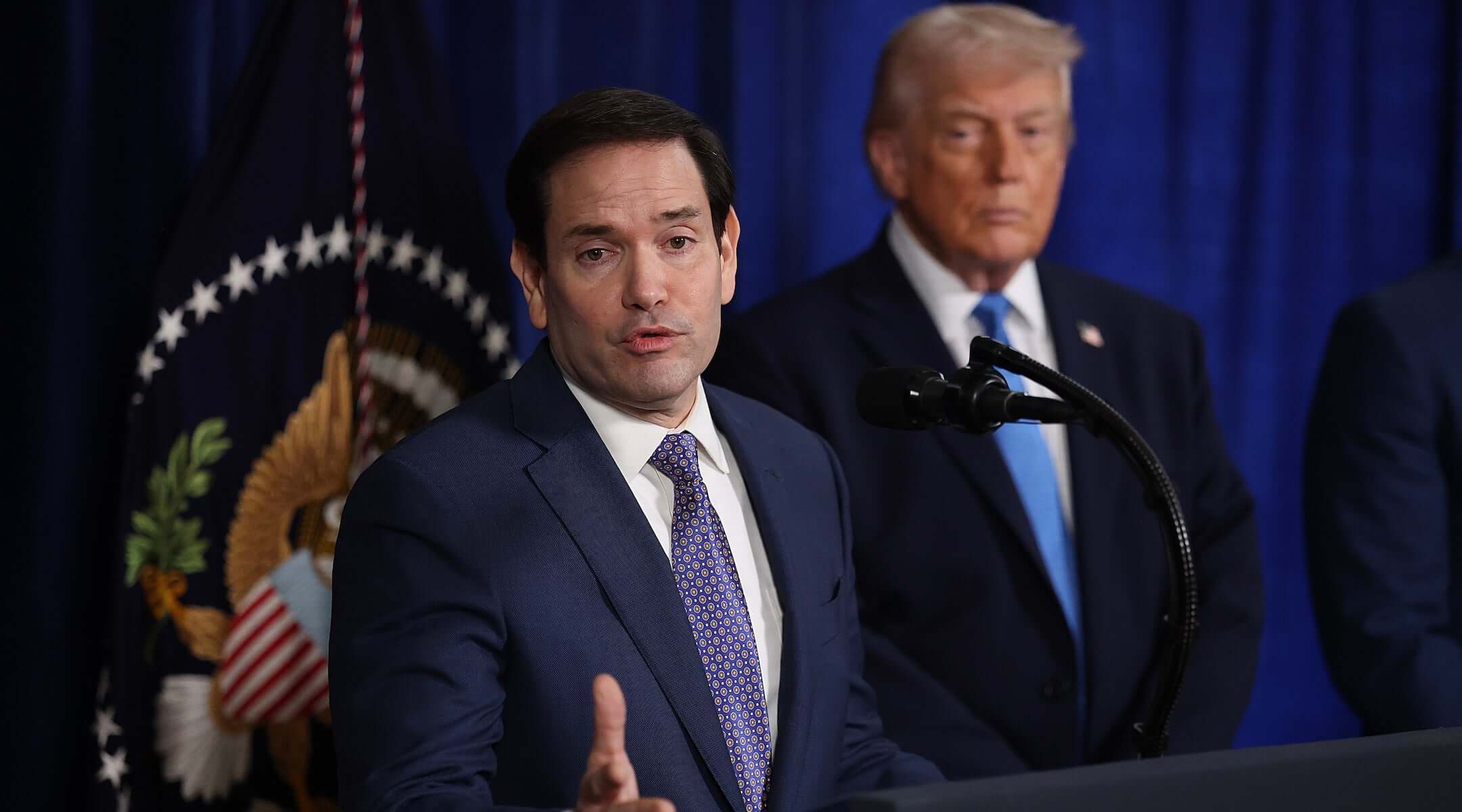
Secretary of State Marco Rubio speaks during a press conference as U.S. President Donald Trump listens at Mar-a-Lago club on January 03, 2026, in Palm Beach, Florida. During the event, President Trump confirmed that the U.S. military carried out a large-scale strike in Caracas overnight, resulting in the capture of Venezuelan leader Nicolas Maduro and his wife, Cilia Flores. Photo by Joe Raedle/Getty Images

By Asaf Elia-Shalev January 5, 2026
(JTA) — In the wake of the U.S. operation that brought Venezuelan leader Nicolás Maduro to the United States to face charges, Secretary of State Marco Rubio said the mission is also about ending Iran and Hezbollah activity inside Venezuela.
Rubio made the remarks on U.S. television a day after elite U.S. forces carried out a pre-dawn raid in Caracas that resulted in Maduro’s capture and his transfer to federal custody in New York. President Donald Trump and Rubio have framed the mission as aimed at dismantling narco-trafficking networks and foreign influence tied to Caracas.
Speaking on CBS’s “Face the Nation,” Rubio said the United States will exert leverage, including continued sanctions and pressure on Venezuela’s oil sector, to ensure that the country “no longer cozy up to Hezbollah and Iran in our own hemisphere.”
On NBC’s “Meet the Press,” he offered a shorthand for U.S. goals: “No more drug trafficking, no more Iran Hezbollah presence there, and no more using the oil industry to enrich all our adversaries around the world.”
Rubio also dismissed comparisons between the Venezuela operation and U.S. military interventions in the Middle East, saying Venezuela’s Western Hemisphere context is different.
“The whole foreign policy apparatus thinks everything is Libya, everything is Iraq, everything is Afghanistan,” Rubio told CBS. “This is not the Middle East. And our mission here is very different. This is the Western Hemisphere.”
The Venezuela operation drew attention in Israel, where leaders used it to signal a warning to Tehran amid mounting unrest inside Iran. Opposition leader Yair Lapid wrote on X that “the regime in Iran should pay close attention to what is happening in Venezuela,” framing the U.S. action as a broader message to a government facing intensifying protests and riots at home.
Diaspora Affairs Minister Amichai Chikli said the capture of Maduro struck a blow to what he called the “global axis of evil” and sent a “clear message” to Iranian Supreme Leader Ayatollah Ali Khamenei about the consequences of supporting narcoterrorism and militant proxies such as Hezbollah, according to the Jerusalem Post.
“Maduro did not run a country; he ran a crime and drug empire that directly fueled Hezbollah and Iran,” Chikli said. “The president’s decisive steps have proven once again that strong leaders are the only way to defeat dictators.”
Israeli Prime Minister Benjamin Netanyahu, fearing a preemptive attack by Tehran, reportedly assured Russian President Vladimir Putin on Monday that Israel does not intend to attack Iran right now. At the same time, Trump posed with a “Make Iran Great Again” hat in Washington.
Rubio’s comments underscore a broader U.S. security concern about Tehran’s relationships in the Americas, especially its ties to Caracas. Venezuela and Iran built close diplomatic and economic ties during the presidencies of Maduro and his predecessor, Hugo Chavez.
The relationship deepened in the mid-2000s, when Chávez cast Venezuela as part of what he called an “axis of unity” with Iran and other U.S. adversaries. In June 2022, Iran and Venezuela signed a 20-year cooperation pact meant to shore up their alliance and blunt U.S. sanctions, expanding collaboration on energy, technology and security. The deal included Iranian assistance for Venezuela’s oil sector in exchange for economic access, along with stepped-up military cooperation, including drones.
U.S. officials believe that those ties have also created space for Hezbollah, Iran’s Lebanese proxy, to raise money and build logistical networks in Venezuela and neighboring countries. Over the years, Washington has sanctioned Venezuelan officials and businessmen accused of helping Hezbollah operatives obtain passports, move cash and participate in smuggling schemes, allegations the Maduro government has denied.
Hezbollah has been active in South America in the past. It is believed to have orchestrated two major attacks on Jewish targets in Buenos Aires in the 1980s that together killed hundreds of people. The current president of Argentina, Javier Milei, supports Israel and has taken steps to hold Hezbollah accountable for those attacks.