He researches antisemitism for a living. Why does the State Department want to kick him out of the country?
Imran Ahmed, who runs the Center for Countering Digital Hate, has worked with mainstream Jewish groups
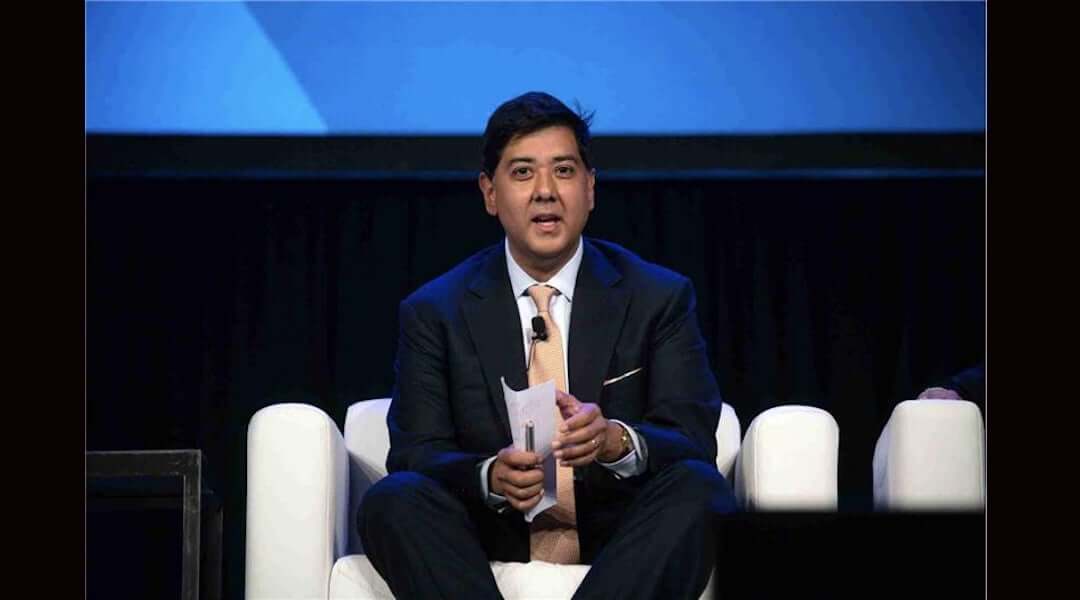
Imran Ahmed, founder of the Center for Countering Digital Hate Courtesy of Center for Countering Digital Hate
(JTA) — For years, Imran Ahmed has presented his research on how tech platforms enable the spread of antisemitism to receptive audiences across the ideological spectrum.
He’s worked with the Anti-Defamation League and Jewish Federations of North America; the latter credits Ahmed with the backbone of much of its own policy proposals. He’s appeared at a conference organized by the first Trump administration, with Mike Pompeo, the former secretary of state, and Israeli Prime Minister Benjamin Netanyahu also in attendance.
He’s joined Republicans in advocating for an end to Section 230, a law granting special protections to social media platforms. During the first Trump administration, on the strength of his research, the British-born Ahmed received a priority visa as an “alien of extraordinary ability” — the so-called “Einstein visa,” after the German-born Jewish physicist.
All of that only added to Ahmed’s befuddlement when, just before Christmas, the current Trump State Department announced it would be revoking his visa because of what Secretary of State Marco Rubio tweeted were “egregious acts of extraterritorial censorship.”
“It is confusing,” Ahmed told the Jewish Telegraphic Agency on Friday, speaking from his home in Washington, D.C. “Certainly there was some alarm.”
The confusion came not least because Ahmed, as a legal permanent resident, no longer has a visa to revoke. He received an EB-1 visa, which provides a fast pathway to permanent residency, in January 2021, at the end of Trump’s first term and now has a green card.
Ahmed was different from the four other digital anti-hate activists named in the State Department announcement, all of whom are based in Europe. Since 2021, his organization, the Center for Countering Digital Hate, has been registered as a U.S. nonprofit — a status that he notes should confer First Amendment protections. Last year, the group reported $4.2 million in revenue.
Ahmed has received no formal notification of an effort to revoke his residency. Neither Rubio’s own tweet, nor a State Department press release announcing the sanctions, mentioned him. There’s just a tweet, from a State Department undersecretary, mentioning him by name as a “key collaborator with the Biden Administration’s effort to weaponize the government against U.S. citizens.”
The State Department did not answer questions about Ahmed’s case. “The Supreme Court and Congress have repeatedly made clear: the United States is under no obligation to allow foreign aliens to come to our country or reside here,” a spokesperson told JTA in a statement.
At a time of aggressive immigration enforcement activity that has ensnared others with green cards, Ahmed isn’t taking changes. He sought (and was granted) a legal restraining order to prevent the government from seizing him and moving him to an immigrant detention facility without trial, as officials have done to an estimated 59,000 migrants in the last year. On Monday he returned to court, petitioning to make the order permanent.
“We want to make sure that they can’t take me away from my friends, family and support network,” he said. He’s optimistic on that front. “I have faith in the courts, and I have faith that the rule of law is still intact in the United States.”
What happens next is anyone’s guess. But Ahmed’s ordeal has cast a cloud of uncertainty over the work of a trusted Jewish communal ally — and further muddled the Trump administration’s own stated commitment to fighting antisemitism.
“Absolutely fascist — and dangerous — effort by the admin to ban my colleague Imran Ahmed and others from the US,” Amy Spitalnick, head of the Jewish Council of Public Affairs, wrote on X last week.
Ahmed partnered with Spitalnick’s group on a report about the rise of antisemitic influencers on X after Oct. 7. “He’s dedicated his career to fighting online hate and extremism,” Spitalnick recently told JTA, noting the two had first connected after the 2017 “Unite the Right” march in Charlottesville, Virginia, during which one counter-protester was killed.
A columnist at Britain’s Jewish News also criticized the Trump administration’s targeting of Ahmed: “Imran Ahmed was a friend to America and an important voice in debates about free speech,” wrote David Hirsh. “He obeyed the law, just as the Americans he worked with obey the law, and he should be treated the same, while working in and contributing to the United States of America.”
The Trump administration has taken special pains to prevent immigration by Muslims, last month blocking visas for passport holders from 20 mostly Muslim countries and targeting Afghans especially after an Afghan national shot and killed a National Guard member in Washington in November.
Ahmed’s parents are Afghan, and in his column Hirsh called Ahmed, “a brilliant Muslim Brit.” Ahmed, who was born in England, has said that he now considers himself an atheist.
His allies see his case as part of a different Trump administration priority. Spitalnick told JTA the targeting of Ahmed was “all part of the broader weaponization of the federal government to go after perceived political enemies and advance an extremist agenda, which in this case is to push back against any regulation of tech.”
In the State Department’s targeting of him, Ahmed sees the handiwork of his longtime foes: the tech “oligarchs” who control the social media giants he seeks to rein in.
“This is quite clearly an attempt to silence the work that we do studying and exposing the way that social media platforms encourage, amplify and reward — with money — antisemitism and other forms of hate,” he said. “These guys have been lobbying aggressively in Washington long before President Trump was president. They’ve been invited to the White House and treated like demigods for decades now.”
Fighting antisemitism is central to the CCDH’s origin story, Ahmed said. A former staffer with the British Labour Party with plans to run for office himself, he quit after the 2015 ascension of Jeremy Corbyn, whom Ahmed calls “an avowed antisemite.” (Corbyn, who came to lead Labour amid a party overhaul that saw a massive influx of antisemitic sentiment, was suspended by his party over his handling of the antisemitism issue before ultimately being expelled in 2023.)
Ahmed wanted to understand why what he perceived as a newfound flurry of antisemitic social media activity seemed to follow Corbyn and his allies. He was also disturbed by the 2016 murder of Labour parliamentarian Jo Cox by a far-right figure associated with neo-Nazi groups who had been radicalized online. Together, he reasoned, there was something yet undiscovered about the role social media was playing in pushing out antisemitism across the political spectrum.
“This has always been an organization that, at its heart, has been trying to answer the question, how is it that ancient lies about Jews have been able to gain such purchase in our society?” he said. “And what can we do to change that?”
In the years since Ahmed founded the CCDH (which he relocated to the United States after receiving his green card), his group has published a series of papers on the various ways social media algorithms promote and reward antisemitism and other forms of hate speech. With the ADL, they published a 2023 report on Iranian state media’s use of social media to spread antisemitism. In November, with JFNA, they released a report on how Instagram has effectively monetized antisemitic content.
Ahmed presented those findings at JFNA’s annual meeting, in front of federation heads from around the country; he credits his work with helping groups like JFNA focus more of their attention on the problem of social media algorithms instead of individual bad actors online. A JFNA representative recently told JTA that Ahmed’s research has been integral to the umbrella group’s crafting of its own online antisemitism policy proposals.
“He is a valuable partner in providing accurate and detailed information on how the social media algorithms have created a bent toward antisemitism and anti-Zionism,” Dennis Bernard, a JFNA lay leader who heads their government relations efforts, told JTA.
Ahmed’s work has made him enemies, too. Elon Musk, the world’s richest man and head of X, sued the CCDH in 2023, alleging that it violated the X’s terms of service in gathering data for a report on its amplification of hate content. A judge threw the case out, but Ahmed isn’t so sure Musk — who wielded tremendous power over the federal government at the helm of Trump’s Department of Government Efficiency and remains close with administration figures, including the president — has moved on.
“I think it’s incredibly telling that the earliest and most vociferous reactions [to the visa sanction] were actually from people like Elon Musk, who himself has spread antisemitic lies and presided over the descent of this platform formerly known as Twitter into a hellscape of antisemitism,” he said. On X, Musk responded to news of the visa sanctions with fire emojis.
If the State Department is indeed targeting activists like Ahmed as a matter of policy, it would seem to be at odds with its newly confirmed special antisemitism envoy, Yehuda Kaploun. He recently indicated that he, too, wanted to see more restrictions on social media platforms that promote antisemitism.
“It makes it very confusing for them to claim foreign policy problems, which is what they’ve claimed, when U.S. foreign policy is to reduce antisemitism,” Ahmed said.
Another possibility: that the State Department’s targeting of Ahmed has to do with something else entirely. In her post blasting him, the public diplomacy undersecretary Sarah Rogers focused on a different research project the CCDH had undertaken during the COVID-19 pandemic.
“Ahmed’s group, Center for Countering Digital Hate (CCDH), created the infamous ‘disinformation dozen’ report, which called for platforms to deplatform twelve American ‘anti-vaxxers’, including now-HHS Secretary @SecKennedy,” Rogers wrote. She was referring to a 2021 CCDH report finding that Robert F. Kennedy, Jr., and 11 other anti-vaccine activists were responsible for more than 65% of all anti-vaccine content on social media. Kennedy, now Trump’s secretary of health and human services, also celebrated the visa restrictions on Ahmed and the others.
Ahmed dismisses the idea. “The pandemic is long over, so it would be very odd to be targeted for work that we did four years ago. That seems implausible to me,” he said.
He is convinced, instead, that he’s being singled out because he seeks to put guardrails on the big technology platforms more generally.
In their case to the judge for the restraining order, Ahmed’s lawyers — including prominent Jewish attorneys Roberta Kaplan and Norm Eisen — brought up one striking comparison: to the pro-Palestinian activist Mahmoud Khalil, a green-card holder detained for months for what the U.S. government argued was exhibiting support for terrorism. Ahmed insists his case and Khalil’s are nothing alike in substance; the government has so few cases of threatening the citizenship of green-card holders that a legal comparison just made sense, he said.
While Spitalnick has vocally rebuked the Trump administration over its targeting of Ahmed, his other Jewish partners have remained relatively quiet. Many Jewish organizations have found themselves torn since Trump took office as the administration has taken an aggressive stance on fighting antisemitism while also pursuing policies that Jewish communities have historically opposed, including barring immigration.
Bernard, while praising Ahmed’s work, also said JFNA would review its collaboration with him and, “if there’s something there we don’t know about,” would “terminate our relationship.”
The ADL, which has found itself in the Trump administration’s crosshairs, has not made any public statement about Ahmed’s case and did not respond to a request for comment for this story.
Ahmed isn’t bothered by any of this, though he is grateful for the Jewish support he has received. He says he’s received “hundreds of texts” from Jewish supporters, and even spent his first “Jewish Christmas” with some last month, chowing down on Chinese food and watching American football. Despite their years of collaboration, he didn’t expect the big Jewish names to come rushing publicly to his aid.
“I’m not asking anyone else to fight this fight for me,” he said, worried the spectacle will “distract us from the job” of pressuring tech platforms. “They’ve made this about me as a person. And when they can’t defeat the message, they go after the messenger.”