BBC draws fire after airing Holocaust cello repair story that does not specially mention Jews
The production company behind the episode said they believed the subject’s Jewish identity was ‘implicit’
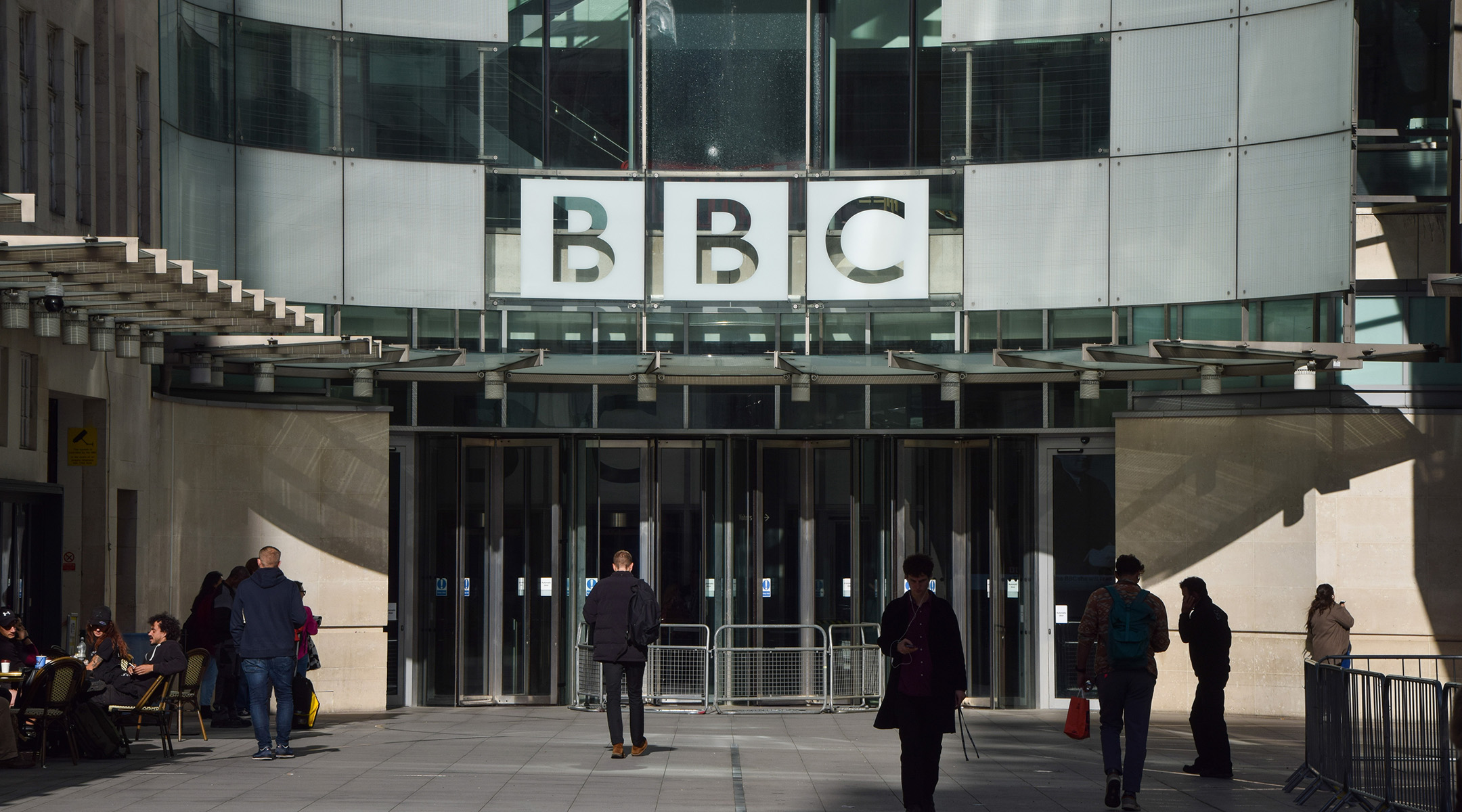
The BBC headquarters is located in London. Photo by Vuk Valcic/SOPA Images/LightRocket via Getty Images
(JTA) — In a Christmas special this year, a BBC One program devoted a quarter of its episode to telling the story of a Jewish child refugee whose cello was damaged while fleeing the Nazis on the Kindertransport.
But while the story itself is steeped in Jewish history, the segment of the program failed to make any mention of Jews, igniting criticism from British Jews who are on high alert for signs of antisemitism from the network.
Now, the BBC has issued a clarification, adding a note to the program description in its iPlayer app explaining that the Kindertransport evacuated Jewish children from Nazi territory.
The production company behind “The Repair Shop,” a popular show where family heirlooms are refurbished, said it believed the historical context of Martin Landau’s cello would be obvious to viewers when Helen Mirren, the famed actress who recently portrayed the Israeli prime minister Golda Meir, brought it in during the episode that aired Dec. 26.
“We were honoured to share the history of Martin Landau’s cello and play a small part in telling an important and emotive story with contemporary resonance,” a Ricochet spokesperson said in a statement. “We felt that Martin’s story was told clearly and succinctly, and we believed the fact that he was Jewish was implicit in the story.”
Born in Berlin in 1924, Landau — who later became a prominent theater director — was 14 when he brought his cello with him on board the Kindertransport, a rescue effort that brought nearly 10,000, mostly Jewish, children to safety in Europe during World War II.
But before getting on the train, the neck of Landau’s instrument was “deliberately snapped in two,” according to a description of the episode on the BBC website.
“Despite this blow, Martin guarded the cello carefully for the remainder of his life, eventually gifting it to Denville Hall, a care home for retired members of the entertainment industries, of which both he and Dame Helen are loyal supporters,” the episode’s description continues. “Sadly, the cello has remained silent for over 80 years, and the residents would dearly love to see it restored so that they can hear it played for the first time.”
Thirty-one members of Landau’s family, including his parents, were killed in Bergen-Belsen, Dachau and Auschwitz, according to his obituary in The Times. In London, Landau went on to become a prolific producer of plays and musicals. He died in 2011 at 86.
The Jewish Chronicle was first to report frustration over the show’s lack of explicit mention of Landau’s Jewish identity. It reported that a reference to Jews appeared to be truncated from a sentence by Mirren, who said, “…children were put on the Kindertransport.”
The episode is one of several antisemitism and Israel-related controversies to hit the British public broadcaster in recent months. In October, the BBC was penalized after it failed to identify the narrator of a Gaza documentary as the son of a Hamas government official. Over the summer, it was also criticized for airing a performance by the punk group Bob Vylan that included chants of “Death to the IDF.”
On Saturday, the BBC also reached a settlement with an Israeli family whose home it filmed following the Oct. 7 attacks without consent.
Now, the network has added new language to the “The Repair Shop” episode, too.
“This program is subject to a clarification. The Kindertransport was the organized evacuation of approximately 10,000 children, the majority of whom were Jewish, from Germany, Austria, and Czechoslovakia,” the iPlayer description read. (The initiative was funded largely by Jewish groups, but a small number of the children rescued were Roma, Christian children of Jewish parents or the children of political prisoners.)
During the episode, the repaired instrument was played by the British Jewish cellist Raphael Wallfisch, whose 100-year-old mother Anita Lasker-Wallfisch is the only surviving member of the Women’s Orchestra of Auschwitz.
https://www.instagram.com/p/DSE4luvCGya/?hl=en