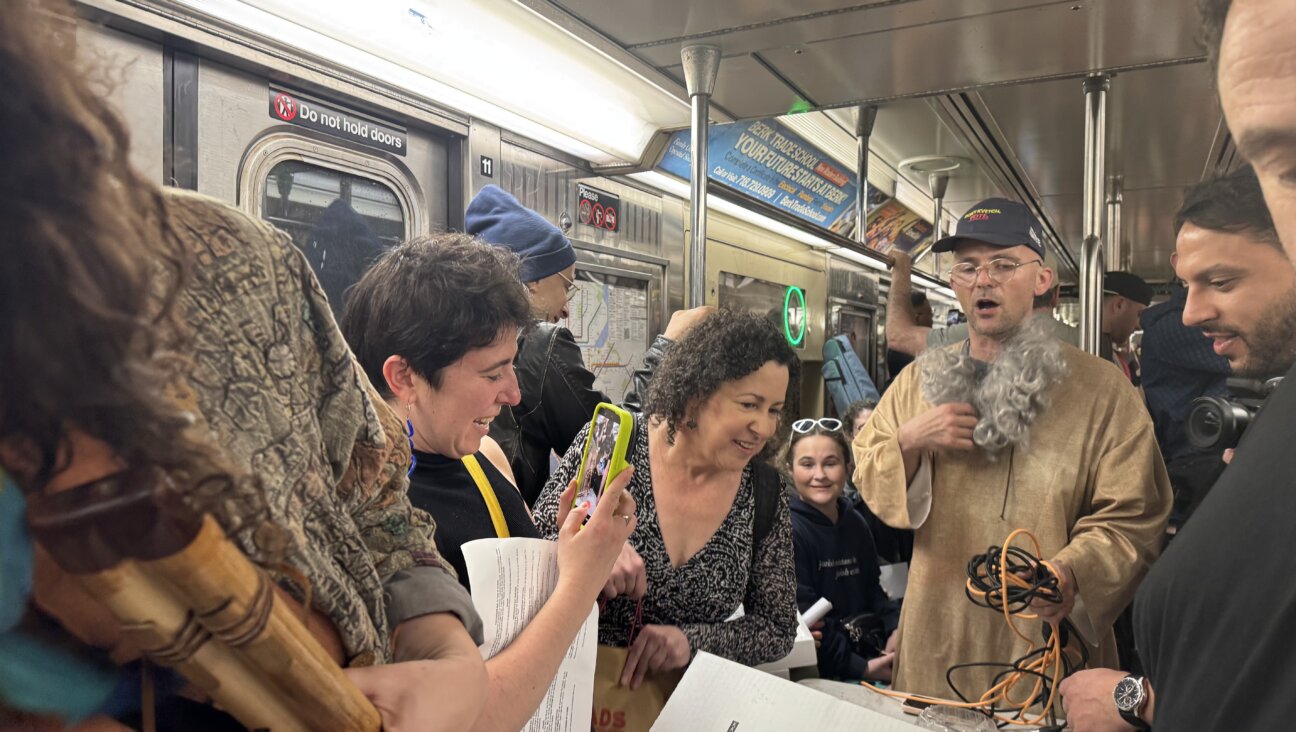
Invoking Torah, Minnesota Jews mobilize against ICE operations
Jewish groups opposed to the aggressive surge in immigration enforcement are signing open letters, helping plan protests and mending frayed interfaith partnerships
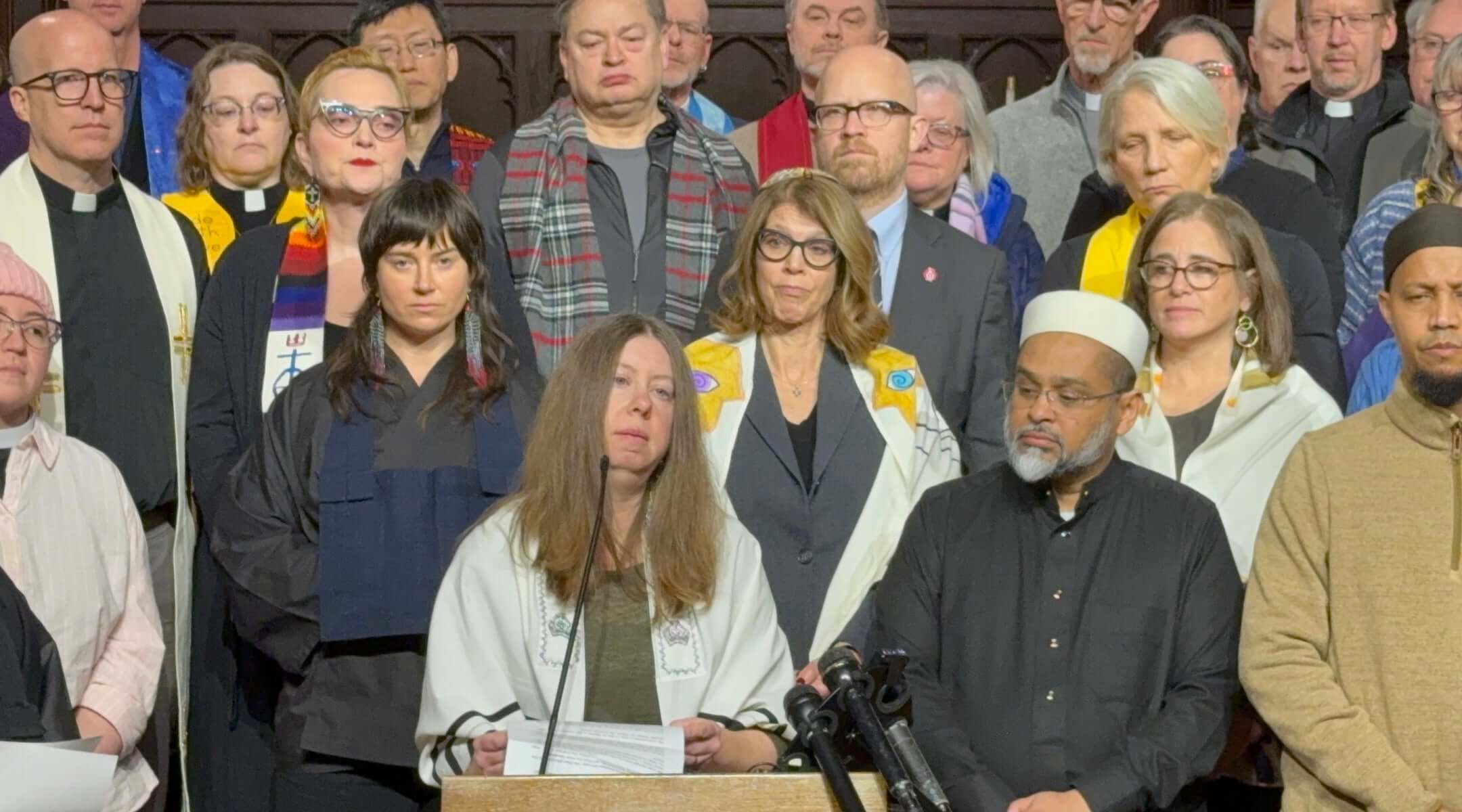
Rabbi Tamar Magill-Grimm, of the Conservative Beth Jacob Congregation in Mendota Heights, Minnesota, speaks out with other faith leaders against Immigrations and Customs Enforcement operations in the Twin Cities at a press conference at a Lutheran church in St. Paul, Jan. 20, 2026. Local cantors Tamar Havilio and Rachel Stock Spilker are behind Magill-Grimm to the right. Photo by Courtesy of TC Jewfolk
(JTA) — The Hebrews’ flight from Egypt is on a lot of Jewish minds right now, as the annual cycle of Torah readings has reached the Book of Exodus.
But for many Jewish leaders in Minnesota, the ancient story has particular resonance.
With Immigration and Customs Enforcement agents descending on the Twin Cities in search of undocumented immigrants and stirring chaos and pushback, the story of Exodus — about a king who tries to thwart the growing number of “foreigners” in his midst, and the leader who seeks to protect them — is inspiring widespread anti-ICE actions.
“As we’re currently reading in the Torah, Moses confronts Pharoah knowing it won’t be easy, and feeling his own doubts about such an act,” Rabbi Aaron Weininger, who leads the Conservative Adath Jeshurun Congregation in the suburb of Minnetonka, told the Jewish Telegraphic Agency. “And in doing so, the Israelites enslaved in Egypt are able to get unstuck. They’re able to taste freedom.”
Inspired by such teachings, and frequently invoked Jewish injunctions like “welcoming the stranger,” Jewish groups are signing on to open letters, and synagogues are actively involved in pro‑immigrant actions and advocacy. The Jewish presence at an interfaith anti-ICE rally this week is expected to be substantial.
“Our community members and staff live and work in every corner of society. There are too many stories of lives upended by what the government itself refers to as the ICE surge,” reads an open letter, issued Monday, spearheaded by the Jewish federation and signed by around two dozen Jewish groups.
Jewish groups “are deeply concerned by the current volatile situation throughout the Twin Cities and Minnesota,” according to the letter. Its signatories as of press time include 13 area congregations, ranging from Reform to Modern Orthodox; two Jewish day schools; Minnesota Hillel; the Minnesota JCC; the progressive group Jewish Community Action, and Jewish Family and Children’s Service of Minnesota.
ICE’s presence — which includes masked, heavily armed officers conducting aggressive traffic stops, neighborhood raids and street patrols — has led to a lack of caregivers tending to local Jewish seniors, according to the letter.
It follows an earlier open letter from 49 Minnesota Jewish clergy, distributed on Friday, that describes “grief” and “horror” over ICE “wreaking havoc across our state.”
Quoting Deuteronomy — “Love the stranger, for you were strangers in the land of Egypt” — the rabbis and cantors spotlight the “tragic death” of driver Renee Good at the hands of an ICE officer Jan. 7 and include a prayer to “spread a canopy of peace and protection over all those wrongfully targeted by ICE at this moment.”
Both of those letters precipitated what is turning into a larger institutional Jewish pushback to ICE. On Wednesday, leaders of the Reform, Conservative and Reconstructionist movements issued a joint statement to “condemn, in the strongest terms, the violence with which the Department of Homeland Security is enforcing American immigration law — above all, in Minneapolis, Minnesota, as well as in cities and towns across the nation.”
“Our sages taught that the Book of Deuteronomy’s directive, ‘Justice, justice shall you pursue’ (16:20), implies that the law must be enforced through a fair process, and that one should pursue justice whether it would be to one’s advantage or to one’s loss,” the statement reads, with the Jewish leaders further calling on the Justice Department to investigate Good’s death.
Rabbi Jill Avrin, campus lead at the Jewish Community Relations Council of Minnesota and the Dakotas, said it was “unprecedented” for such a wide variety of local Jewish groups to sign onto such messages.
“We have a really diverse Jewish community here, and we felt that this is a moment that is impacting all of us,” Avrin, who helped draft the letters, told JTA.
The multiple open letters are trying to appeal to shared spiritual values as the standoffs between protesters and ICE agents become increasingly fraught. A number of prominent figures — most recently Bruce Springsteen — have compared ICE’s tactics to the Gestapo; at the same time, an anti-ICE protest that disrupted a church service over the weekend has prompted concern and controversy across the interfaith community and led at least one Republican to compare the protesters to Hamas.
Local Jewish leaders say they are not dissuaded from what they view as a Jewish imperative to respond.
“Judaism isn’t about skipping the hard parts,” Weininger said. “It’s about noticing the struggles for centuries that have led us to this point: slavery, persecution, destruction, exile, coming home.”
Rabbis have been active in local mobilizing against ICE. They attended a community vigil for Good; Weininger discussed the issue during his Shabbat sermon. He also helped draft the rabbinical open letter, and this week is one of around 80 to 90 rabbis — many others from out of town — planning to attend an interfaith march in Minneapolis with more than 600 clergy present. Around 50 of the rabbis expected to attend are part of T’ruah, a Jewish social justice network, which mobilized after local clergy put out the request.
“What’s scary is that lawful actions are being targeted,” Weininger said about the situation on the ground. “We’re talking about protest and prayer and taking action in community, and even those modes of engagement are under attack.”
Recalling how Minneapolis Jews similarly mobilized in 2020 to protest George Floyd’s murder by Minneapolis police, the rabbi described “a real sense of civil society here, and I think that is true of the Jewish clergy community in how people care for one another.”
Rabbis also spoke out at a Tuesday interfaith press conference denouncing ICE and outlining plans for this week’s march. “As people of faith, as leaders of faith communities, we are called to say, ‘Enough. Not on our watch,’” Rabbi Tamar Magill-Grimm, who leads the Conservative Beth Jacob Congregation in Mendota Heights, said while standing next to a local imam.
Some Jewish groups across the country have raised concern about ICE’s activities for months, with some synagogues posting signs identifying themselves as houses of worship that agents do not have authority to enter. Rabbis affiliated with T’ruah have participated in “ICE watch” actions in other cities.
But Minnesota’s Jews have now witnessed firsthand the effects of a sustained, targeted ICE presence on their community. Local synagogues have hosted “upstander” training seminars for congregants to learn how to react in the face of an ICE encounter. For many congregants, the experience has pushed them to action — but it’s also invoked an eerie sensation, bringing echoes of a dangerous past.
“As a Jewish parent in Minneapolis, history feels too close right now,” one Twin Cities resident told Daci Platt, a fellow Minnesotan who works at Kveller, a JTA sister publication. “The sense of safety we usually rely on feels shakier than it ever has.”
Jewish community organizations are particularly concerned about the threat the ICE raids, which have focused primarily on non-white Twin Cities residents, pose to a caregiving workforce largely composed of immigrants.
“Jewish seniors are not having their basic needs met because their caregivers are too afraid to come to work,” says the letter spearheaded by the federation.
Amy Weiss, CEO of Jewish Family and Children’s Service of Minnesota, told JTA that ICE has also affected her organization’s ability to serve its nonsectarian clients more generally. Much of their own staff are from immigrant communities, and Weiss worries about drawing attention to them by sending them out into the field to help clients.
“People are afraid to go to work. They’re afraid to leave their homes,” Weiss said. “I don’t see this as political. When you look at our mission, to support people in need, then this is very basic. These are the very basic needs of the community.”
The open letter also notes that there are Jews “who are immigrants themselves, have family members who are immigrants, or could be reasonably perceived to be immigrants. Many of these people are scared to leave their homes out of fear of being arrested and deported.”
The federation-backed letter is careful not to deride all law enforcement. It states, “We affirm our commitment to the rule of law, the lawful implementation of statutes, and the thousands of law enforcement officers charged with keeping us safe, whose efforts we deeply appreciate.”
Avrin, too, praised local law enforcement, whom she called “amazing” and “not the same thing as the ICE agents who are here on the ground.” She also noted that not all of the Jewish communal leaders shared the specific goals of this week’s march, which other Jewish leaders helped plan. The march’s demands include “ICE must leave Minnesota immediately” and “ICE should be investigated for human and Constitutional violations of Americans and our neighbors.”
“This moment is a moment that calls for coalition,” she said. “We are acknowledging and naming that we might be showing up with people whom we don’t actually agree with their broader platform.”
That discomfort has also arisen in some of the language of the opposition. As ICE protests in Minnesota attract growing national attention, comparisons to Nazis and the Gestapo have also grown. Avrin said the JCRC discourages such rhetoric
During a concert in New Jersey last weekend, Springsteen decried “heavily armed, masked federal troops invading an American city and using Gestapo tactics against our fellow citizens.” He then repeated a catchphrase popularized by Jacob Frey, Minneapolis’s Jewish mayor: “ICE should get the f–k out of Minneapolis.” (On Tuesday, Frey, along with other state officials, was subpoenaed by the Justice Department for alleged obstruction of immigration agents. Some of his critics have called attention to his Jewish identity.)
The faith-based protests suffered a distraction when anti-ICE protesters disrupted a St. Paul church service. The protesters, including Black Lives Matter Minnesota, claimed that one of its pastors also works as a local ICE field office leader. The Trump administration has announced an investigation into the protest, which officials said could amount to a violation of a federal law permitting free access to any worship site.
Following the protest, Cities Church in Minnesota issued a statement saying the protesters “accosted members of our congregation, frightened children, and created a scene marked by intimidation and threat. Such conduct is shameful, unlawful, and will not be tolerated.”
The statement added, “Invading a church service to disrupt the worship of Jesus — or any other act of worship — is protected by neither the Christian Scriptures nor the laws of this nation.” A founding pastor of the church has ties to Pete Hegseth, Trump’s defense secretary.
One Republican, Rep. Will Self of Texas, said the protesters — who had livestreamed themselves from inside the church — reminded him of Hamas livestreaming on Oct. 7.
“When you livestream something, you want it to cause terror in the population,” Self told the far-right TV network Newsmax. “So when they livestreamed it, I compare them to Hamas, who livestreamed the attack in Israel that killed thousands of people.”
American Jewish leaders, for whom the freedom of worship in America has long been a key policy plank, say they disagree such a protest in a house of worship. Rabbi Jill Jacobs, who heads T’ruah, told JTA her organization “would not organize a protest of a church.”
The local JCRC also criticized the church protest, which comes in the aftermath of recent pro-Hamas synagogue protests in New York that were widely condemned by Jewish and progressive leaders alike.
“That is something we are absolutely opposed to. We would never encourage people to disrupt a worship service. That is not aligned with our values in any way,” Avrin said. “In my opinion it doesn’t reflect the broader efforts that are happening on the ground. That’s going to happen any time you have a large movement.”
Jews in that movement are focusing on injunctions drawn from the Bible. Speaking at New Birth, a historically Black Baptist church in Georgia with links to the family of Martin Luther King Jr., Georgia Democrat Sen. Jon Ossoff, who is Jewish, gave a biblically inflected anti-ICE message.
“How can it be that masked federal agents set up checkpoints in American cities, demand papers, rip Americans from their cars, and throw them to the ground? Kill? Kill? With apparent license from the very top,” Ossoff told the congregation. “There’s a wickedness to the program. I don’t know, Pastor, where it is in scripture that it says ‘deny care to the sick, take from those with the least to give to those with the most, violate the house of worship to hunt down the refugee.’ Where in the scripture are those lessons taught?”
Ossoff, who is defending his seat in a tight reelection campaign, added that he and the church’s pastor had been “texting” about the Exodus journey of Moses, and how he used his staff to rally the Israelites.
In the face of the groundswell in Minnesota, President Donald Trump again forcefully rebuked the protesters and defended ICE.
“They’re apprehending murderers and drug dealers and a lot of bad people,” the president said of the agents during a press conference to mark one year of his second term.
Holding up images he said were of immigrant criminals apprehended by ICE, including one who he claimed was connected to Hezbollah, Trump asked the White House press pool, “Why don’t you talk about that more?… Do you want to live with these people?”
The president also referenced the church protest. “I have such respect for that pastor. He was so calm. He was so nice. He was just accosted,” Trump said of the clergyman whose sermon was interrupted. (He was not the pastor the protesters were targeting.) “What they did in that church was horrible.”
Trump, too, has been a mobilizing force for Jews in Minnesota. Following the president’s derogatory comments last month about the Somali population in the state — which Trump said justified the ICE raids — many local Jewish leaders had held coalition meetings with interfaith partners.
For some in the room at the time, Avrin recalled, it was the first time they had come face-to-face with these partners since Hamas’ Oct. 7, 2023 attack on Israel and the start of the war in Gaza, which frayed many Jewish-liberal coalitions when other communal groups denounced Israel and “Zionists.”
Such partners had “stopped speaking to us, basically,” she said.
But for the Jewish leaders in the room, the Talmudic imperative to love the stranger overcame lingering uncertainty about reconfiguring these coalitions: “We can’t walk away from that just because we’ve been hurt,” she said.
This is a moment of great uncertainty. Here’s what you can do about it.
We hope you appreciated this article. Before you go, we’d like to ask you to please support the Forward’s independent Jewish news this Passover. All donations are being matched by the Forward Board - up to $100,000.
This is a moment of great uncertainty for the news media, for the Jewish people, and for our sacred democracy. It is a time of confusion and declining trust in public institutions. An era in which we need humans to report facts, conduct investigations that hold power to account, tell stories that matter and share honest discourse on all that divides us.
With no paywall or subscriptions, the Forward is entirely supported by readers like you. Every dollar you give this Passover is invested in the future of the Forward — and telling the American Jewish story fully and fairly.
The Forward doesn’t rely on funding from institutions like governments or your local Jewish federation. There are thousands of readers like you who give us $18 or $36 or $100 each month or year.
Support our mission to tell the Jewish story fully and fairly.