Oct. 7 spurred this secular private school in Manhattan to start holding an annual Shabbat gathering
The Town School’s head of school is also the vice president at the Stephen Wise Free Synagogue
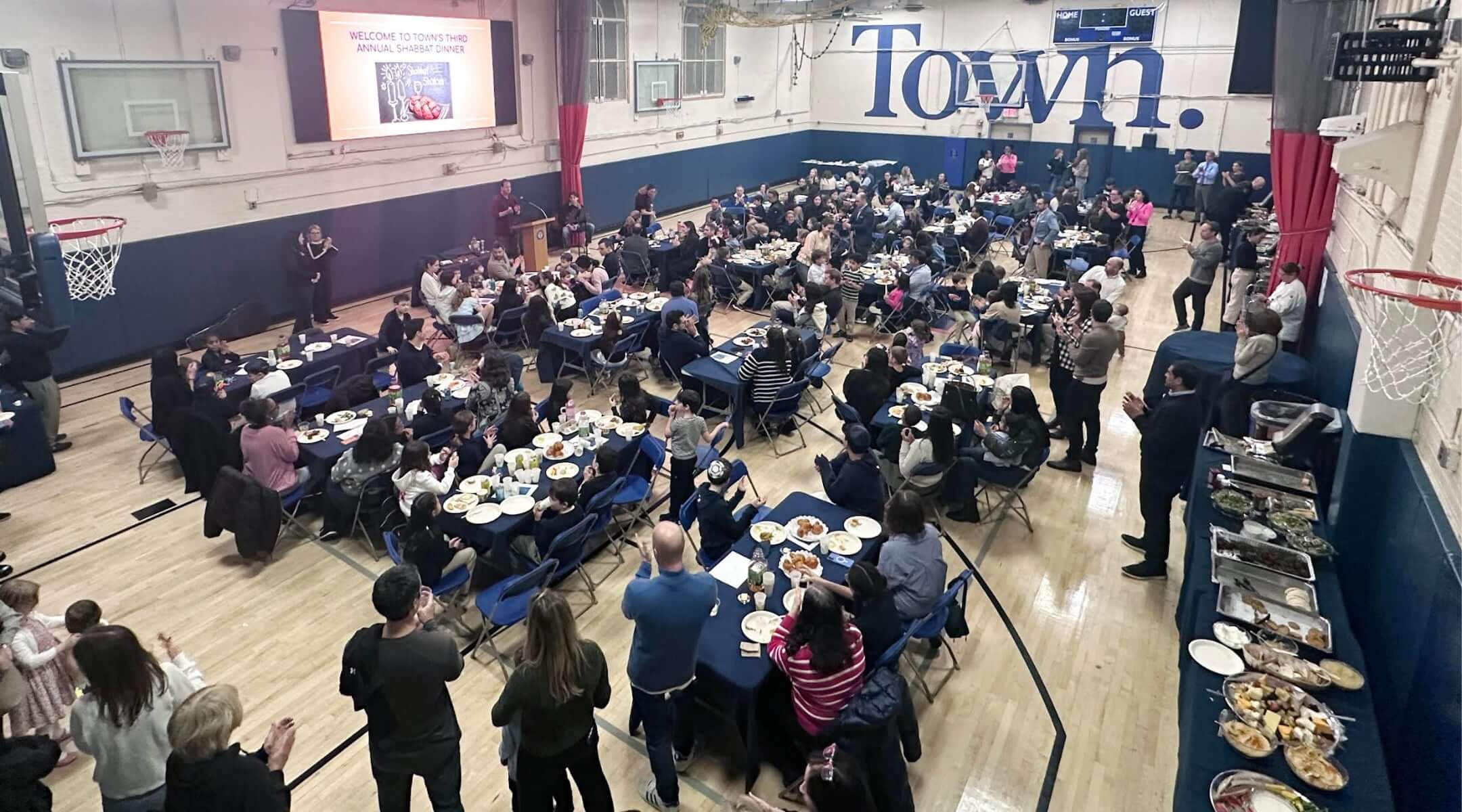
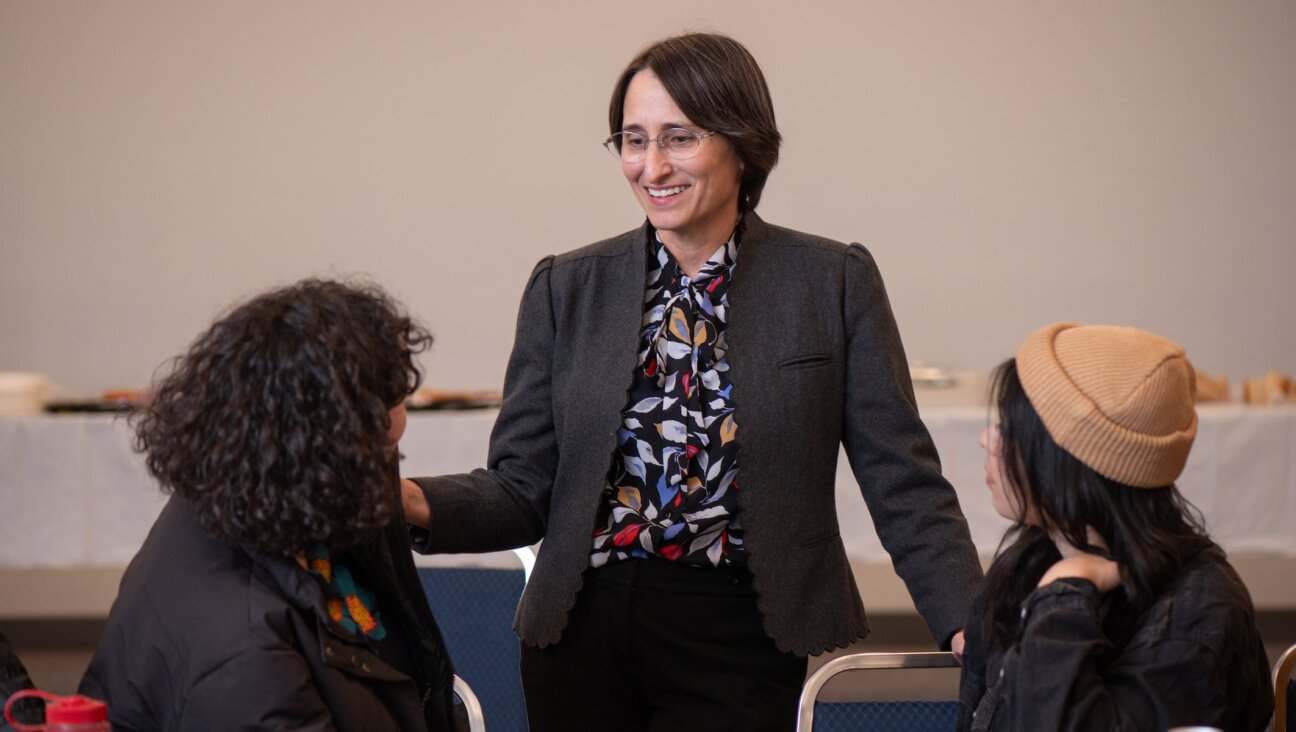
Students and parents at the Upper East Side’s Town School celebrate the school’s third annual Shabbat. Photo by Pierangelo Rossi
(New York Jewish Week) — A new Jewish tradition has taken hold at a private, non-Jewish school in Manhattan.
On a recent Friday, about 240 students, parents and educators from the Town School, located on the Upper East Side, stayed late to eat matzah ball soup, recite blessings over challah and candles, and sing Hebrew songs.
It was the third time in as many years that the school had held a Shabbat celebration, and more than half of the students and parents in attendance weren’t Jewish.
“I think there is a real enthusiasm and excitement for families who are not Jewish to come into their first Shabbat or learn more about it again,” said Pierangelo Rossi, the Town School’s director of equity and community action.
Originally from Peru, Rossi is not Jewish. His first Shabbat experience ever was at the Town School in 2024, after Jewish parents organized a gathering in the wake of the Oct. 7, 2023, attack on Israel.
For years, the school had special “affinity groups” and spaces for students and parents of color, for “white anti-racist” students, and for queer students and their allies. The attack, and the surge of antisemitism that followed, spurred Jewish students and parents to work with the school to create their own.
While the Town School does not collect information about students’ religion, officials estimate that at least a quarter of the student body is Jewish.
“After Oct. 7, we knew — and it became clear to all of us — that our Jewish community was looking for that sense of affirmation in a way they hadn’t before,” said Head of School Doug Brophy.
Brophy, who has led the Town School since 2018, understood how they felt. He is also vice president of the Stephen Wise Free Synagogue on the Upper West Side.
Affinity groups have emerged as a hot-button issue in the debate over DEI, or diversity, equity and inclusion. While their proponents say the groups give minority and marginalized populations desperately needed spaces of their own, critics of DEI say the groups can reinforce divisions and inappropriately inject progressive ideologies into schools and other institutions.
Jewish “anti-woke” advocates have particularly criticized the affinity group framework for too often forcing Jewish students into a binary framework about race and privilege that does not recognize the complexity of Jewish identity.
At the same time, tensions amid the aftermath of Oct. 7 roiled some New York City private schools. The head of one elite private school stepped down last summer after members of the school community clashed over identity, antisemitism, Islamophobia and the Gaza war.
At the Town School, officials and parents say, those tensions have been absent. Instead, the entire school community has embraced the Shabbat celebrations alongside the other special events held to honor students’ traditions, such as a lion parade on the school’s block to mark Lunar New Year and a Persian New Year observance led by parents.
“Whether it’s coming from a vulnerability or a difference, it’s [about] wanting to be part of something bigger than yourself, and not just our Jewish families and colleagues feeling a sense of identity, but everyone else developing a greater sense of empathy,” Brophy said.
The Town School is not the only non-Jewish private school in the city to hold Shabbat celebrations in recent years: Riverdale Country Day School in the Bronx says 700 people attended its November 2024 gathering. But it has committed to annual gatherings, which are growing in attendance.
That first Shabbat in 2024 was led by Rabbi Bradley Solmsen from the Conservative Park Avenue Synagogue; in 2025, by Rabbi Rena Rifkin from Stephen Wise; and this year, by Ana Turkienicz, an educator from the Upper West Side’s Rodeph Sholom School and the Pelham Jewish Center.
“For me, it was really a very different context where you have non-Jews that are interested in learning about what is it that Jews do and are open,” Turkienicz said. “And it was beautiful.”
To create an educational plan that was still engaging for children of all ages, she narrowed the focus of the event to two words: “Shabbat” and “shalom,” meaning “Sabbath” and “peace.”
“I need to use vocabulary, and I need to work with the room only, with those with concepts that are universal,” Turkienicz added. “And there is a lot. There’s a lot in ‘Shabbat’ and ‘shalom’ that are universal.”
She taught the guests the songs “Bim Bam” and “Salaam” — the latter being the Arabic word for “shalom” — and recited the blessings over the candles and challah, and the younger children decorated placemats, while the older children hung out with their classmates.
14-year-old Daniel Rybak stuck around near the school after his last class of the day got out so he could attend the after-school Shabbat service for his second time.
Rybak, whose mother is Catholic and whose father is Jewish, has attended the Town School for nine years.
“Just talking about the greater world at this point, with all the troubles in the Levant, with Israel and Gaza, as well as just the general sense, I suppose, that things are getting a little more violent around the world — it’s just a nice thing that brings people back to that sense of, ‘Hey, we’re here, we’re family, we’re OK, we’re getting through this,’” Rybak said. “It just shows that even throughout all that that’s happened everywhere, there’s still pockets of community and of real hope.”
This year, the Shabbat gathering took on added meaning for some attendees as some of New York’s Jews feel increasingly alienated or afraid following the election of Zohran Mamdani, a longtime and staunch critic of Israel, to the mayor’s office.
“The whole time I was thinking: 20 blocks north from here, there is a new mayor that we don’t know what [he’s] going to be for the Jewish community in New York,” Turkienicz said. “Twenty blocks south of his mansion, we have a private, non-Jewish school doing a Kabbalat Shabbat.”
Katy Williamson, a Jewish parent who helped organize the last two Town School Shabbats and attended this year’s, said she was “really blown away by the sense of community” and surprised by how many people attended.
“I read the news. Obviously, we live in New York City. I’m very aware of what’s going on outside of this, just in the world right now,” she said. “There was just this really warm feeling. … So many people from the school community joined and wanted to be a part of it.”