After Minneapolis shooting, local Jewish service channels a city’s grief and resolve
Twin Cities Jewish clergy guided worshippers to grief and loss after the fatal shooting of Alex Pretti
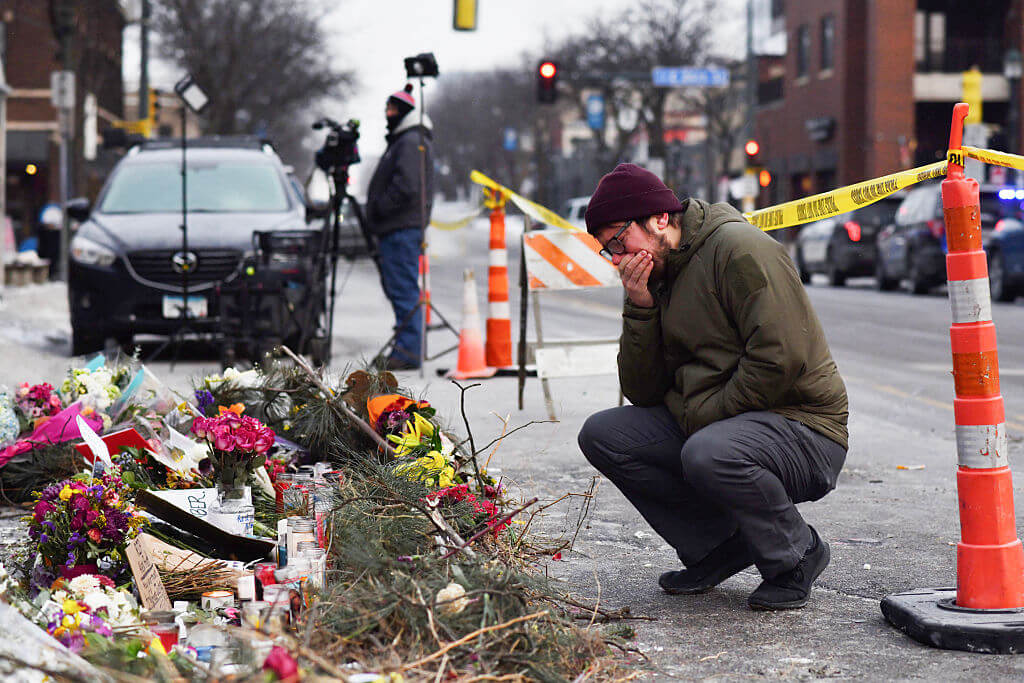
A mourner visits a makeshift memorial on January 25, in the area where Alex Pretti was killed in Minneapolis, Minnesota. Photo by Octavio Jones/AFP via Getty Images
By Robin Washington January 25, 2026
Alex Pretti was killed Saturday. Within hours, a Jewish community gathered to mark the end of Shabbat — and to reckon with his death.
The shock of his killing rippled quickly through Temple Israel of Minneapolis. As night fell, they joined online with Jews throughout the region to acknowledge the loss during Havdalah, the brief ritual that separates sacred time from the workweek, folding an act of communal mourning into the moment when Shabbat slips away.
The service, typically meditative and transitional, took on added weight. Alongside the familiar blessings, congregants spoke of Pretti — of the violence that ended his life and of the unease that followed them into a new week.
Pretti, a 37-year-old intensive care nurse and Minnesota resident who confronted immigration enforcement, was fatally shot by federal agents on Saturday. Several videos capturing the incident show agents wrestling him to the ground before firing multiple shots. Pretti, whose religion has not been revealed, has been the subject of numerous religious observances including a Mass by the Catholic Archdiocese of Saint Paul and Minneapolis.
On Friday, there had been no sign of the tragedy to come. At least 100 rabbis and other Jewish leaders arrived in Minneapolis to participate in protests. Temple Israel hosted an interfaith service with clergy from around the city and the country, joined by other dignitaries including both of Minnesota’s U.S. senators. The service opened with a Muslim call to prayer and the blowing of a shofar, and included a candle lit in remembrance of slain Minneapolis protester Renée Good and those detained by ICE.
On Saturday evening, Rabbi Marcia Zimmerman opened the online-only Havdalah service by recounting the emotional whiplash of the previous 24 hours, moving from Friday’s sense of hope and collective purpose to the shock of Saturday’s events.
“Not more than a few hours into Shabbat overnight, we were met with more violence and the killing of Alex Jeffrey Pretti,” she said at the service, which drew more than 700 people logging in via Zoom. “This tension is overwhelming and exhausting and terrifying. Havdalah asks us to hold the tension between light and darkness, between what is and what should be.”
She turned to the ritual objects to frame the moment. “The braided candle reminds us we do not cross the sea alone,” Zimmerman said. “We are part of a community, the candle with its many wicks intertwined. Even on Zoom, even shaken and grieving, we stand together, carrying each other forward.”
That sense of closeness, despite physical distance, was echoed by Rabbi Arielle Lekach-Rosenberg of Shir Tikvah Congregation, who asked participants to lean toward their screens.
“We are 24 pages worth of people arrayed,” she said of Zoom’s gallery view. “So I’m going to invite us to move our faces a little bit closer to the camera.” She added: “We are in community together to feel this sense of closeness across our Twin Cities — Twin Cities that are in such need of care and love.”
Lekach-Rosenberg invoked the names of three people killed in connection with federal immigration enforcement: Victor Manuel Diaz, while in ICE custody in Texas, along with Good and Pretti. “We call for justice, and we pray that their memories will be an inspiration and a blessing,” she said.
Other clergy also reflected on how Shabbat’s promise of rest had been broken by unfolding news events. Like Zimmerman, Rabbi Jen Hartmann, also of Temple Israel, noted a Shabbat that had begun with the inspiration of the massive march gave way to grief. She urged her fellow Minnesotans to remain strong, citing an out-of-state comment she had seen online: “I want to move to Minneapolis because those folks — they know how to neighbor.”
The service made room for wordless mourning as well. Rabbi Jason Rodich, also of Temple Israel, called for a moment of silence, asking participants to refrain from even responding with emojis — so that “we can simply be in grief and memory” for Pretti, Good, Diaz, and others who died.
Zimmerman ended with the Oseh Shalom prayer for peace, reminding participants that while every human being is created in God’s image, “This is not a God problem; it’s a people problem.”
This is a moment of great uncertainty. Here’s what you can do about it.
We hope you appreciated this article. Before you go, we’d like to ask you to please support the Forward’s independent Jewish news this Passover. All donations are being matched by the Forward Board - up to $100,000.
This is a moment of great uncertainty for the news media, for the Jewish people, and for our sacred democracy. It is a time of confusion and declining trust in public institutions. An era in which we need humans to report facts, conduct investigations that hold power to account, tell stories that matter and share honest discourse on all that divides us.
With no paywall or subscriptions, the Forward is entirely supported by readers like you. Every dollar you give this Passover is invested in the future of the Forward — and telling the American Jewish story fully and fairly.
The Forward doesn’t rely on funding from institutions like governments or your local Jewish federation. There are thousands of readers like you who give us $18 or $36 or $100 each month or year.
Support our mission to tell the Jewish story fully and fairly.