New York City Council pushes action on antisemitism, without Mamdani
Jewish lawmakers say they won’t wait for Mayor Zohran Mamdani to define the city’s response to rising antisemitism
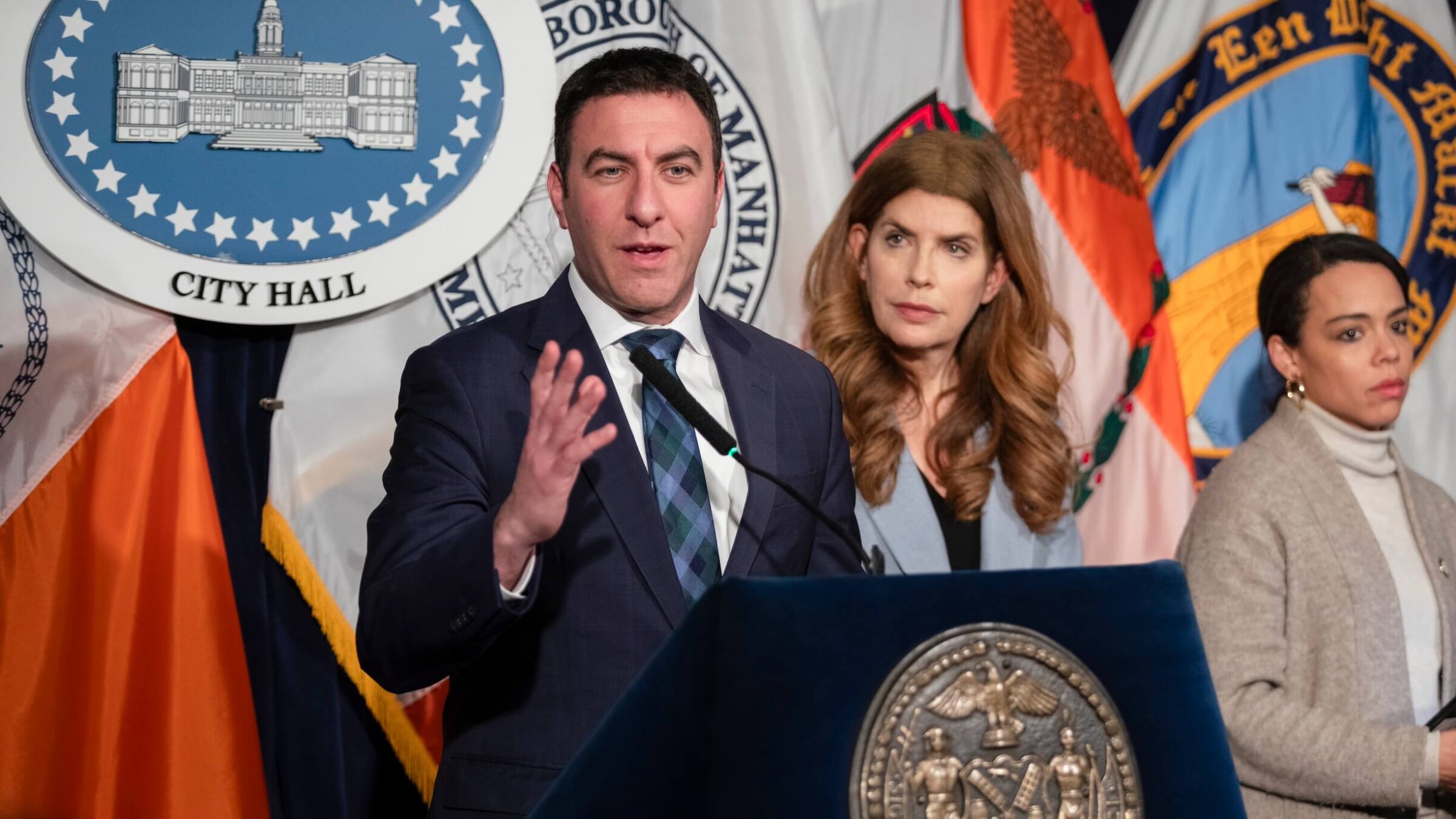
NYC Council Speaker Julie Menin and Eric Dinowitz, chair of the NYC Jewish Caucus, on Jan. 29. Photo by Emil Cohen/NYC Council Media Unit

By Jacob Kornbluh January 30, 2026
The announcement Thursday by New York City Council Speaker Julie Menin of a new task force dedicated to combating antisemitism — co-chaired by a critic of Mayor Zohran Mamdani — is setting up potential tension between the City Council and the mayor’s office over how to respond to the rise in antisemitism.
So is the introduction of a measure that could limit protests outside synagogues, part of a package of new Council bills aimed at antisemitism.
Councilmember Eric Dinowitz, a Democrat from the Bronx, who was selected along with Brooklyn Councilmember Inna Vernikov, a Republican, as co-chair of the seven-member working group, said they intend to take a more assertive legislative role in addressing rising concerns among Jewish New Yorkers “in a way that may be different than what the mayor wants to do.”
That includes weighing the adoption of the International Holocaust Remembrance Alliance definition of antisemitism, which considers most forms of anti-Zionism as antisemitic, as a framework for investigating hate crimes — a position Mamdani opposes. “I believe that IHRA has a good structure for defining antisemitism,” Vernikov said in an interview. In 2023, Vernikov passed a resolution to create an annual day to “end Jew-hatred.”
On his first day in office earlier this month, Mamdani drew criticism from mainstream Jewish organizations for revoking an executive order by former Mayor Eric Adams that adopted the IHRA definition of antisemitism. Liberal Jewish groups oppose that framework. Some support the Nexus Document, which states that most criticism of Israel and Zionism is not antisemitic. The mayor has declined to say how his administration will define antisemitism when determining which cases to investigate or pursue.
Mamdani has kept open the recently created Mayor’s Office to Combat Antisemitism, which he said will pursue his vision to address rising acts of hate against Jews. Mamdani said on Thursday that he’s in the final stages of selecting an executive director for that office.
Dinowitz, who also chairs the council’s Jewish Caucus, said it was important to move forward in parallel with the mayor’s efforts. “We are a separate, co-equal branch of government that has our own ideas and initiatives that we need to pursue to keep Jewish New Yorkers safe,” he said. Dinowitz, who represents the heavily Jewish neighborhood of Riverdale, added that most members of the task force are not Jewish, underscoring that antisemitism is not solely a Jewish issue.
Antisemitic incidents accounted for 57% of reported hate crimes in 2025, according to the NYPD. The new year started with a rash of antisemitic incidents across the city. On Thursday, a 36-year-old man was charged with attempted assault as hate crimes after repeatedly crashing into the entrance of the Chabad-Lubavitch world headquarters in Brooklyn the night before. On Tuesday, a rabbi was verbally harassed and assaulted in Forest Hills, Queens, and last week, a playground frequented by Orthodox families in the Borough Park neighborhood in Brooklyn was graffitied with swastikas two days in a row. In both incidents, the suspects have been arrested.
Vernikov’s past remarks draw scrutiny
Thursday’s announcement also drew controversy.
Vernikov has faced criticism for incendiary remarks on social media and has been a vocal critic of the Democratic Party’s approach to antisemitism. During the mayoral election, she warned that “Jihad is coming to NYC” if Mamdani wins, and called him a “terrorist-lover.” In response to a Yiddish-language campaign flyer, she wrote that Mamdani wants Jews “to burn in an oven.” She called the Jewish liaison for State Attorney General Letitia James a “Kapo Sell Out” for praising Mamdani’s outreach. In 2023, Vernikov was arrested after being pictured with a gun at her waist as she attended a pro-Israel counter-protest near a pro-Palestinian rally at Brooklyn College. A judge later dismissed the charges against her.
The progressive Jews For Racial & Economic Justice, which endorsed Mamdani through its affiliated political arm, The Jewish Vote, called Vernikov’s appointment unacceptable. Sophie Ellman-Golan, a JFREJ spokesperson, said Vernikov “regularly diminishes the seriousness of antisemitism by reducing it to a political cudgel.”
Menin, who some see as a check on the mayor and a potential guardrail on his actions, defended the appointment. “The Jewish Caucus voted to have this task force,” Menin told reporters. “Obviously, I don’t agree with the comments that she made in the past, and I’ve made that known to her.” Menin, the first Jewish speaker of the City Council, has pointed to the symbolism of her elevation alongside Mamdani, the city’s first Muslim mayor, as an opportunity to “take the temperature and the rhetoric down.”
Vernikov confirmed that the Jewish Caucus approved her selection, but insisted the speaker was involved in the initiative.
In the interview, Vernikov noted that Mamdani “has said things and done things that make the Jewish community very fearful.” She added that she hopes the mayor will translate his pledge to fight antisemitism into concrete action, “but until then, we have a trust issue with him.”
Mamdani addressed Vernikov’s attacks in an interview with Bloomberg TV on Thursday. “I know that there are so many in this city who have to deal with similar kinds of smears,” he said. “But what I know that New Yorkers want to see, what I want to see, is a humanity embodied in our politics, not the language of darkness that has taken hold.”
Menin’s legislative package to counter antisemitism
Also on Thursday, Menin introduced a legislative package as part of her five-point plan to combat antisemitism, including a proposal to ban protests near the entrances and exits of houses of worship, $1.25 million in funding for the Museum of Jewish Heritage, and the creation of a city hotline to report antisemitic incidents.
Mamdani said he broadly supports the package but expressed reservations about the proposed 100-foot buffer zone around synagogues and other houses of worship. “I wouldn’t sign any legislation that we find to be outside of the bounds of the law,” he said.
At a press conference, Menin said the measure was designed not to restrict protest but to prevent confrontations. “Enforcement is not based on speech or viewpoint,” she said. “It is based on conduct that endangers others.”
The Council will vote on the measures at its next meeting in February.
This is a moment of great uncertainty. Here’s what you can do about it.
We hope you appreciated this article. Before you go, we’d like to ask you to please support the Forward’s independent Jewish news this Passover. All donations are being matched by the Forward Board - up to $100,000.
This is a moment of great uncertainty for the news media, for the Jewish people, and for our sacred democracy. It is a time of confusion and declining trust in public institutions. An era in which we need humans to report facts, conduct investigations that hold power to account, tell stories that matter and share honest discourse on all that divides us.
With no paywall or subscriptions, the Forward is entirely supported by readers like you. Every dollar you give this Passover is invested in the future of the Forward — and telling the American Jewish story fully and fairly.
The Forward doesn’t rely on funding from institutions like governments or your local Jewish federation. There are thousands of readers like you who give us $18 or $36 or $100 each month or year.
Support our mission to tell the Jewish story fully and fairly.