How a law used to protect synagogues is now being deployed against ICE protesters and journalists
The FACE Act has now been used against protesters at a New Jersey synagogue — and Don Lemon
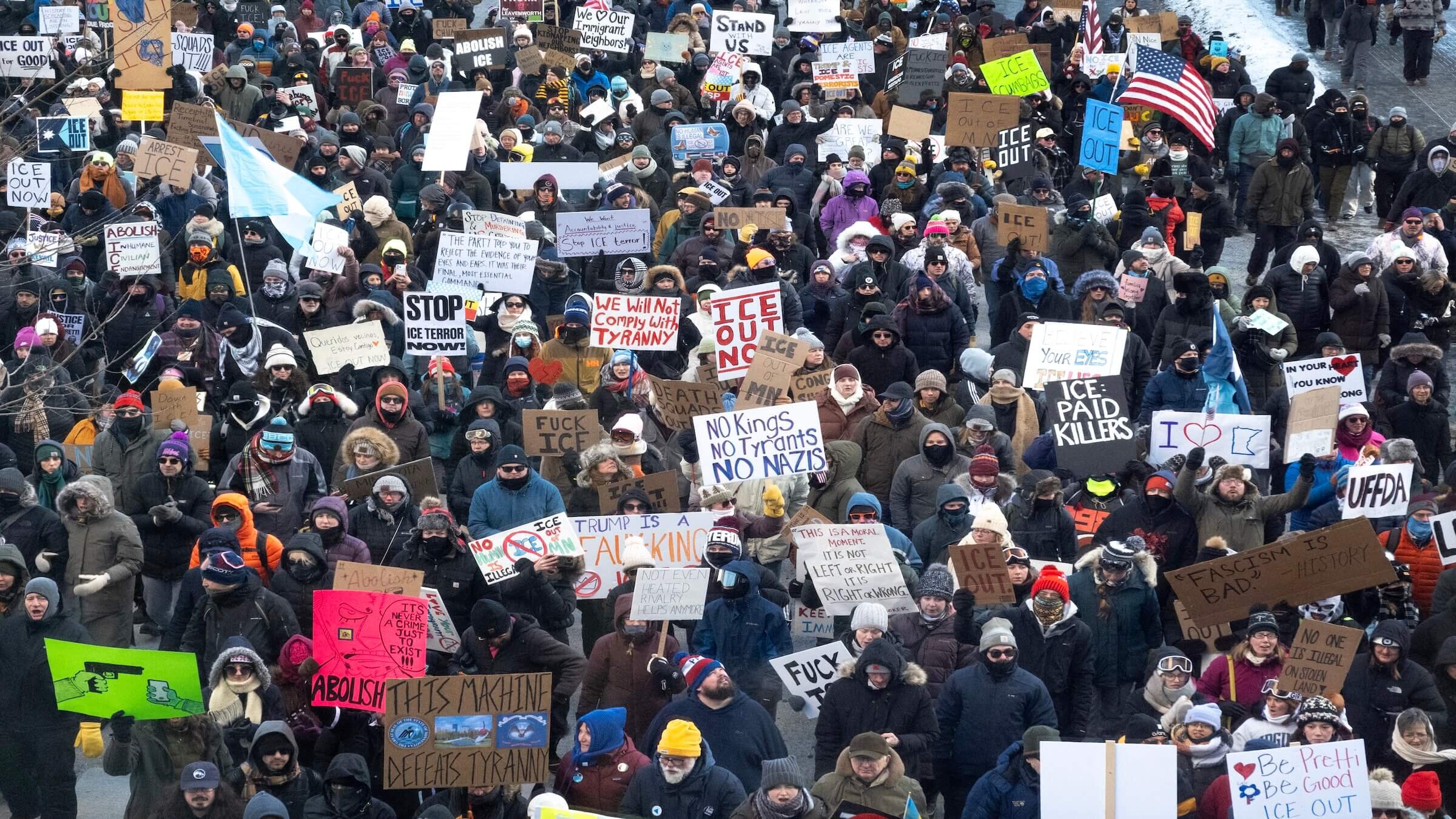
Demonstrators march through downtown Minneapolis protesting ICE operations and the death of Renee Good and Alex Pretti. Photo by Scott Olson/Getty Images

By Hannah Feuer January 30, 2026
After a pro-Palestinian protest at a New Jersey synagogue turned violent in October, the Trump administration took an unusual step — using a federal law typically aimed at protecting abortion clinics to sue the demonstrators.
Now, federal authorities are attempting to deploy the same law against journalists as well as protesters against Immigration and Customs Enforcement amid the agency’s at times violent crackdown in Minneapolis.
Former CNN anchor Don Lemon, a local journalist, and two protesters were arrested after attending a Jan. 18 anti-ICE protest at a church in St. Paul, Minnesota, Justice Department officials said Friday. Protesters alleged the pastor at Cities Church worked for ICE.
The federal law they are accused of violating, the Freedom of Access to Clinic Entrances Act, or FACE, prohibits the use of force or intimidation to interfere with reproductive health care clinics and houses of worship.
But in the three decades since its passage in 1994, the law had almost entirely been deployed against anti-abortion protesters causing disruptions at clinics.
That changed in September of last year, when the Trump administration cited the FACE Act to sue pro-Palestinian demonstrators at Congregation Ohr Torah in West Orange, New Jersey.
It was the first time the Department of Justice had used the law against demonstrators outside a house of worship, Harmeet Dhillon, an assistant attorney general for the department’s civil rights division, said at the time.
The novel legal strategy — initially advanced by Jewish advocacy groups to fight antisemitism — is now front and center in what First Amendment advocates are describing as an attack on freedom of the press.
“I intend to identify and find every single person in that mob that interrupted that church service in that house of God and bring them to justice,” Dhillon told Newsmax last week. “And that includes so-called ‘journalists.’”
How the law has been used
The FACE Act has traditionally been used to prosecute protesters who interfere with patients entering abortion clinics. Conservative activists have long criticized the law as violating demonstrators’ First Amendment rights, and the Trump administration even issued a memo earlier this month saying the Justice Department should limit enforcement of the law.
But in September, the Trump administration applied the FACE Act in a new way: suing the New Jersey protesters at Congregation Ohr Torah.
They had disrupted an event at the Orthodox shul that promoted real estate sales in Israel and the West Bank, blowing plastic horns in people’s ears and chanting “globalize the intifada,” a complaint alleges.
Two pro-Israel demonstrators were charged by local law enforcement with aggravated assault, including a local dentist, Moshe Glick, who police said bashed a protester in the head with a metal flashlight, sending him to the hospital. Glick said he had acted in self defense, protecting a fellow congregant who had been tackled by a protester.
The event soon became a national flashpoint, with Glick’s lawyer alleging the prosecution had been “an attempt to criminalize Jewish self-defense.” Former New Jersey Gov. Phil Murphy pardoned Glick earlier this month.
The Trump administration sued the pro-Palestinian protesters under the FACE Act, seeking to ban them from protesting outside houses of worship and asking that they each pay thousands of dollars in fines.
At the time, Nathan Diament, executive director of the Orthodox Union Advocacy Center, told JNS he applauded the Trump administration “for bringing this suit to protect the Jewish community and all people of faith, who have the constitutional right to worship without fear of harassment.”
Diament did not respond to the Forward’s email asking whether he supported the use of the FACE Act against the Minneapolis journalists and protesters.
Mark Goldfeder, CEO of the National Jewish Advocacy Center, a pro-Israel group that says it uses legal tools to counter antisemitism, did not express concern over the use of the FACE Act in the Minnesota arrests — and emphasized the necessity of protecting religious spaces from interference.
“The idea that ‘you can worship’ means nothing if a mob can make it unsafe or impossible,” Goldfeder wrote in a statement to the Forward. “So if you apply it consistently: to protect a church in Minnesota, a synagogue in New Jersey, a mosque in Detroit, what you are actually protecting is pluralism itself.”
Goldfeder has also attempted to use the FACE Act against protesters at a synagogue, citing the law in a July 2024 complaint against demonstrators who had converged on an event promoting Israel real estate at Adas Torah synagogue in Los Angeles. That clash descended into violence.
The Trump administration Justice Department subsequently filed a statement of interest supporting that case, arguing that what constituted “physical obstruction” at a house of worship under the FACE Act could be interpreted broadly.
Now, similar legal reasoning may apply to journalists covering the Sunday church protest in Minneapolis. Press freedom groups have expressed deep alarm over the arrests, arguing that the journalists were there to document, not disrupt.
The arrests are “the latest example of the administration coming up with far-fetched ‘gotcha’ legal theories to send a message to journalists to tread cautiously,” said Seth Stern, chief of advocacy for Freedom of the Press Foundation. “Because the government is looking for any way to target them.”
This is a moment of great uncertainty. Here’s what you can do about it.
We hope you appreciated this article. Before you go, we’d like to ask you to please support the Forward’s independent Jewish news this Passover. All donations are being matched by the Forward Board - up to $100,000.
This is a moment of great uncertainty for the news media, for the Jewish people, and for our sacred democracy. It is a time of confusion and declining trust in public institutions. An era in which we need humans to report facts, conduct investigations that hold power to account, tell stories that matter and share honest discourse on all that divides us.
With no paywall or subscriptions, the Forward is entirely supported by readers like you. Every dollar you give this Passover is invested in the future of the Forward — and telling the American Jewish story fully and fairly.
The Forward doesn’t rely on funding from institutions like governments or your local Jewish federation. There are thousands of readers like you who give us $18 or $36 or $100 each month or year.
Support our mission to tell the Jewish story fully and fairly.