ADL retracts Tumbler Ridge shooting antisemitism claim
A day after the antisemitism watchdog said the alleged mass killer in Canada had posted ‘the Zionists want me to hate Jews,’ the ADL said the social media account was ‘not credible’
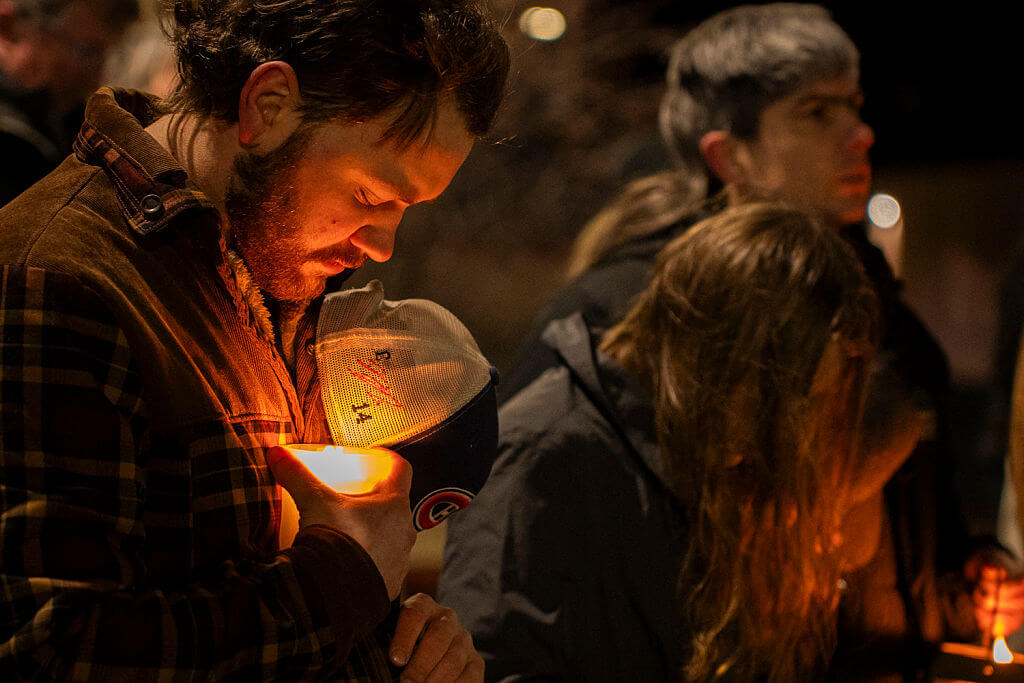
Residents of Tumbler Ridge, British Columbia attend a candlelight vigil Feb. 12, for the victims of a mass shooting. Photo by Paige Taylor White/AFP via Getty Images

By Louis Keene February 13, 2026
The ADL published and then retracted a claim that the alleged mass shooter at a school in Canada maintained a social media account with antisemitic posts, a day after it posted the erroneous information on its website.
The organization wrote Thursday at the bottom of an updated page about alleged Tumbler Ridge Secondary School shooter Jesse Van Rootselaar that it had incorrectly concluded that an X account containing the posts belonged to the alleged shooter. Nine people were killed in the shooting, including Van Rootselaar.
“A preliminary investigation uncovered an X account appearing to belong to the shooter. Upon further investigation, that X account has been found not credible. References to it have been removed,” the correction read.
Authorities in British Columbia said they could not speculate on the motive of the shooter.
The ADL, the most prominent U.S. antisemitism research and advocacy organization, had posted the claim Wednesday on its website.
The Forward has reached out to the ADL for comment.
The error, posted by the ADL’s Center On Extremism, comes amid broader changes in the ADL’s approach.
The ADL’s original post said that on Sunday — two days before the attack — an X account connected to Van Rootselaar posted, “I need to hate jews because the zionists want me to hate jews. This benefits them, somehow.”
“The Tumbler Ridge shooter’s X profile photo also featured an image of the Christchurch shooter superimposed over a Sonnenrad, a neo-Nazi symbol, and a transgender pride flag,” the ADL wrote in the original post, referencing an antisemitic mass murder in New Zealand.
It did not link to the profile or include images of it, leaving the claim difficult to verify.
The Center On Extremism is a flagship program that has been overhauled in recent years as the organization has shifted toward a greater focus on fighting antisemitism. In September, it deleted its Glossary of Extremism, which had contained over 1,000 pages of background information on hate groups and ideologies. It said at the time that the entries were outdated.
This is a moment of great uncertainty. Here’s what you can do about it.
We hope you appreciated this article. Before you go, we’d like to ask you to please support the Forward’s independent Jewish news this Passover. All donations are being matched by the Forward Board - up to $100,000.
This is a moment of great uncertainty for the news media, for the Jewish people, and for our sacred democracy. It is a time of confusion and declining trust in public institutions. An era in which we need humans to report facts, conduct investigations that hold power to account, tell stories that matter and share honest discourse on all that divides us.
With no paywall or subscriptions, the Forward is entirely supported by readers like you. Every dollar you give this Passover is invested in the future of the Forward — and telling the American Jewish story fully and fairly.
The Forward doesn’t rely on funding from institutions like governments or your local Jewish federation. There are thousands of readers like you who give us $18 or $36 or $100 each month or year.
Support our mission to tell the Jewish story fully and fairly.