Israel’s bobsled team is chasing more than medals in its first Olympic outing in Milan
Founder AJ Edelman wants to change Israeli sports culture
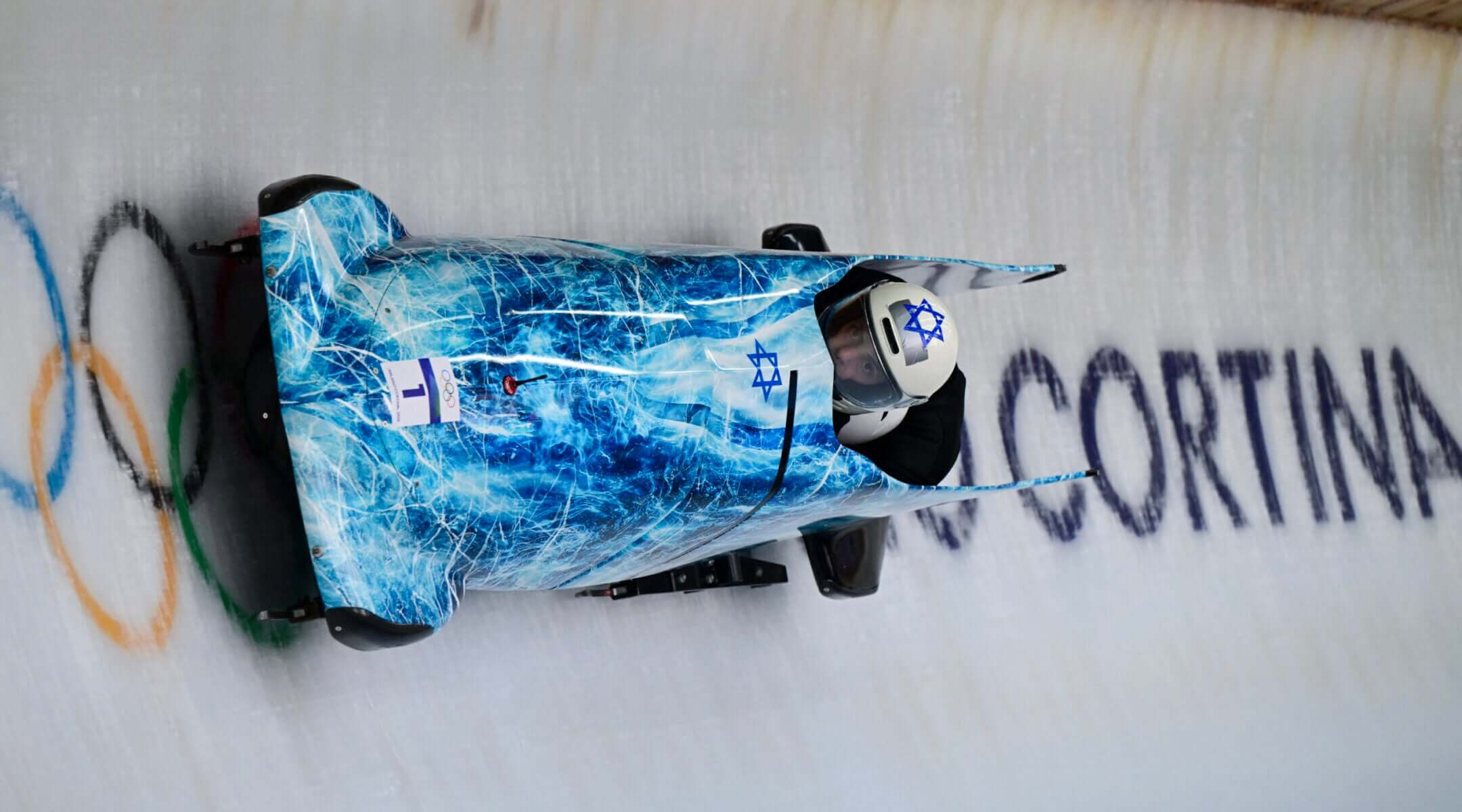
Israel’s AJ Edelman pilots in the bobsleigh men’s two-man training Heat 4 at Cortina Sliding Centre during the Milano Cortina 2026 Winter Olympic Games in Cortina d’Ampezzo on Feb. 13, 2026. Photo by Stefano Rellandini/AFP via Getty Images
(JTA) — No matter what happens when Israel’s bobsled team hits the ice next week at the 2026 Winter Olympics, team captain Adam “AJ” Edelman has already had a year for the history books.
The 34-year-old Brookline, Massachusetts, native is the first Orthodox Jewish athlete to compete at the Winter Olympics, and now the first Israeli to qualify for the Games in two sports. He placed 28th in skeleton at the 2018 Olympics in PyeongChang, South Korea.
But for Edelman, the 12-year journey that culminated in Israel’s first-ever Olympic bobsled appearance — which he has nicknamed “Shul Runnings,” a spin on the 1993 movie about Jamaica’s bobsled team — is about more than success on the track.
“The Olympics were never a goal,” Edelman told the Jewish Telegraphic Agency in an interview prior to the Games. “The Olympics were the tool, or the stepping stone, to get to the goal, which was to fundamentally redefine, or change, how our community — both the Israeli and the Jewish one — view investment into and the role of sport.”
Edelman’s journey began in 2013, when Israel attempted to recruit him to play for its national hockey team. Hockey had been Edelman’s first sport, which he played through college at the Massachusetts Institute of Technology, where he was the first Shabbat-observant player in program history.
Edelman discussed the idea with the long-time alumni director of his Jewish day school, Brookline’s Maimonides School. Mike Rosenberg pointed something out to Edelman that ultimately sparked a calling.
“AJ, no one from this school has ever gotten to the level of sport beyond high school that you’ve gotten to that didn’t go to, let’s say, [Yeshiva University] or Brandeis,” Edelman recalls Rosenberg, who died last year, telling him about the two historically Jewish colleges.
Edelman couldn’t believe that. Out of thousands of Maimonides alumni (including his older brother, Emmy award-winning comedian Alex Edelman), only Edelman — who called himself “not a very gifted athlete” — had reached that level? He had a theory as to why that might be.
“I came to the conclusion that it had to be a self-selection process,” Edelman explained. “That people were selecting out of sport as a journey before they got to that level. And why were they doing it? Because there was no priority placed on sport. It wasn’t something people in our community aspired to do or invest in.”
Edelman said the lack of investment in sports led to a lack of infrastructure and a dearth of role models for Jewish kids to look up to. He set out to change that — to “be the change.”
“The only way to do that was a certificate, so to speak, of excellence in sport, and that’s the Games,” he said. “The Games are essentially the certificate of, ‘you did something.’ So in that way, the Olympics became very, very much the tool for which I wanted to make the change.”
Edelman began training in skeleton after graduating from MIT in 2014. His initial scouting report was not promising: he was told he was “not athletic, would never make the Olympics, and would never be competitive in sliding sport.”
That did not deter him. Edelman moved to Israel in 2016, where he kept training, teaching himself the sport on YouTube when he couldn’t afford a coach. He ultimately clinched Israel’s first sliding sport Olympic appearance in 2018.
Then the pandemic hit. Edelman was pursuing an MBA at Yale University when classes were suspended. Edelman was visiting Jordana Balsam, a close friend who is an attorney in New York City, when the Olympics came up.
“He was telling me about his history with skeleton, and how he competed in the 2018 Games, and how he was actually really intrigued by bobsled,” Balsam recalled. “And in an offhand comment, I’m like, ‘Well, why don’t you pursue that, since you have this time off from Yale?’ And I guess something clicked in his brain, where he was just like, ‘Yes, I’m gonna do that.’ And the rest is history.”
Edelman began working toward bringing Israel to the Olympics in bobsled. Again, there were hurdles. He had to recruit a team from scratch. Israel’s own athletic authorities were skeptical — its Olympic committee almost didn’t accept an invitation to the 2026 Games. Funding was practically non-existent. Still, the team continued training, ultimately missing out on Olympic qualification for the 2022 Games by 0.1 second.
Then came Oct. 7, 2023, and the subsequent Gaza war, in which five members of the team were called into combat and multiple team sponsors backed out. Still, Edelman kept his eye trained on the 2026 Games. He used Instagram DMs to recruit a new team — most of whom play other sports and had never been in a bobsled — which also features Israel’s first Druze Olympian, Ward Farwasy.
Israel ultimately qualified in late January at an event in Lake Placid, the same location where Edelman had been told 12 years ago that he’d never make it. The team often trains there, as well as in Park City, Utah, British Columbia and elsewhere. Edelman said he is rarely in the same place for more than a few weeks at a time.
“Once he had something in his head — an idea, a concept, a goal that he has — he dives into it 200%, and it’s something that I admire greatly,” Balsam said. “I’ve never seen anyone so dedicated to their craft, to their sport, to their goal. It really is inspirational.”
But even qualifying for the Games didn’t end the obstacles. Due to Olympic security, Edelman said his team’s training time in Cortina was limited. Then the team’s apartment in the Czech Republic, where they were training prior to leaving for Italy, was robbed on Feb. 7. Edelman said thousands of dollars in personal belongings, including passports, were stolen.
Throughout the process, Edelman said the wave of support, particularly from American Jews, has been “pleasantly surprising” — especially compared to the reaction after he qualified in 2018, which he called more of a “blip.”
That support has manifested through donations and merchandise sales, with Edelman fundraising to support the team’s Olympic costs. There has also been ample news and social media coverage, inside the Jewish and Israeli communities and out. U.S. Ambassador to Israel Mike Huckabee has given the team a shoutout, too.
Edelman said the positive response has been all the validation he needed.
“There was a constant question of, at the end of the road, you’re doing this for a reason, right?” he said. “ And the only reason to do this is for the goal, the goal of making a change. Of people caring about sport. Of being the change. So if the change doesn’t come and it doesn’t make an impact, then all of it is irrelevant… I think that, from what we’ve seen in the last [several weeks], the answer is an unequivocal yes. It was 100% worth it.”
In Israel, sports fans are proud of the historic nature of the bobsled team’s Olympic appearance, but the story has not broken through to the same extent, according to David Wiseman, who lives in Jerusalem and runs the popular “Follow Team Israel” Facebook page that tracks Israeli sports.
“The media are very football [soccer] and basketball-centric, so they get all the headlines,” Wiseman said. “Someone like Deni Avdija gets significantly more coverage. They know of him being the first Israeli to play in the [NBA] All-Star game far more so than this. They think it’s cool that [Edelman] made it, but they don’t devote any more thought to it. Independent of Israel, bobsled is a niche, niche sport.”
Still, Edelman and some of his supporters have seized on the narrative draw of Israel’s underdog bobsled story — not to mention the apartment break-in and other obstacles — to amplify an almost muscular form of pro-Israel advocacy. Edelman commonly uses the phrase “victors, not victims,” in reference to his team and to Israel’s spirit more broadly.
Jared Firestone, who is representing Israel in skeleton in Italy, said there was “no chance I’d be here without AJ’s guidance.” Edelman helped coach Firestone in skeleton after he made aliyah in 2019, and the pair co-founded the nonprofit Advancing Jewish Athletes to support other Jews in sports.
“I think it means so much to Israelis and to the Jewish community at large to see, with a little investment, how much can be accomplished,” Firestone said. “Unfortunately for me and AJ, we’ve had to dedicate so much of our time that could’ve gone to training and progressing on the ice to fundraising, but hopefully we’ll be inspiring people who could help to create that infrastructure so the next AJ and Jared could just focus on sport and being even better than we are.”
Balsam, who also serves as a director of Advancing Jewish Athletes, said it’s hard to articulate how meaningful Edelman’s achievement of making the Olympics is to him, and to her.
“AJ has been very, very passionate about trying to cultivate the idea that sports can be a career path for Jewish kids,” she said. “He wanted to make it to the Olympics. He wanted to show that this is possible. So for him to combine both of his passions and achieve his dream, I think is something that he can’t put into words, that I can’t put into words, but it’s just immense pride.”
Now comes the actual tournament. Israel will compete in the two-man races on Feb. 16 and 17 and in four-man on Feb. 21 and 22, with Edelman piloting the sleds. His Shiba Inu Lulu, the team’s mascot, is staying with Balsam in New York, where they’ll be cheering him on.
But no matter where Israel places, Edelman has one more box to check to fully accomplish his mission to change Israeli sports.
“There is one thing that I wish beyond anything, and it’s that I’m not the only one to do it,” he said. “ What I really wanted to accomplish through it was that someone else saw it and decided to do it themselves. That they saw that pathway opened by someone who was less than stellar, who was not, like, a God-gifted athlete, and went, ‘You know what? I’m pretty good at what I do. I can do that.’
“You have to leave it better than you found it, and it has to be for a purpose, and that purpose is always going to be to inspire someone to do it better than you did.”
This is a moment of great uncertainty. Here’s what you can do about it.
We hope you appreciated this article. Before you go, we’d like to ask you to please support the Forward’s independent Jewish news this Passover. All donations are being matched by the Forward Board - up to $100,000.
This is a moment of great uncertainty for the news media, for the Jewish people, and for our sacred democracy. It is a time of confusion and declining trust in public institutions. An era in which we need humans to report facts, conduct investigations that hold power to account, tell stories that matter and share honest discourse on all that divides us.
With no paywall or subscriptions, the Forward is entirely supported by readers like you. Every dollar you give this Passover is invested in the future of the Forward — and telling the American Jewish story fully and fairly.
The Forward doesn’t rely on funding from institutions like governments or your local Jewish federation. There are thousands of readers like you who give us $18 or $36 or $100 each month or year.
Support our mission to tell the Jewish story fully and fairly.