Berlin film festival fends off criticism after jury president Wim Wenders rebuffs calls to criticize Israel
Author Arundhati Roy backed out of the festival after Wenders said, “We have to stay out of politics”
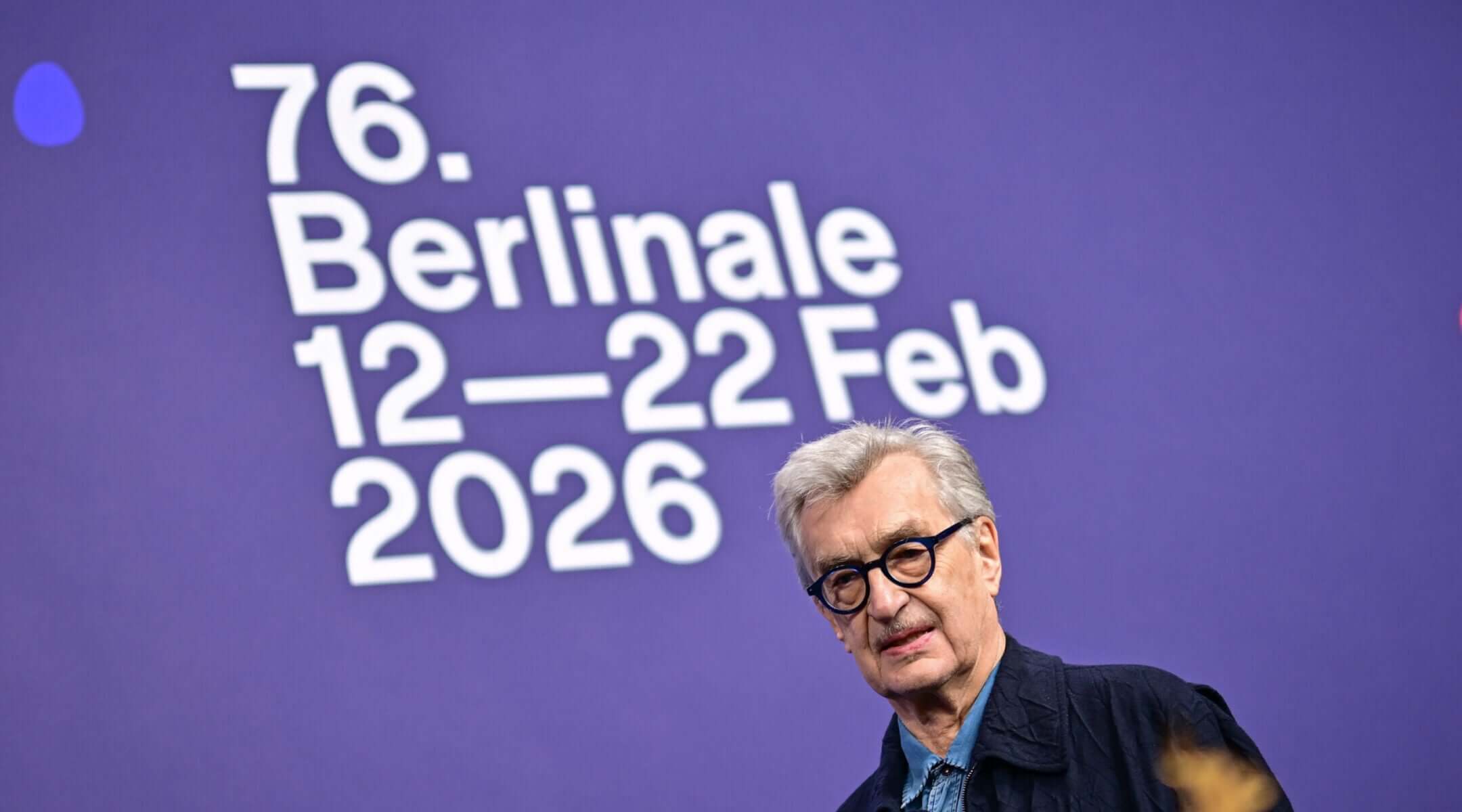
Wim Wenders, president of the Berlinale Jury, arrives at the press conference of the Berlinale International Jury on Feb. 12, 2026, in Berlin. Photo by Sebastian Christoph Gollnow/dpa via Getty Images
(JTA) — BERLIN — The renowned Indian author Arundhati Roy has announced she will not attend Berlin’s annual international film festival over its jury’s refusal to comment on the war in Gaza.
Dozens of past and present participants in the Berlinale, meanwhile, are criticizing the festival for its “silence” on Gaza in an open letter published on Tuesday. They include Javier Bardem, Tilda Swinton, and Nan Goldin.
Both actions follow comments by the president of the festival’s jury, the renowned director Wim Wenders, appearing to argue that art should be apolitical.
“We have to stay out of politics because if we made movies that are dedicatedly political, we enter the field of politics, but we are the counterweight to politics,” Wenders said during the first press conference of the Berlinale on Thursday. “We have to do the work of people, not the work of politicians.”
Wenders was responding to a question from a journalist who accused the festival of showing solidarity with people in Iran and Ukraine, but not with Palestinians. The journalist asked the jury whether it supported a “selective treatment of human rights,” knowing that “the German government supports the genocide in Gaza and is the Berlinale’s main financial backer.”
Another jury member, the Polish film producer Ewa Puszczynska, said that it was “not fair” to ask the judges about government positions on the war in Gaza.
Following the comments, Roy, who has long criticized Israel’s conduct in Gaza, announced her withdrawal from the festival, calling the statement “unconscionable.”
“To hear them say that art should not be political is jaw-dropping,” Roy said. “It is a way of shutting down a conversation about a crime against humanity even as it unfolds before us in real time – when artists, writers and film-makers should be doing everything in their power to stop it.”
The controversy comes as the Berlinale opens in a tense climate vis-a-vis the war in Gaza. While the festival has long cultivated a reputation as one of the more overtly political major film festivals, Germany has maintained firm prohibitions on some forms of Israel criticism even as challenges to its conduct in Gaza have surged among many Germans and artists worldwide.
In 2024, the same year the festival invited and later disinvited members of the far-right party Alternative for Germany, the Berlinale filed criminal charges against an employee who posted an unapproved message about Gaza on its Instagram page.
Now, in defense of its jury, the festival issued a statement on Saturday saying that “artists are free to exercise their right of free speech in whatever way they choose.”
“Artists should not be expected to comment on all broader debates about a festival’s previous or current practices over which they have no control,” wrote festival director Tricia Tuttle. “Nor should they be expected to speak on every political issue raised to them unless they want to.”
Defending the artists and jury, Tuttle lamented that filmmakers increasingly “are expected to answer any question put to them. They are criticised if they do not answer. They are criticised if they answer and we do not like what they say. They are criticised if they cannot compress complex thoughts into a brief sound bite when a microphone is placed in front of them when they thought they were speaking about something else.”
Several films at the festival focus on the Israel-Palestinian conflict, some more directly than others. They include a recut version of “A Letter to David,” a documentary that premiered last year about an Israeli hostage in Gaza who has since been released.
Following a screening of her short film about a boy in Lebanon who lives against the backdrop of Israeli warplanes overhead, meanwhile, director Marie-Rose Osta told the audience that, in case they did not know where Lebanon is, it is “north of Palestine, which some of you may call Israel.”
Roy, in a statement issued by her publisher, said that art should in fact be political, and accused the jury of stifling discussion “about a crime against humanity.” She called the statements by the jury “outrageous.”
A film festival spokesperson told the Juedische Allgemeine, the German Jewish newspaper, that it regretted Roy’s decision, “as her presence would have enriched the festival discourse.” A 1989 film based on her screenplay, “In Which Annie Gives It Those Ones,” is showing in the festival’s classics section.