Eli Sharabi’s ‘Hostage’ memoir named Jewish book of the year
Journalist Julia Ioffe, former Obama aide Sarah Hurwitz and historian Pamela Nadell are also winners of a National Jewish Book Award
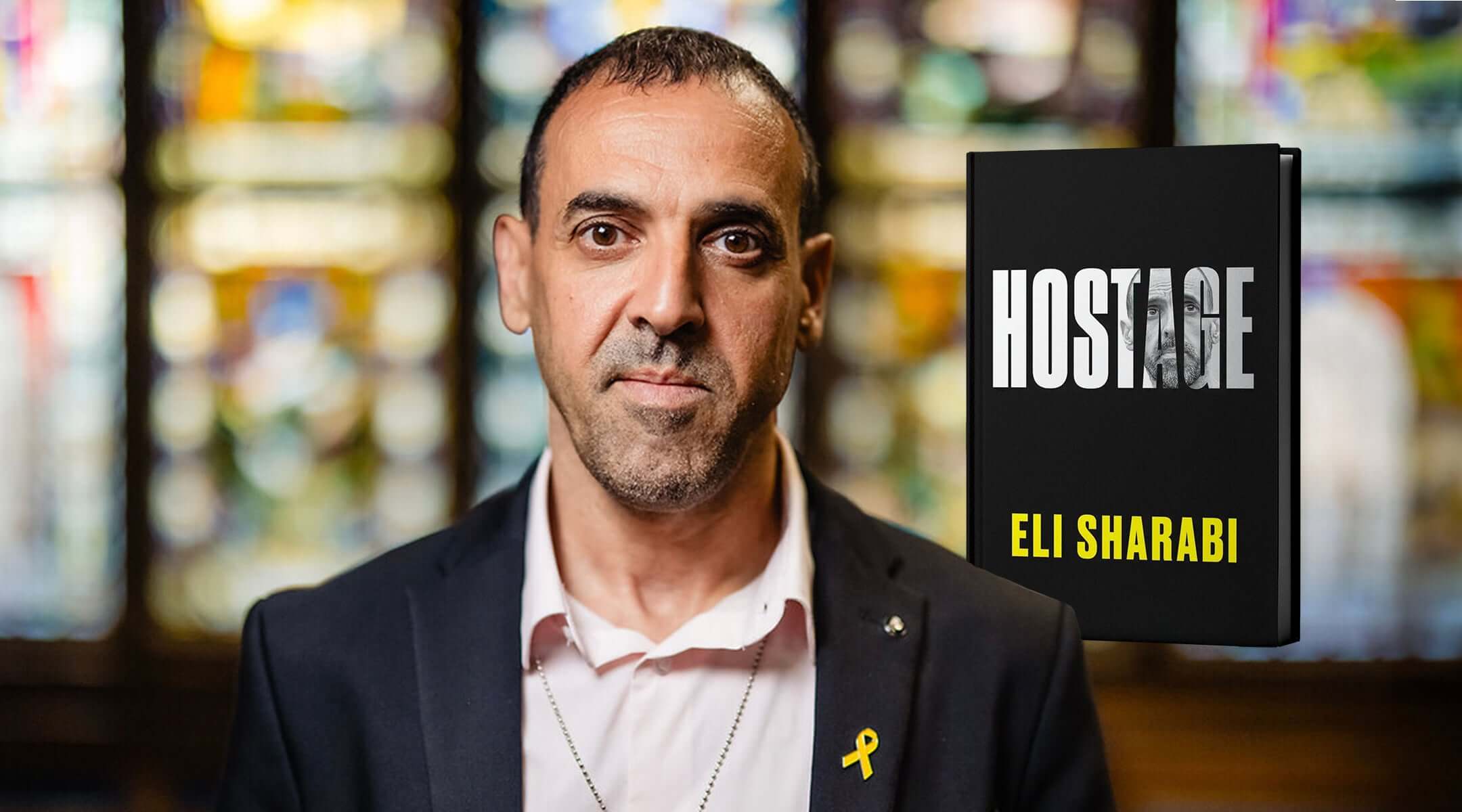
Eli Sharabi’s memoir recounts his 491 days as a Hamas hostage in Gaza. Courtesy of Harper Influence
By Andrew Silow-Carroll February 18, 2026
(JTA) — Eli Sharabi’s memoir “Hostage,” recounting his experience in Hamas captivity after the Oct. 7, 2023 attack, has been named Book of the Year by the National Jewish Book Awards, organizers announced Wednesday.
The awards, presented by the Jewish Book Council and considered among the most prestigious honors in Jewish literature, recognize outstanding English-language books of Jewish interest across dozens of categories. Founded in 1950, the program is the longest-running North American awards initiative devoted to Jewish books.
Sharabi’s memoir, which details his abduction from Kibbutz Be’eri and the more than year he spent in captivity, became a bestseller in Israel and was later released in English in the United States.
“This recognition means so much to me, not only personally, but for the memory of my family and all those we lost,” Sharabi said in a statement. “’Hostage’ is my testimony, a story of my survival, written so others could bear witness. I hope it helps ensure that what happened is never forgotten.”
Other major winners reflect the breadth of contemporary Jewish writing, spanning scholarship, fiction, memoir and children’s literature.
In American Jewish studies, Pamela S. Nadell won for “Antisemitism, an American Tradition,” a look at the forms antisemitism took in the country from the early Dutch settlers to the present day. The Russian-born journalist Julia Ioffe took the autobiography and memoir prize for “Motherland: A Feminist History of Modern Russia, from Revolution to Autocracy.” The book blends memoir, journalism and history to examine modern Russia through the lens of women’s experiences.
Jack Fairweather’s “The Prosecutor: One Man’s Battle to Bring Nazis to Justice,” the story of a Jewish judge and Holocaust survivor from Stuttgart who pursued Nazi perpetrators in post-war Germany, won the biography award.
Fiction honors went to Allison Epstein for “Fagin the Thief,” a retelling of the Dickens novel “Oliver Twist” from the perspective of its Jewish antihero, and Zeeva Bukai received the debut fiction prize for “The Anatomy of Exile,” about the multigenerational echoes of a secret love affair between an Israeli Jewish woman and a Palestinian poet.
The Hebrew fiction in translation category recognized “Dog,” by Yishay Ishi Ron, translated by Yardenne Greenspan, which also earned a selection in the book club category. The novella’s protagonist is an Israeli combat veteran haunted by his service in one of the Gaza campaigns prior to Oct. 7.
This year’s awards arrive as the Jewish discourse has been reshaped by the aftermath of Oct. 7, a global surge in antisemitism and the polarizing debate over Israel that followed. Last year’s winner for book of the year, “10/7: 100 Human Stories” by Lee Yaron, was also an account of the attacks and their aftermath.
Jewish anxieties in light of Oct. 7 are the subject of Sarah Hurwitz’s “As A Jew: Reclaiming Our Story From Those Who Blame, Shame, and Try to Erase Us,” which won in the contemporary Jewish life and practice category. Hurwitz, a speechwriter in the Obama administration, provides a primer on Jewish history, texts and practices in order to counter what she calls misinformation among Jews, their allies and their critics.
“Especially amid rising antisemitism and Jewish authors facing increased scrutiny, Jewish books have the power to create and sustain community,” said Naomi Firestone-Teeter, CEO of Jewish Book Council, in a statement announcing the winners.
In “Hostage,” Sharabi writes about the terror of his abduction and the daily struggle to survive after Hamas fighters stormed Kibbutz Be’eri. He would spend 491 days in captivity, much of it in tunnels beneath Gaza, before being released on Feb. 8, 2025, as part of a negotiated deal. Throughout the ordeal, Sharabi clung to the hope of rescue, writing: ‘I refuse to let myself drown in pain. I am surviving. I am a hostage. In the heart of Gaza. A stranger in a strange land. In the home of a Hamas-supporting family. And I’m getting out of here. I have to. I’m getting out of here. I’m coming home.”
Other nonfiction winners included Elissa Bemporad’s “Jews in the Soviet Union: A History: Revolution, Civil War, and New Ways of Life, 1917–1930, Volume 1,” which won in history; Anna Hájková’s “People Without History are Dust: Queer Desire in the Holocaust,” honored in Holocaust studies alongside translator William Ross Jones; and Tobias Schiff’s “Return to the Place I Never Left,” which won the Holocaust memoir award, with Dani James recognized for translation.
Awards recognizing contemporary Jewish thought and scholarship included Lawrence Grossman’s “Living in Both Worlds: Modern Orthodox Judaism in the United States, 1945–2025,” and Debra Kaplan and Elisheva Carlebach’s “A Woman Is Responsible for Everything: Jewish Women in Early Modern Europe,” which won multiple prizes, including scholarship and women’s studies.
In children’s and young readers’ categories, Alison Goldberg’s “The Remembering Candle,” illustrated by Selina Alko, won for children’s picture book; Janice Shapiro’s “Honoria: A Fortuitous Friendship” took the prize for middle grade literature; and Eugene Yelchin’s graphic memoir “I Wish I Didn’t Have to Tell You This” won in young adult literature.
Other winners include Miriam Udel’s “Modern Jewish Worldmaking Through Yiddish Children’s Literature,” which won in education and Jewish identity; Raegan Steinberg, Alexandre Cohen and Evelyne Eng’s “Arthurs: Home of the Nosh,” honored in food writing and cookbooks; Ariella Aïsha Azoulay’s “Golden Threads,” which won for Sephardic culture; Elizabeth E. Imber’s “Uncertain Empire,” for writing based on archival material; and Aharon Shabtai’s “Requiem & Other Poems,” translated by Peter Cole, which won the poetry award.
The winners will be honored at an awards ceremony in New York next month hoisted by the entertainer Jonah Platt. At the ceremony, journalist Sam Feedman will be presented with the council’s Mentorship Award, named in honor of Carolyn Starman Hessel, longtime former director of the JBC. Freedman, a former New York Times reporter and professor at the Columbia Journalism School, taught a popular course that helped over 100 students turn their ideas into books, including “When They Come for Us, We’ll Be Gone: The Epic Struggle to Save Soviet Jewry,” Gal Beckerman’s 2010 history of the Soviet Jewry movement.
“Sam Freedman changed my life as a writer,” Beckerman said in a statement. “He believed in me before I believed in myself, pushed me to take my work seriously, and opened doors I didn’t even know existed. With tough love and deep generosity, he guided me through the daunting process of writing a book as if it were his own. What he did for me, he did for dozens of writers.”
This is a moment of great uncertainty. Here’s what you can do about it.
We hope you appreciated this article. Before you go, we’d like to ask you to please support the Forward’s independent Jewish news this Passover. All donations are being matched by the Forward Board - up to $100,000.
This is a moment of great uncertainty for the news media, for the Jewish people, and for our sacred democracy. It is a time of confusion and declining trust in public institutions. An era in which we need humans to report facts, conduct investigations that hold power to account, tell stories that matter and share honest discourse on all that divides us.
With no paywall or subscriptions, the Forward is entirely supported by readers like you. Every dollar you give this Passover is invested in the future of the Forward — and telling the American Jewish story fully and fairly.
The Forward doesn’t rely on funding from institutions like governments or your local Jewish federation. There are thousands of readers like you who give us $18 or $36 or $100 each month or year.
Support our mission to tell the Jewish story fully and fairly.