At the BBYO International Convention, Jewish teens demand a seat at the table
From a global youth resolution to calls for boardroom inclusion, thousands of teens in Philadelphia pushed to shape the future of Jewish life
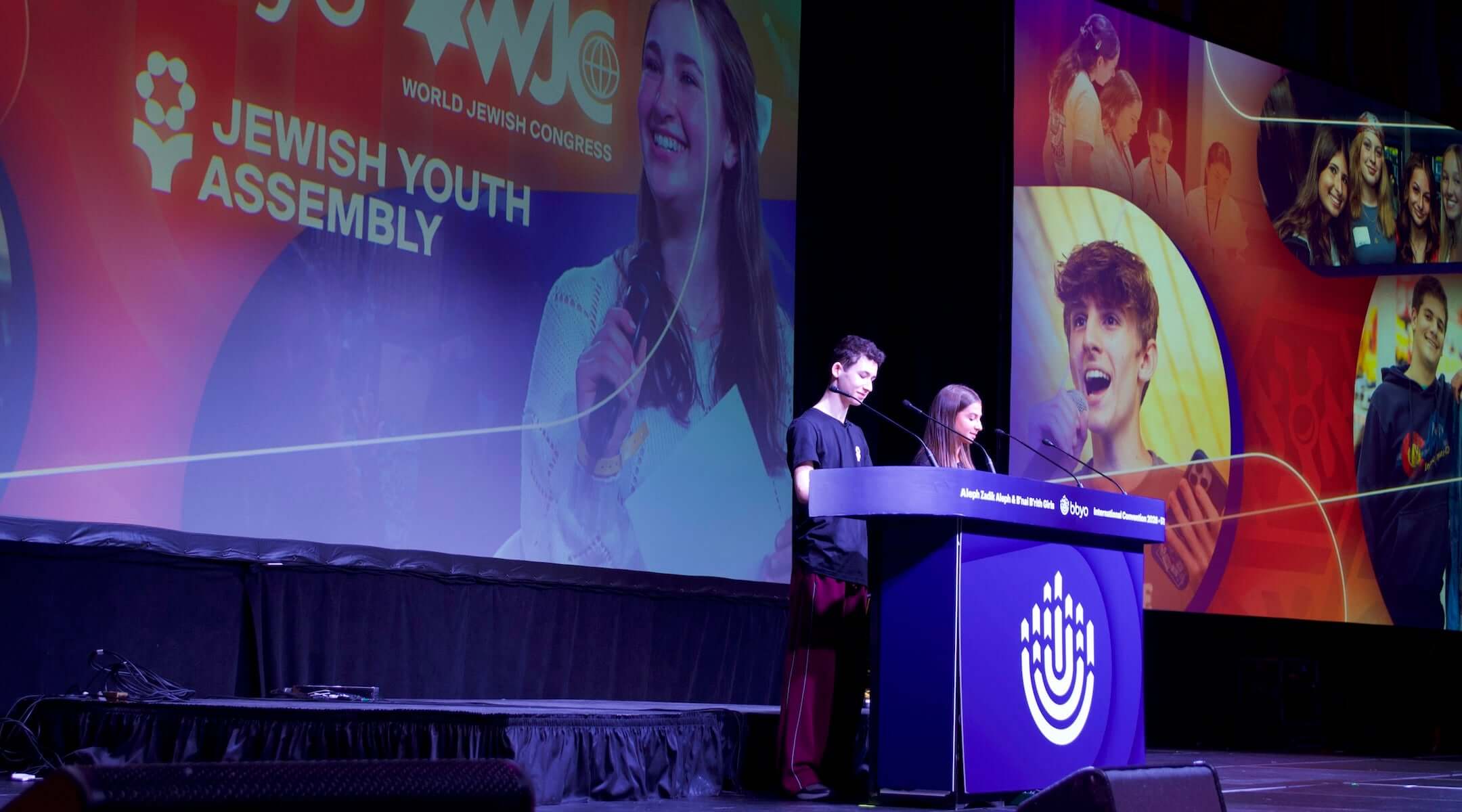
Leo Coen and Raquel Rogoff present the Jewish Youth Assembly resolution at the BBYO International Convention on Feb. 14, 2026. Courtesy of Jewish Telegraphic Agency
(JTA) — Standing before thousands of teens packed into the BBYO International Convention Saturday night in Philadelphia, Leo Coen and Raquel Rogoff unveiled the culmination of days of collaboration with their peers: a resolution meant to shape not just the next year of Jewish advocacy, but who gets to define it.
“People often say that we are the future of the Jewish people, but BBYO has never waited its turn,” said Coen as his voice echoed through the cavernous event hall. “This resolution claims our seat at the table, and through our ideas, our work and our commitment to leading with purpose.”
Tucked away in conference rooms around downtown Philadelphia throughout the week, Coen and Rogoff deliberated with over three dozen teens from more than 15 countries to draft the 2026 Jewish Youth Assembly (JYA) Resolution, an initiative of the World Jewish Congress.
“Our voices will be heard, our ideas will inform policy and our generation will help guide the Jewish future,” said Rogoff, 16, of Cape Town, South Africa. “We stand together, confident, committed and ready. We are not the future of the Jewish people, we are its present, and together, we are forever resilient.”
Amid chanting crowds, buzzing hallways and closed-door deliberations that stretched on for days, BBYO’s Jewish teens were asserting more than enthusiasm. They were pressing for influence, calling on Jewish leaders to take seriously the forces shaping their daily lives — the normalization of online antisemitism, political polarization and a quiet but persistent mental health strain — and to let their realities guide communal priorities. More than slogans, they were asking for a role in shaping the decisions that define Jewish life.
The resolution, which will be sent off to the WJC’s network of global Jewish leaders, featured a litany of recommendations, ranging from improving interfaith dialogue to calling for increased moderation on social media.
“Our communities are navigating rising antisemitism, social division, mental health challenges, and an online environment where misinformation spreads faster than truth,” the opening paragraph of the resolution read. “We reject a future in which Jewish identity fades through assimilation, is misunderstood by others, or is defined solely through crisis.”
The resolution also included seven recommendations on countering antisemitism and misinformation on social media and artificial intelligence platforms.
This year, the teens were presented with the topic “Strengthening Jewish Resilience in a Time of Global Uncertainty,” but many came into the exercise with their own priorities already front of mind.
Going into the week, which drew roughly 3,400 Jewish teens from 52 countries within BBYO’s network, Coen, a 16-year-old BBYO delegate from London, said that he wanted to discuss the “issue of Jews trusting the extremist right-wing.”
“I think the Jews just back figures that support their values, which isn’t necessarily wrong, but I think Jews are blindly following people, especially in Europe right now, who just say that they like Israel,” said Coen, who attends the prestigious Jewish school JFS in London.
Jesse Vaytsman, 16, from Cleveland, Ohio, said that he came into the week with JYA most concerned about “polarization” and a lack of unity within the Jewish community.
“There are instances where we see people criticize something that we care about, you know, Israel, and then we decide that, okay, they don’t care about Israel, they’re not Jewish,” said Vaytsman, who is the teen president of Ohio for Israel. “We’re struggling to see the idea that we’re not all so different.”
While the teens were given autonomy to insert their ideas into the resolution, representatives from the WJC also offered their own input into the draft.
During the teens’ deliberations on Thursday, Yfat Barak-Cheney, the WJC’s director of technology and human rights, vetoed the teen’s suggestion to recommend “community notes” on social media platforms, a new feature she said had been “a disaster.” Barak-Cheney also advised that the teens not use the word “demand” on resolution prompts that make requests of outside groups.
Michal Yeshurun, the digital advocacy and NextGen communication manager for the WJC, said the WJC representatives had tried to “steer the ship,” but that the final say on the resolution’s contents were on the teens.
BBYO, originally the B’nai B’rith Youth Organization, is an expansive, pluralistic Jewish teen movement that reaches roughly 70,000 Jewish teens across 750 communities in 65 countries. It is likely the largest Jewish youth movement not affiliated with one of the Jewish denominations.
At last week’s convention, a flagship BBYO event dubbed “the IC,” the teens’ feverish energy was palpable across a packed slate of programming and panels. Ahead of the opening ceremony, where teens later rushed the barrier for a performance by the cast of “Hamilton,” they ran through the convention center’s hall chanting and wearing costumes representing their regions.
But amid the sea of teens mingling throughout the Marriott, the resolution was not the only way young people at the conference sought to assert influence over the direction of Jewish life.
As their peers shuttled between programming and chatted in corners of the sprawling Marriott, the international co-presidents of BBYO, Mercedes Benzaquen, 18, and Logan Reich, 19, were meeting with Jewish institutions to offer a proposition: invite teens into their boardrooms.
The initiative, titled “Seat for the Future,” calls on national Jewish organizations, including the Anti-Defamation League and Jewish Federations of North America, to install teens on their boards.
Thus far, Reich and Benzaquen, who themselves have served on BBYO’s board of directors, said there had been no official commitments to their offer.
“We deserve a seat at the table, because we know that we’re bringing something unique, and we are bringing a voice of a generation that is currently not heard all the time in these spaces,” said Reich, of Asheville, North Carolina.
Reich and Benzaquen, who have spent the past year visiting over 150 BBYO chapters around the world, said that they had seen a “disconnect” between Jewish organizations and what Jewish youth are looking for from leadership. For Reich, the inclusion of Jewish youth within larger organizations had often felt “tokenized.”
“There’s usually not a youth voice or a teen voice, but it’s more people trying to imagine what they want, and so there is this disconnect, because sometimes it feels like it’s two separate things,” said Benzaquen, of Barcelona, Spain.
Perhaps the most recent example of that disconnect on display was the Blue Square Alliance’s Super Bowl ad last week, which drew widespread criticism for its portrayal of antisemitism faced by Jewish teens today.
While Reich said he did not hear much discussion about the ad during the conference, the topic of antisemitism and efforts to combat it loomed large over the convention.
“I know this is a moment sometimes that can feel dark. Understand, you are not victims. You are the ones with the power to make a change in your community,” said Pennsylvania Gov. Josh Shapiro at the convention’s opening ceremony.
During his travels over the past year, Reich said that the proliferation of antisemitism on social media had been a frequent topic of discussion.
“I remember when the Myron Gaines and Nick Fuentes stuff blew up when they went to that club, and that was shared, that’s very present in my mind,” said Reich, referring to a video of right-wing influencers singing Ye’s song “Heil Hitler” at a Miami nightclub last month.
Reich said that, while it is often difficult to bear witness to the antisemitic rhetoric online, he said his peers “also feel a responsibility as teen leaders to know what is happening.”
“Kanye West has more Instagram followers than there are Jews in the world,” said Reich. “It’s not a thing that we will change. None of us will, alone, have that reach or influence on a global scale. We also live day to day as proud Jews, and we know that if we continue to be educated and understanding of what the world’s sentiments are, then we can continue to shape and build bridges despite that.”
Rogoff said that she had come into the JYA deliberations hoping to focus on countering the spread of antisemitism on social media, a trend she said had been pervasive in her own experience on platforms.
“It’s very, very common, whether it’s adverts or a trend that’s starting to just be antisemitic or something, I think it’s very common, and it shows up a lot, which is obviously not great,” said Rogoff.
During Friday’s deliberations, the teens told Barak-Cheney that the platforms where they had encountered the most antisemitism were TikTok and Instagram, with many lamenting the prevalence of antisemitic comments on Jewish or Israel-related posts.
“I feel like something that has been happening is Nazi ideologies, like, coming back, and it’s being endorsed by public people like Kanye West and celebrities,” said JYA delegate Amy Hornstein, 17, of Buenos Aires, Argentina. “On social media it’s become a normal thing, and it shouldn’t be.”
Sophia Gleizer, a 17-year-old JYA delegate from Buenos Aires, said that she had been most concerned about addressing a mental health crisis she observed within the Jewish community, one she attributed to a growing sense of isolation.
“We definitely see a decline in trust, we just shutter ourselves more, we’re more reserved,” said Gleizer. “We don’t go to community events as much, and that can definitely take a hit, because when you’re not within your community, we tend to just close ourselves in our own minds.”
Gleizer said that she hoped Jewish leaders would take from the resolution a renewed urgency to start “engaging more active events” to renew connectivity within the Jewish community.
“Fighting antisemitism is definitely the biggest part of it all, but at the same time, it’s just like I mentioned, it’s culture, it’s us liberating ourselves and choosing the world that we want to live with,” said Gleizer.
The BBYO International Convention came amid a wider debate within the Jewish community over whether to invest in efforts to combat antisemitism or focus on strengthening Jewish life.
Earlier this month, Bret Stephens, the right-leaning Jewish New York Times columnist, argued during his 92NY’s annual “The State of World Jewry” speech that funds allocated to groups like the Anti-Defamation League should instead go towards bolstering Jewish education and communal infrastructure.
The convention’s opening ceremony on Thursday night also featured an address from Dan Senor, a columnist and host of the podcast “Call Me Back,” who echoed arguments from his own “State of World Jewry” speech last year that rising antisemitism had created the opportunity for a “Jewish renaissance.” Like Stephens, he urged more investment in Jewish education and identity-building.
“I speak a lot about why we should be focused on the fight against those who discriminate against us and harass us and even do violence against us, but that should never come at the cost of building a robust, strong Jewish identity, and you all embody that,” Senor told the crowd. “You are unapologetic, you are together in terms of a community, you are engaged in Jewish life, and you really give us hope and a real sense of vision of what a renaissance of Jewish life and Diaspora could be.”
For Matt Grossman, the CEO of BBYO, the conversation about where best to focus Jewish communal efforts had been exclusive to the adult realm.
“There’s been a lot of Jewish leaders who’ve been talking about those things, and there’s absolutely zero Jewish teens talking about those things,” said Grossman. “I don’t think they look at it as binary. I don’t think, you know, it’s antisemitism or joy, or the way to fight antisemitism is this or that, I think they look at it as how do they live full lives in the world they live in? How do they use their Jewish faith to inspire change, to build community?”
For Reich, the question was not what initiative to focus on, but who was taking part in the conversation.
“There’s so many things going on in the Jewish community, either things that are happening against us or things that we’re building for us, and if there’s one constant theme in all of that, it’s that we want a seat at the table in building these decisions and continuing to shape what Jewish life looks like,” said Reich.
This is a moment of great uncertainty. Here’s what you can do about it.
We hope you appreciated this article. Before you go, we’d like to ask you to please support the Forward’s independent Jewish news this Passover. All donations are being matched by the Forward Board - up to $100,000.
This is a moment of great uncertainty for the news media, for the Jewish people, and for our sacred democracy. It is a time of confusion and declining trust in public institutions. An era in which we need humans to report facts, conduct investigations that hold power to account, tell stories that matter and share honest discourse on all that divides us.
With no paywall or subscriptions, the Forward is entirely supported by readers like you. Every dollar you give this Passover is invested in the future of the Forward — and telling the American Jewish story fully and fairly.
The Forward doesn’t rely on funding from institutions like governments or your local Jewish federation. There are thousands of readers like you who give us $18 or $36 or $100 each month or year.
Support our mission to tell the Jewish story fully and fairly.