Israel’s High Court sides with egalitarian prayer advocates in long-running Western Wall dispute
“The court is ordering an end to the foot-dragging,” Reform Movement attorneys say a decade after a deal to expand egalitarian prayer was struck
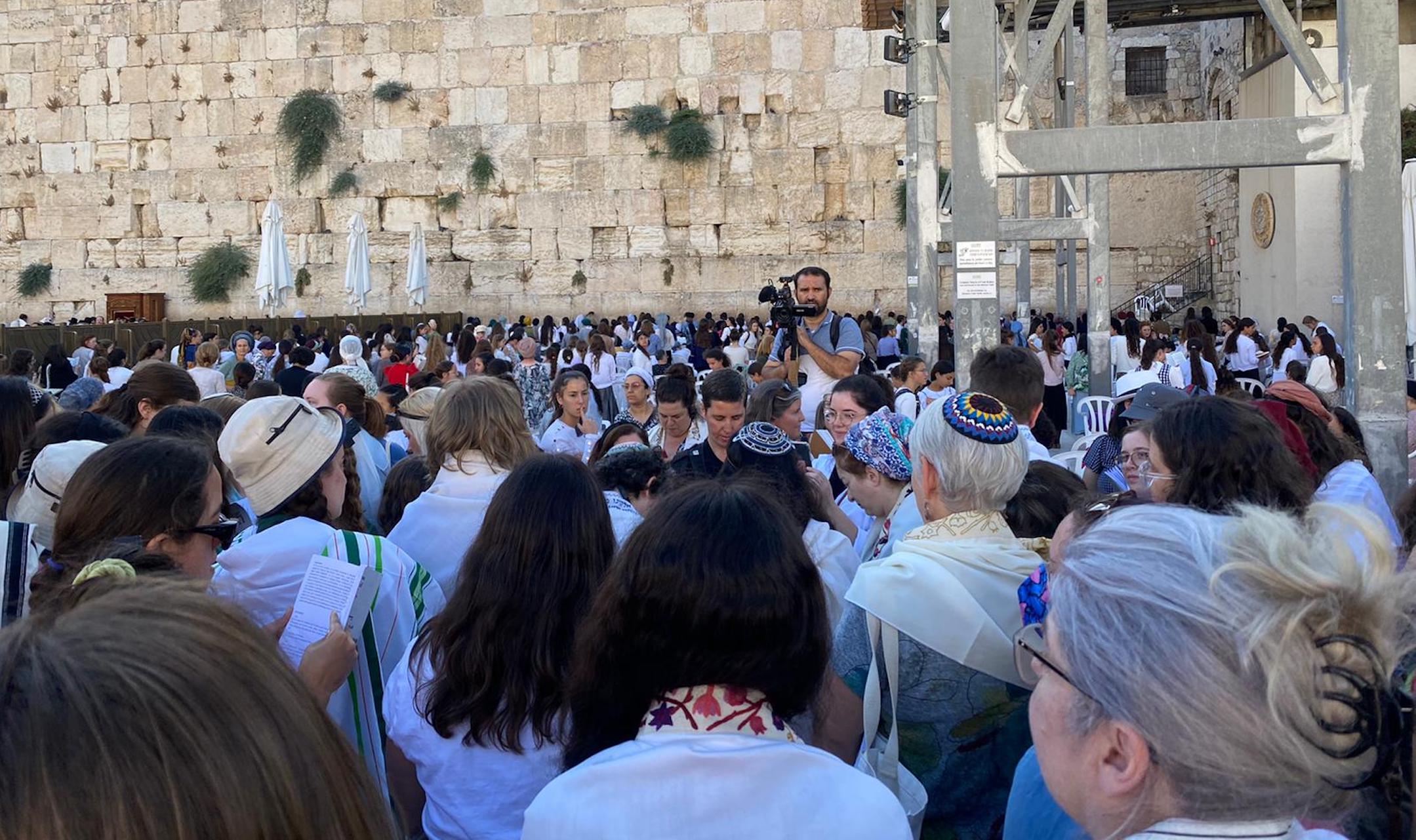
Thousands of protesters gathered around non-Orthodox women, including a bat mitzvah girl and her family, at the Western Wall, July 29, 2022. Photo by Noga Tarnopolsky

By Asaf Elia-Shalev February 19, 2026 · Updated February 20, 2026
(JTA) — Israel’s highest court has delivered a unanimous rebuke to state and municipal authorities over long-stalled plans to upgrade the Western Wall’s egalitarian prayer section, intensifying a dispute that has come to symbolize broader tensions over religious pluralism in Israel.
In a decision issued Thursday, an expanded seven-justice panel of the High Court of Justice ordered the national government and the Jerusalem Municipality to move forward with building permits needed for repairs and infrastructure improvements at the Ezrat Israel prayer platform, the area designated for mixed-gender and non-Orthodox worship south of the main Western Wall plaza.
The ruling imposes strict procedural deadlines aimed at ending what the justices described as years of exceptional delay following a 2016 deal to permit egalitarian prayer at the holy site. Acceding to pressure from haredi Orthodox politicians, Prime Minister Benjamin Netanyahu froze the deal the following year, triggering a legal petition by Judaism’s Reform and Masorti/Conservative movements, Women of the Wall and Israeli religious pluralism advocacy groups.
Today, the groups say, area remains difficult to access, lacks adequate facilities, and does not provide meaningful proximity to the Wall’s stones — conditions they view as discriminatory toward non-Orthodox worshippers.
“For nine years, the state and the municipality have been dragging their feet and refusing to promote an egalitarian, respectful, and accessible alternative in the Ezrat Israel,” Attorneys Ori Narov and Orly Erez-Likhovski, who represent the Reform Movement in Israel, one of the petitioners, said in a statement to Times of Israel. “Now, the court is ordering an end to the foot-dragging.”
The court did not revisit legal questions surrounding prayer rights at the site, emphasizing that the decision focused on the “practical implementation” of matters already litigated. Instead, the justices targeted bureaucratic obstacles that have repeatedly slowed or blocked construction, particularly disputes involving planning approvals and the Israel Antiquities Authority.
The court ruled that existing government approvals are still valid and that any remaining sign-off from the Antiquities Authority must be decided within 14 days, removing key grounds for further delays. After that, the state must file new building permit requests within 14 days. If officials don’t respond within 45 days, it will count as a rejection and the state must appeal. The state and city must also update the court within 90 days.
The decision arrives amid renewed friction at the Western Wall, Judaism’s holiest site and a focal point of Israel’s long-running struggle over religious authority. It also comes just one day after Israeli police detained two leaders of Women of the Wall during the group’s monthly Rosh Chodesh prayer service marking a new Jewish month.
The activists were briefly held after conducting a Torah reading near the site. Women of the Wall, which campaigns for expanded women’s prayer rights, has clashed for years with authorities over practices permitted under non-Orthodox traditions but restricted in the gender-segregated main plaza.
Pluralism advocates hailed the court’s intervention as a significant victory, noting both the unanimity of the decision and the ideological diversity of the judicial panel.
“An expanded panel of the Supreme Court, including conservative jurists, has unanimously ruled that the Government of Israel and the Jerusalem Municipality must put an end to their foot dragging and get to work,” said World Zionist Organization Vice Chairman Yizhar Hess, a senior representative of the Masorti/Conservative movement, in a statement.
Hess accused authorities of maintaining an “endless, creative litany of excuses” to block repairs necessary to ensure direct access to the Wall’s stones at the egalitarian platform. “This is a victory for those who believe in Jewish pluralism in Israel and that every Jew from every stream should have the equal opportunity to pray according to their custom at our holiest site,” he said.
This is a moment of great uncertainty. Here’s what you can do about it.
We hope you appreciated this article. Before you go, we’d like to ask you to please support the Forward’s independent Jewish news this Passover. All donations are being matched by the Forward Board - up to $100,000.
This is a moment of great uncertainty for the news media, for the Jewish people, and for our sacred democracy. It is a time of confusion and declining trust in public institutions. An era in which we need humans to report facts, conduct investigations that hold power to account, tell stories that matter and share honest discourse on all that divides us.
With no paywall or subscriptions, the Forward is entirely supported by readers like you. Every dollar you give this Passover is invested in the future of the Forward — and telling the American Jewish story fully and fairly.
The Forward doesn’t rely on funding from institutions like governments or your local Jewish federation. There are thousands of readers like you who give us $18 or $36 or $100 each month or year.
Support our mission to tell the Jewish story fully and fairly.