At Berlin screening, former Israeli hostages see film about their captivity rewritten after redemption
David and Ariel Cunio and their families received standing ovations at a screening adjacent to the Berlinale
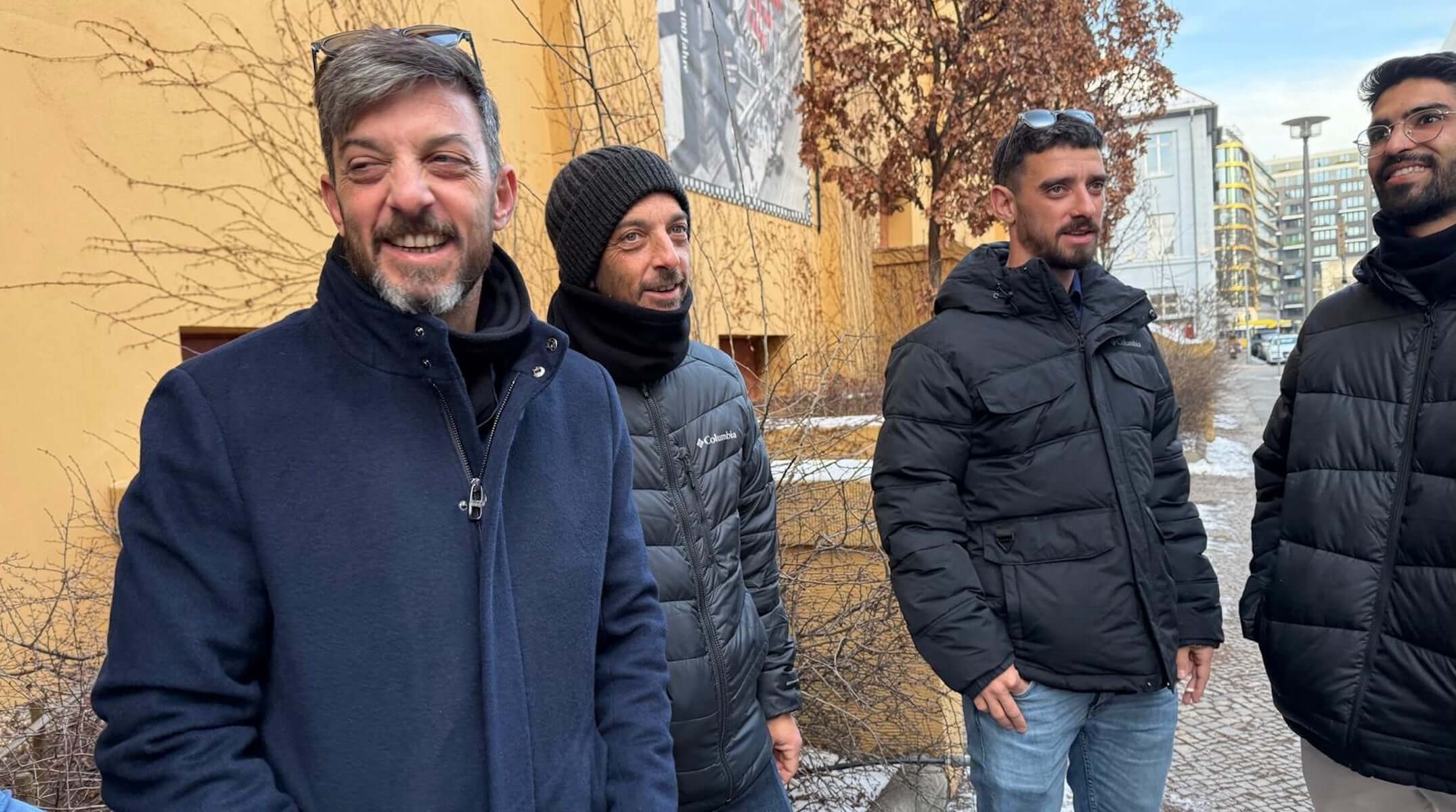
Brothers David, Eitan and Ariel Cunio, from left, stand outside the Berlin theater Babylon before a screening of a documentary about their family, Feb. 20, 2026. Photo by Toby Axelrod
(JTA) — BERLIN — They stood outside Berlin’s Babylon theater, bundled against the cold, laughing and dragging on cigarettes: the Cunio twins David and Eitan, and their younger brother Ariel.
David and Ariel were among the last Israeli hostages released in October from Hamas captivity, after 738 days. Their presence in Berlin — for a screening of a film about them, now recut with a redemptive ending — felt almost like an apparition. On the other side of two heavy glass doors were hundreds of theatergoers, people who had long waited for this moment.
The brothers and their extended family were in Berlin for a second premiere of Tom Shoval’s film “Letter to David.” The original film, shown in 2025 at the Berlin International Film Festival, or Berlinale, dove deep into the struggles of a family whose members had been abducted from Kibbutz Nir Oz on Oct. 7, 2023. By then, six kidnapped members of the family, including three children, had been freed. But David and Ariel remained in captivity.
“Last year I was standing before the screening with a poster of David and Ariel. I was determined, every time I showed the film, to say that it’s an unfinished film,” Shoval told the sold-out audience at the theater in former East Berlin.
“And now I’m standing here. I have David in the audience, and I have Ariel in the audience,” he continued. “This is a precious, precious moment.”
The film “is a testament to love, hope and all the people who did not give up during the two years I was in captivity,” David Cunio said in Hebrew, standing on the stage with his extended family. “You gave me a voice when I could not be present. You were there for me.”
The film’s second showing came as tensions over the war in Gaza and Germany’s support for Israel roiled the Berlinale. After the jury’s president, director Wim Wenders, brushed off a journalist’s exhortation for the festival to take a stand against Israel, the Indian author Arundhati Roy announced she would not attend, and some 80 filmmakers and stars signed an open letter of protest.
Festival director Tricia Tuttle issued a statement saying that “artists should not be expected to comment on all broader debates about a festival’s previous or current practices over which they have no control. Nor should they be expected to speak on every political issue raised to them unless they want to.”
Journalists and filmmakers continued to raise the issue, even on the festival’s final weekend, when some award winners — including the Syrian-Palestinian director Abdullah Al-Khatib, who won best debut film — swatted back at the festival jury, criticizing what they see as Germany’s general support for Israel. Al-Khatib’s allegation that Germany has been “partners in the genocide in Gaza by Israel” prompted a German minister to walk out of the awards ceremony on Sunday.
Friday’s screening of “Letter to David” was by contrast a love fest, and the two police cars out front and uniformed officers circulating inside appeared to have little to do. The audience gave the entire family a standing ovation before the screening.
“I think this is a piece of history,” audience member Nirit Bialer, an Israeli who has lived for years in Berlin, said in an interview. “Just seeing the family, and just following the story about this family on the media, going to the Hostages Square in Israel every time I was there in the last two years: Wow, I’m speechless.”
The film’s original ending showed twins David and Eitan Cunio as actors, grappling with each other in an embrace that is both tender and violent, in a scene from Shoval’s feature film, “Youth,” screened at the Berlinale in 2013.
That ending now segues into a new conclusion, in which the reunited Cunio family embraces. They also view the film together, and Shoval captures their faces as the projector beams from behind.
Shoval said in an interview that he had not changed anything in the first part of the film. “I wanted to leave it as a time capsule, in a way, of how we perceived it back a year ago,” he said.
Though he had been invited to be with the family at their reunion, he chose not to, explaining, “I thought it’s a moment that belongs to them and not to me.”
But he spoke with David soon after he was released. And shortly afterward, he visited Sharon and David Cunio at their home. “I came in the morning and we sat until sunset together and we talked. Even when I’m thinking about it now, I’m getting emotional, because it was really…” He paused. “You’re waiting for a moment for this for so long.”
The Friday screening was not an official part of the Berlinale, but the beleaguered festival director Tuttle made a point of taking the stage herself. The film has been “finished in the way that Tom only hoped and dreamed and believed that he would be able to finish it,” she told the audience.
“We were horrified along with the world and all of you when David Cunio and many members of his family were abducted by Hamas,” she said. And on their release “we rejoiced with everyone as well.”
Saying that the new version was completed too late to be included in the festival schedule, Tuttle thanked two co-production companies that work closely with Israeli artists for backing Friday’s screening: the Israel-based Green Productions and the Berlin-based Future Narrative Fund.
Audience members seemed loath to leave the theater after the screening, lingering over what some described as mix of happiness and worry.
“The fact that David is able to see the movie makes us see the movie in a different way,” commented Konstantin, who had seen the original version last year. A young Jewish actor who lives in Berlin, he asked that his full name not be used, out of concerns about antisemitism. “With the ending, it’s like a full circle, completed.”
Seeing the film again with the Cunio family present “was very uplifting and very happy,” said Berliner Julia Kopp, who also saw the film last year. “But at the same time, it’s not a happy ending … I also have a bit of a heavy heart,” worrying about “how life will go on for them.”
Both brothers have indicated that reentry into everyday life has been challenging after two years of captivity for them and two years of traumatized advocacy by their loved ones. And Ariel Cunio and his partner Arbel Yehud, who was held in captivity until January, have raised nearly $1.8 million since launching a crowdfunding campaign last week aimed at allowing them the time and space to “come back to life.”
A crowdfunding campaign launched on behalf of David and Sharon Cunio their twin daughters, also former hostages, says, “The family not only has to deal with the trauma that follows being held hostage and the events that transpired on October 7th, but also needs to rebuild their entire lives from scratch.”
Shoval said the film — and the screening — offered a vision for what a more settled future might look like.
“For me, the film is about the unification of the brotherhood, and what that means to be torn apart from each other, but also to get back,” Shoval said. “They can sit in the theater and they can see themselves. They can see what they missed, what happened. They can project about the past, about the present. This is a power of cinema, I feel. It felt natural for me to do that: to bring them back.”
This is a moment of great uncertainty. Here’s what you can do about it.
We hope you appreciated this article. Before you go, we’d like to ask you to please support the Forward’s independent Jewish news this Passover. All donations are being matched by the Forward Board - up to $100,000.
This is a moment of great uncertainty for the news media, for the Jewish people, and for our sacred democracy. It is a time of confusion and declining trust in public institutions. An era in which we need humans to report facts, conduct investigations that hold power to account, tell stories that matter and share honest discourse on all that divides us.
With no paywall or subscriptions, the Forward is entirely supported by readers like you. Every dollar you give this Passover is invested in the future of the Forward — and telling the American Jewish story fully and fairly.
The Forward doesn’t rely on funding from institutions like governments or your local Jewish federation. There are thousands of readers like you who give us $18 or $36 or $100 each month or year.
Support our mission to tell the Jewish story fully and fairly.