A war-weary Jerusalem marks Purim one day after the rest of the world, a tradition born in what is now Iran
A missile attack from Iran briefly halted the festivities, but then the party went on
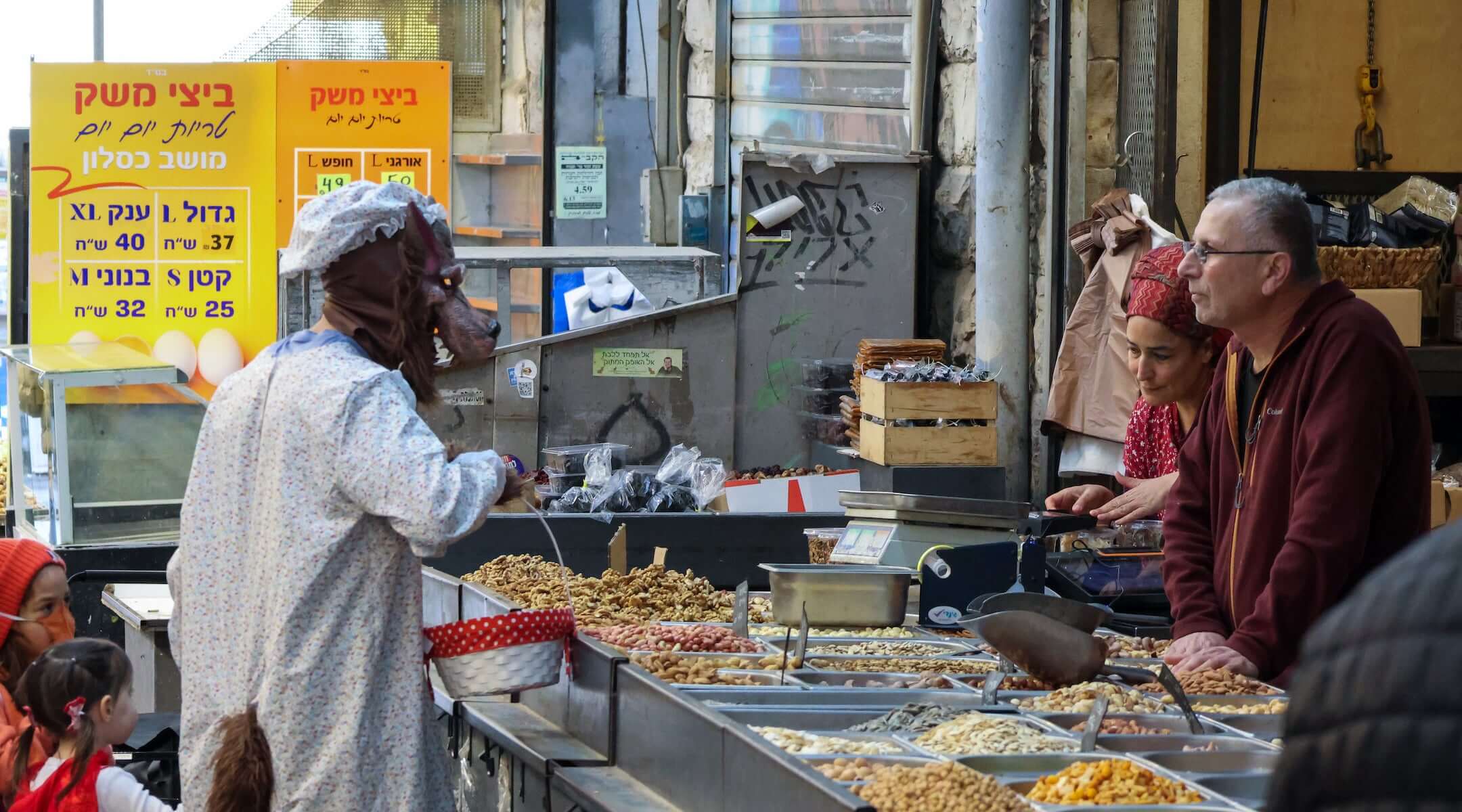
A man wearing a wolf costume with his daughter dressed as Little Red Riding Hood shops at a stall in the Machane Yeduda market in Jerusalem, which was operating at limited capacity because of the war with Iran, during Purim in Jerusalem, March 4, 2026. Photo by Theia Chatelle
(JTA) — JERUSALEM — As the sun rose over Jerusalem on Wednesday morning, sirens rang out, signaling yet another incoming missile attack from Iran.
This time, it coincided with the morning of Shushan Purim, as thousands of Israelis gathered — despite a prohibition on public gatherings — to read the Megillah and fulfill the mitzvah of hosting a reading after sunrise on the day of Purim.
Purim in Jerusalem, known as Shushan Purim, takes place a day later than in the rest of the world due to its status as a walled city during the time of the holiday’s story, when the Jews in Shushan, also a walled city located in what is now Susa, Iran, fought for their survival a day longer than Jews elsewhere in the kingdom.
Emergency regulations imposed by Home Front Command ban large gatherings, even in shelters, but Israelis have eschewed the restrictions to continue their celebrations. Top rabbis in Israel encouraged Israelis to follow government guidelines but opined that Zoom readings do not fulfill the requirement under Jewish law to hear the Megillah read in a prayer quorum. On Tuesday, Israelis across the country celebrated Purim in bomb shelters and underground parking garages, many of which are rated to withstand bombs dropped from above.
Just a few hours after the air raid alert ended on Wednesday, Jerusalemites could be seen wandering the streets, some intoxicated and others wearing costumes — or both — to celebrate the public holiday.
Two yeshiva students from New Jersey said, while waiting to catch a light rail train into the city, that they “were not worried at all about the missiles. We check our phones and go to the shelter.”
In the haredi neighborhood of Mea Shearim, life continued largely as normal. Children wandered the streets wearing costumes, and families walked into synagogues for Shacharit services, with prayers echoing through the streets.
In more secular neighborhoods, friends gathered to drink and celebrate the holiday, with some describing a “waiting game” to get their drinking in before another missile is launched and they have to head back to the shelter.
An ultra-Orthodox man celebrates in the streets of Mea Shearim, holding wine in one hand and showing a thumbs up with the other. The official commandment from the Torah is to drink until one cannot tell the difference between “cursed is Haman” and “blessed is Mordecai.”
Amber, Maya and Vicky kept their family shop open on Jaffa Street despite the threat of missiles. You Need Coffee has been open at its current location since 2011, and Maya described how “during the last war our business took a really big hit, and it’s something we expected this time, but the community keeps showing up.”
Vicky added, “They need their coffee, and we know our customers, so there’s a sense of we’re all in this together. Plus, we have a shelter in the basement, so it’s safer here than anywhere else.”
This is the second full-scale war with Iran in the last nine months, but all of the workers in the shop said they were willing yet again to deal with the consequences for the “freedom of the Iranian people.”
A family wearing matching costumes waits to catch the light rail into the Jerusalem city center. Public transportation in Israel is operating at limited capacity due to the war. The light rail had been closed since the war’s start but reopened on Wednesday.
A child who lives in Beit Yisrael, a haredi neighborhood in central Jerusalem, poses for a photo to show off his IDF soldier costume.
Children walk down the streets of Mea Shearim with their parents as they shop for goodies to celebrate the holiday. Pashkevils, or public announcements, cover the walls and communicate rabbinical rulings and other public information.
A Beit Yisrael family poses for a photo showing off their Purim costumes.
A man wearing a bunny costume walks in the streets of Mea Shearim, where not everyone was in costume for the holiday. Still, Yiddish techno music could be heard echoing off the brick walls of the neighborhood from the parties taking place there.
On Etz Hayim Street, just outside the Jerusalem shuk, a young Israeli poses to show off his costume — one half Israeli soldier, the other half sporting a suit.
One of the commandments for the Purim holiday is to give tzedakah, or charity to the poor — matanot la’evyonim — which requires giving to at least two people in need on the holiday. A young boy waits on the street, asking passersby for donations.
This is a moment of great uncertainty. Here’s what you can do about it.
We hope you appreciated this article. Before you go, we’d like to ask you to please support the Forward’s independent Jewish news this Passover. All donations are being matched by the Forward Board - up to $100,000.
This is a moment of great uncertainty for the news media, for the Jewish people, and for our sacred democracy. It is a time of confusion and declining trust in public institutions. An era in which we need humans to report facts, conduct investigations that hold power to account, tell stories that matter and share honest discourse on all that divides us.
With no paywall or subscriptions, the Forward is entirely supported by readers like you. Every dollar you give this Passover is invested in the future of the Forward — and telling the American Jewish story fully and fairly.
The Forward doesn’t rely on funding from institutions like governments or your local Jewish federation. There are thousands of readers like you who give us $18 or $36 or $100 each month or year.
Support our mission to tell the Jewish story fully and fairly.