How Germany’s unusual approach to fighting antisemitism is ensnaring Jews who are critical of Israel
Jewish critics of the Israeli government say they will be punished by a proposed ban on pro-Palestinian slogans
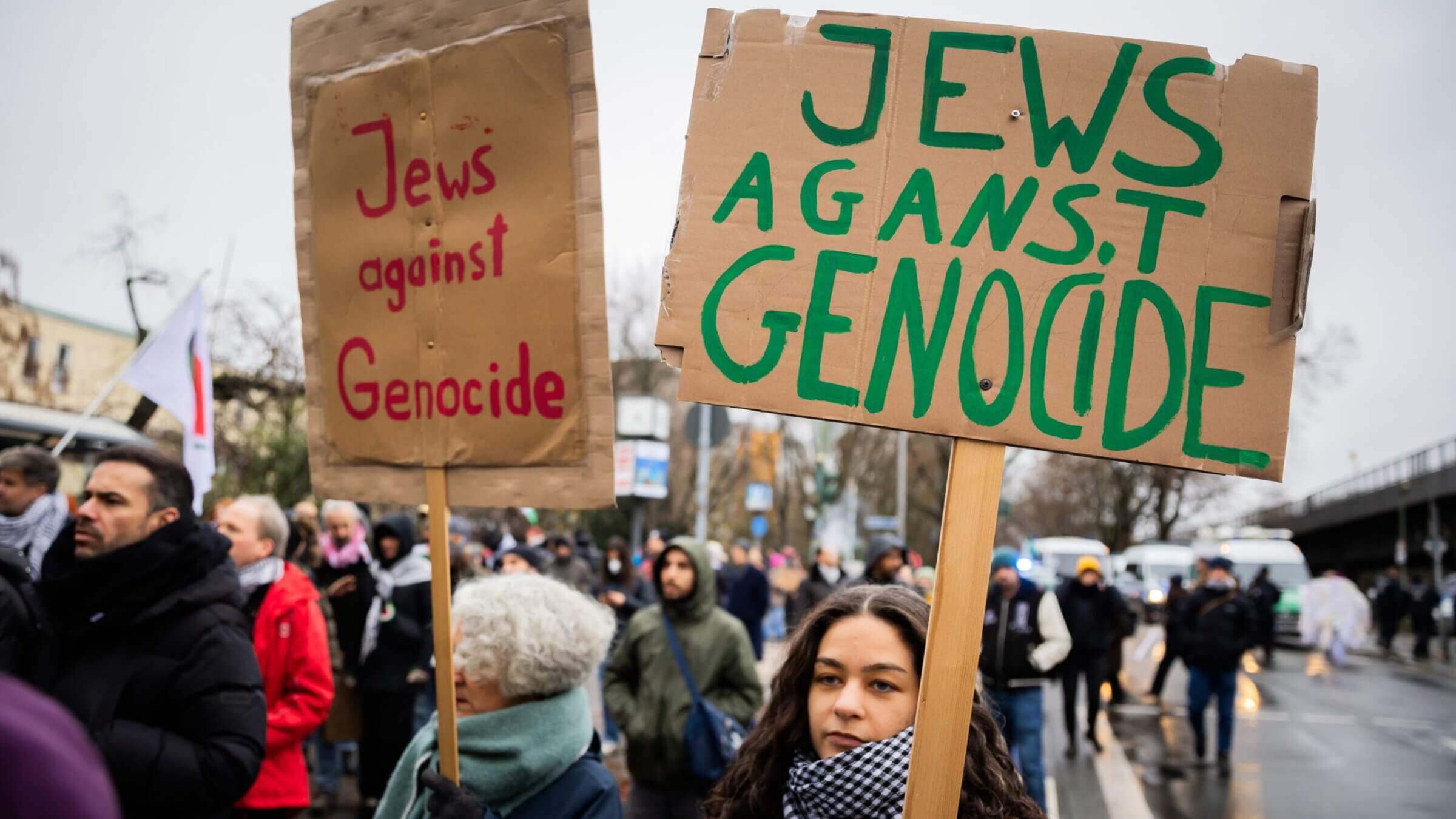
‘Jews against genocide’ is written on posters at a demonstration of several hundred people in Berlin, Dec. 23, 2023. Photo by Christoph Soeder/Picture Alliance via Getty Images
(JTA) — The first time Iris Hefets was detained by German police, she was standing alone on a street corner in Berlin with a sign that read, “As a Jew and Israeli, stop the genocide in Gaza.”
That was October 2023. Hefets, a 60-year-old psychoanalyst who moved from Israel in 2002, was standing by herself because Berlin authorities had barred activist groups from holding pro-Palestinian demonstrations after the Oct. 7 Hamas attack on Israel. By carrying a sign alone, she believed she was circumventing the ban on assembly.
But the police said her sign itself was an offense. Since then, Hefets has been detained four more times while protesting Israel’s actions in Gaza, all for the language on her signs. The offenses were logged in police reports as hate speech and included on the surging list of antisemitic incidents in Germany since 2023.
For Hefets, the penalties carry an obvious irony.
“It made me feel like a Jew,” she said. “This is the first time in my life that I really felt what it meant to be a Jew, and in the minority being persecuted.”
Germany has cracked down on speech and demonstrations that assert support for Palestinians and accuse Israel of atrocities, even since Israel and Hamas agreed to a ceasefire in October 2025. Hefets’ detainments were part of a national policy toward antisemitism, defined over decades in the shadow of the Holocaust and sharpened recently under the helm of Felix Klein, the first federal commissioner for combating antisemitism.
Klein announced last month that he will leave his post, which he has held for eight years, this summer to join the Organisation for Economic Co-operation and Development in Paris. He leaves behind a proposal to criminalize chants that could be interpreted as calling for Israel’s destruction, such as “From the river to the sea, Palestine will be free.”
The proposed legislation is currently being reviewed by the Ministry of Justice, and its future may rest in the hands of the next antisemitism commissioner, who has yet to be announced.
Whoever is chosen for the role will face down a fraught debate over Germany’s historic allegiance to Israel and the legal boundaries of pro-Palestinian speech. Many Jews say they feel safer under such bans, including the Central Council of Jews in Germany, which recommended Klein for his appointment as antisemitism czar. Some human rights groups and pundits have objected, however, saying the bans limit free speech and criminalize legitimate expressions of support for the Palestinian cause.
The next commissioner will also have to grapple with Jewish intellectuals, artists and activists like Hefets, who say that Germany’s antisemitism enforcers are suppressing Jewish voices that don’t fall in line.
The first swell of dissent from Jews came soon after Oct. 7. In an open letter published in the German newspaper “Die Tageszeitung” on Oct. 22, 2023, 121 Jewish writers and artists living in Germany condemned Hefets’ arrest and bans on pro-Palestinian demonstrations.
“Virtually all of the cancellations, including those banning gatherings organized by Jewish groups, have been justified by the police in part due to the ‘imminent risk’ of ‘seditious, anti-Semitic exclamations,’” said the letter. “These claims, we believe, serve to suppress legitimate nonviolent political expression that may include criticisms of Israel.”
Emily Dische-Becker, the Germany director of the international group Diaspora Alliance and a Jewish German-American from Berlin, said Klein’s proposal to outlaw slogans like “From the river to the sea” could cement a sacrifice of free speech, ultimately harming Jews and other minorities.
“I do not think that treating antisemitism as a state of exception to our democratic laws and constitutional rights is going to help combat antisemitism,” she said.
For Klein, there is no contradiction in a German officer arresting a Jewish person for antisemitism. “It doesn’t really matter who is the person who spreads antisemitism,” he said in an interview. “Although it sounds odd at first sight, antisemitism can also be spread by Jews.”
Klein also dismissed efforts to distinguish between anti-Zionism and antisemitism.
“In Germany, we hardly ever talk about anti-Zionism. The political notion hardly exists,” he said. “We talk about Israel-related antisemitism. When someone says, ‘I’m only anti-Zionist, I’m not antisemitic,’ I think in most of the cases, anti-Zionism is also a form of antisemitism. They say Israel, but they mean Jews.”
Germany’s grip on speech about Israel is rooted in a decades-old effort to expunge the taint of its Nazi past. During the 1980s and 1990s, the country formalized a process of “Vergangenheitsbewältigung,” or reckoning with the Nazi era through memorials, education and narratives about German identity. Key to this identity — and to Germany’s rehabilitation — was a special responsibility toward Israel.
Former Chancellor Angela Merkel summed up this bond in 2008. Speaking to the Knesset on the 60th anniversary of the founding of Israel, she said Israel’s security was part of Germany’s “Staatsräson,” or the reason for the existence of the state.
Now deeply ingrained in German politics, that concept has become a tool in the prosecution of pro-Palestinian protesters accused of antisemitism. Last year, immigration authorities ordered the deportation of three European nationals and one U.S. citizen over their alleged activity at pro-Palestinian protests. Three of the orders cited “Staatsräson,” although the protesters’ lawyer said the word had no legal standing.
Disputes over Israel recently erupted at the Buchenwald concentration camp memorial, as both Israel’s critics and its defenders claim the Holocaust for their terrain. The anti-Zionist group Kufiyas in Buchenwald announced a demonstration at Buchenwald on April 11, the anniversary of its liberation, in protest against a German court’s decision that the site could refuse entry to visitors who wear a Palestinian keffiyeh.
The court said it was “unquestionable” that wearing a keffiyeh to send a political message “would endanger the sense of security of many Jews, especially at this site.” Meanwhile, the protesters argued that their campaign encompasses the “descendants of Holocaust survivors,” including Buchenwald inmates, and said the site has become a place of “historical revisionism and genocide denial.”
The group also said the memorial had suppressed other voices that criticized Israel, including the Israeli philosopher Omri Boehm, who was slated to give a commemoration speech at Buchenwald last year. Boehm, the grandson of Holocaust survivors and a critic of the Israeli government, was disinvited after pressure from the Israeli embassy in Berlin.
The planned Buchenwald protest was condemned by the European Jewish Congress, and Klein said it marked a “new low point in the unfortunately all-too-common reversal of perpetrator and victim roles.”
Klein’s office, titled in full the “Federal Government Commissioner for Jewish Life in Germany and the Fight against Antisemitism,” was created in 2018. Germany has since produced a web of antisemitism commissioners, with 15 installed at the state level and others assigned to universities and cultural institutions. The only Jewish state czar, Stefan Hensel of Hamburg, resigned at the end of 2025. (Hensel, who cited rising antisemitic threats in his decision to step down, converted to Judaism shortly before he started the job in 2021.)
According to Klein, the chief target of this antisemitism-fighting bureaucracy is clear: the pro-Palestinian movement. “The most common and most dangerous form of antisemitism in Germany, like in other countries, is Israel-related antisemitism,” he said.
Germany’s Federal Criminal Police Office records the political origins of antisemitic crimes. In 2024, it said that antisemitism driven by left-wing extremism rose a dramatic 172%, from 40 incidents the previous year to 109. Another category titled “foreign ideology” was reported to spur 1,940 incidents, a 63% increase from 2023.
But by far, right-wing extremism drove the most antisemitic crimes, a total of 3,016. Though that figure fell slightly from 2023, the office said that right-wing extremism also constituted the majority of offenses “in every previous year.”
The publicly available statistics do not break down responsibility for different types of antisemitic incidents, from hate speech to property damage to violence, and how many were reported to have Jewish victims.
Nevertheless, Dische-Becker criticized Klein’s office for “decoupling” its focus from far-right activity. She noted that the nationalist Alternative for Germany party or AfD, which has welcomed neo-Nazis to meetings, is rapidly becoming one of the country’s most popular parties and could win in some state-level elections this year.
Klein has support from the Central Council of Jews in Germany, a representative body whose 100,000 members comprise about half of the total Jews living in Germany. The group has said that “From the river to the sea” means “the annihilation of Israel and the expulsion and destruction of the Jews living there,” adding that Germany has an “urgent duty” to clarify that definition. The Central Council did not respond to requests for comment in time for publication.
Israel is an “existential concern” for many German Jews, according to A. Dirk Moses, a scholar of genocide, memory studies and modern Germany at the City College of New York. The Central Council emphasizes that it views the well-being of Jews in Germany as “dependent on the robustness of the Israeli state,” Moses said.
Even when German Jews do not fully align with the Central Council’s platform, he added, they often weigh language about Israel against the risk of undoing Germany’s progress in confronting the Holocaust.
“It’s the fear that you will give ammunition to antisemites in Germany, who will say, ‘Ah, the Jews are committing genocide too, just like our grandparents did, so we don’t owe them anything,’” he said.
The Central Council of Jews in Germany represents a population of Jewish families who largely arrived as refugees from Soviet countries and rebuilt Jewish life in Germany after the Holocaust. Many came in poverty and depended heavily on community structures, including the Central Council, which is state-funded. Today, Jewish retirees still depend on basic social security at 10 times the rate of the average German, said Dische-Becker.
Many of these Jews also carry the memory of Soviet anti-Zionist campaigns, which employed antisemitic propaganda, shut down Jewish life and targeted Jews as ideologically suspect.
“The communities that are part of this umbrella organization are overwhelmingly older, post-Soviet migrants,” said Dische-Becker. “They have an experience of Soviet anti-Zionism that was antisemitic, and oftentimes they lean very right-wing.”
Johanna Vollhardt, a social psychologist at Clark University affiliated with the Strassler Center for Holocaust and Genocide Studies, grew up in Germany’s Reform Jewish movement. She experienced the marginalization of Reform Judaism, which was born in Germany in the early 19th century and destroyed there by World War II, only gaining formal recognition by the Central Council and state funding in the early 2000s.
She viewed the Reform movement as part of a vast, diverse ecosystem of Jewish ideas that was stamped out, and remains stifled by policies like Klein’s proposal.
“To me, it’s important to emphasize this pluralism that was destroyed in the Holocaust and not allowed to rebuild,” said Vollhardt. “This is part of the lack of support for the expression of anti-Zionist Jewish thought, or any other non-Zionist, non-mainstream Jewish thought.”
Over recent decades, younger, richer and more politically liberal Jews have moved to Germany, particularly Berlin. Among them are up to 30,000 Israelis, including some who left Israel out of frustration and anger at their government.
Many of the Jewish artists and intellectuals who came from outside Germany have been caught in the clampdown on alleged anti-Israel or antisemitic expression.
According to data compiled by Diaspora Alliance, Jews were involved in 25% of the performances, exhibits and artistic expressions canceled in 2023 for allegations of antisemitism — despite making up less than 1% of the country’s population. (Palestinian, Muslim and Arab communities were penalized the most.)
Candice Breitz, a Jewish South African artist who has lived in Berlin since 2002, had an exhibition canceled by the Saarland Museum’s Modern Gallery in November 2023. The exhibition centered on sex workers in Cape Town and was unrelated to Israel. Organizers said she had signed a letter from the Boycott, Divestment and Sanctions movement and had not condemned the Oct. 7 attack.
Breitz denied both claims. She said she was not a supporter of BDS, and wrote on Instagram before the museum’s decision, “It is possible to fully condemn Hamas (as I do, unequivocally), while nevertheless supporting the broader Palestinian struggle for freedom from oppression, discrimination and occupation.”
Deborah Feldman, the Brooklyn-born ex-Orthodox Jew and author of the bestselling book “Unorthodox” who moved to Berlin in 2014, said she saw invitations to promote her latest book canceled in 2023. The book, titled “Judenfetisch” or “Jew Fetish,” argued that Germany’s guilt over the Holocaust had distorted its relationship to Jews and Israel.
Other Jewish intellectuals who don’t live in Germany say they have been shunned from coming. The Russian-American writer M. Gessen had a prestigious award from the Heinrich Böll Foundation pulled in December 2023, following an essay in The New Yorker comparing Gaza to a Nazi-era Jewish ghetto (and criticizing Germany’s constraints on pro-Palestinian views). Gessen ultimately received the award after the original ceremony was canceled.
In 2024, Nancy Fraser, a philosophy professor at the New School in New York, was disinvited from a visiting position at the University of Cologne over her signature on a letter titled “Philosophy for Palestine.” The university said that Fraser’s job offer was rescinded because the letter called into question “Israel’s right to exist as an ‘ethno-supremacist state’ since its foundation in 1948.”
Iris Hefets is a founding member of Jüdische Stimme für gerechten Frieden in Nahost (Jewish Voice for a Just Peace in the Middle East), a pro-Palestinian organization roughly comparable to the anti-Zionist Jewish Voice for Peace in the United States. It is much smaller, with membership in the hundreds, and counts only Jews as members, unlike the U.S. group. But membership surged after Oct. 7, 2023, said Hefets.
In 2024, the Federal Office for the Protection of the Constitution declared Jüdische Stimme an extremist organization. (The same agency designated the AfD as an extremist group in 2025.)
As a result, newer Jewish immigrants have peeled off from Jüdische Stimme. They don’t want to risk being questioned about their role in an extremist organization while applying for citizenship, said Hefets.
She called it “perverse” to see “Jews being accused of antisemitism by Germans who have Nazi grandparents.” Through her detainments, she believes, German officers were signaling that their “Vergangenheitsbewältigung” was complete; they had finished reckoning with the past.
“What Germany is saying now is actually that Germany worked through its past, and now Germany can go back to business as usual,” said Hefets. “‘We were punished by the Allies, but now it’s over, we are good again, because the Jews forgave us.’ And the Jews, for them, that’s Israel.”
This is a moment of great uncertainty. Here’s what you can do about it.
We hope you appreciated this article. Before you go, we’d like to ask you to please support the Forward’s independent Jewish news this Passover.
This is a moment of great uncertainty for the news media, for the Jewish people, and for our sacred democracy. It is a time of confusion and declining trust in public institutions. An era in which we need humans to report facts, conduct investigations that hold power to account, tell stories that matter and share honest discourse on all that divides us.
With no paywall or subscriptions, the Forward is entirely supported by readers like you. Every dollar you give this Passover is invested in the future of the Forward — and telling the American Jewish story fully and fairly.
The Forward doesn’t rely on funding from institutions like governments or your local Jewish federation. There are thousands of readers like you who give us $18 or $36 or $100 each month or year.
Support our mission to tell the Jewish story fully and fairly.