Workplaces open, schools remain shut — and Israeli parents pull out their hair over wartime Zoom classes
Parents of young children are being allowed to take unpaid leave. They say they need more help.
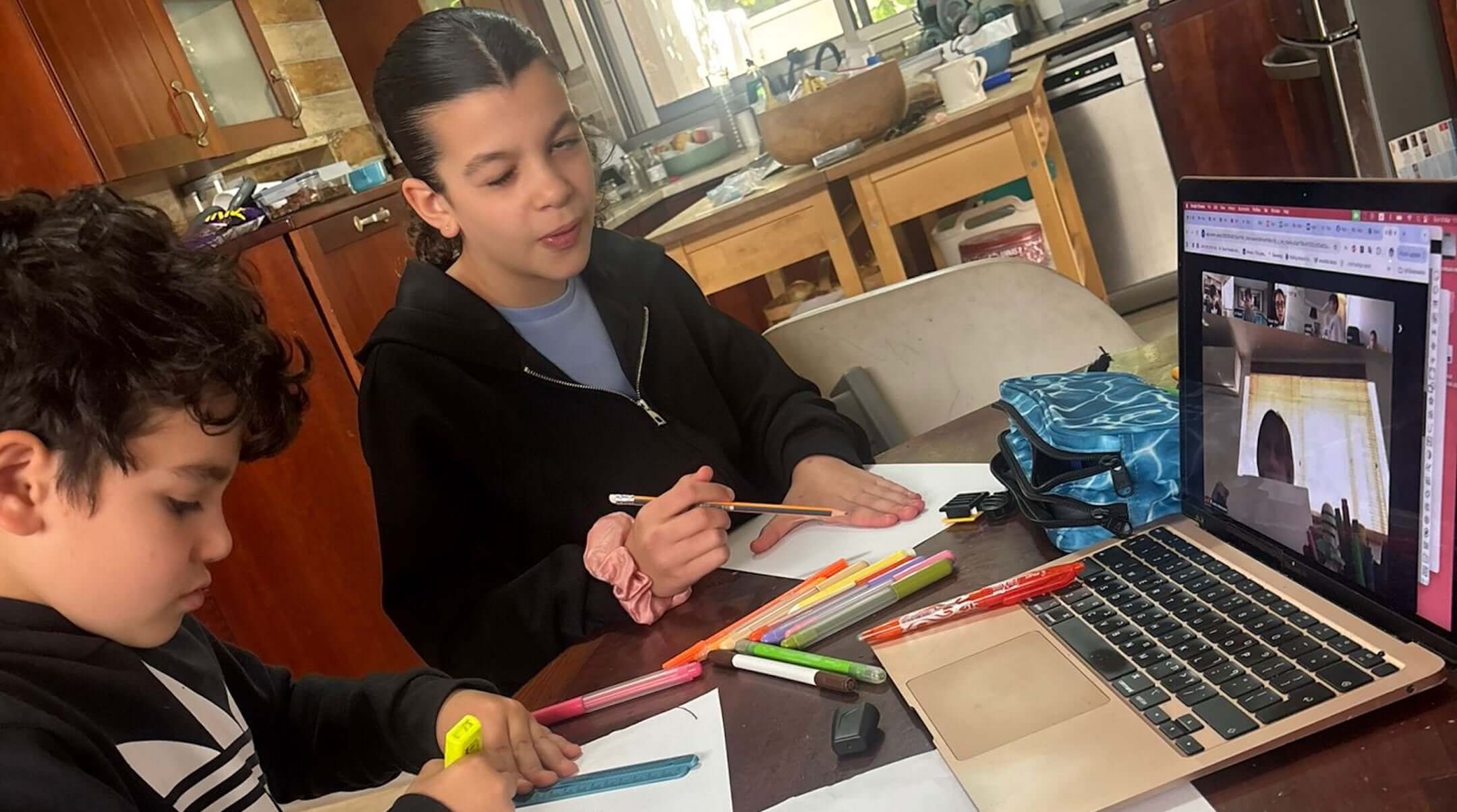
Claire Bloom Moradian’s children participate in a Zoom class while their school is closed during the war with Iran, March 2026. (Courtesy Moradian)
(JTA) — TEL AVIV — When news broke that Israel might gradually reopen schools in areas considered safe enough, Yael Daniel, a mother in Bat Yam in the missile-hit center of the country, joked that she was “moving north.”
The war has shut schools and pushed children onto Zoom learning while many parents, like Daniel, keep working. Trying to supervise remote lessons for her three children, ages 6 to 8, who have attention difficulties, while holding down a full-time job has turned each day into “a nightmare,” she said.
“These are kids that need to be in a serious routine, and they’re not, and it’s really hard. I’m suffering,” she said.
The strain intensified after the IDF’s Home Front Command allowed workplaces to reopen last week under updated wartime guidelines, even as the education system remained closed.
Israeli actress and mother of two Meshi Kleinstein was one of many parents who took to social media as the decision drew anger and disbelief. “What a delusional country. Who looks after the children when the parents return to work?” she said on Instagram.
In response to the outcry, Finance Minister Bezalel Smotrich announced Sunday that one parent in households with children under 14 would be allowed to take unpaid leave while the education system remains shut.
The move prompted further backlash from parents who say it effectively forces families to choose between supervising children at home and losing income.
And for some, like Zehavit, who was speaking from a bomb shelter during a siren in the central city of Jaffa, it didn’t make sense. “Just because my child is 14, does that automatically mean he’s fine to be alone and run to the shelter by himself in the event of a siren?”
Outside the shelter, another mother, Renana, said the arrangement has forced her to reorganize her workday around her son’s online classes.
“I have one child in first grade. Since the Zoom classes started I work less because he uses my computer,” she said.
“He has three consecutive hours with different teachers and I need to sit next to him so he can communicate with them, which means I’m listening to the whole lesson and not working.”
Claire Bloom Moradian spends her days shuffling her children between school Zooms, extracurricular Zooms and playdates just to approximate a routine. “It’s just chaos, I’m absolutely exhausted,” she said.
In a Facebook post, Rachel Sharansky Danziger recounted that the return to Zoom after Oct. 7 was “the straw that broke the camel’s back,” leaving her so overwhelmed that she called a mental health hotline at the time, unable to understand why “all the death, the kidnappings, the horror” had not broken her, but remote learning did.
Zoom had revived the helplessness of the Covid years, she said, with too few devices, constant technical glitches and children yelling that nothing was working — all against a backdrop of dread about what might be looming outside the apartment doors.
“I can be strong,” she had told the woman on the other end of the helpline. “I can be positive and supportive and encouraging and manage myself and the domestic and social arena around me with precision and strength and awareness of the needs of those around me. But I can’t do all of this while trying to solve dozens of technological problems every morning.”
Education Minister Yoav Kisch said on Monday morning that he is examining a gradual reopening of schools using a color-coded system, with institutions expected to resume first in areas classified as “yellow,” meaning places where security conditions and access to protected spaces would allow limited in-person learning, with parents responsible for getting children to school.
About 40% of Israeli schools cannot offer all of their students access to bomb shelters if a siren sounds, according to data released this week.
Kisch’s terminology was another reminder of the pandemic-era, in which cities were ranked by color according to infection levels, with tighter restrictions in “red” areas. On social media, some parents greeted Kisch’s proposal with weary sarcasm. “Ah, yes, the color chart. Because that went so well the first time,” one person tweeted in response.
Municipal leaders were divided over whether to implement Kisch’s plan. Haifa Mayor Yona Yahav said the city would keep schools closed for now, saying he had “no intention of endangering students, drivers, and teaching staff,” as officials weighed the risks of transporting children during ongoing alerts. Others signaled they would move ahead. Roy Levy, mayor of nearby Nesher, said schools would reopen in line with Home Front Command guidelines, calling a return to classrooms “an emotional and social need.” Jerusalem Mayor Moshe Lion also said he would partially reopen the city’s education system, citing the need for “a routine, an educational framework and meetings with friends and teachers.”
But by Monday evening, Kisch was forced to backpedal after the IDF’s Home Front Command said that wartime restrictions would stay in effect across the country, keeping schools shut for now. A limited reopening may be attempted again starting next week — or not.
In one of the darkest incidents to emerge from Israel’s forced return to Zoom schooling, a teacher in Jerusalem was attacked by her partner in front of her students during an online lesson. He struck her in the head and smashed objects in their home before being arrested, later telling investigators he had acted out of “feelings of jealousy.”
Reports of domestic violence in Israel tend to rise during periods of war and home confinement. Data compiled after Oct. 7 showed a 28% increase in calls to Israel’s welfare ministry hotline related to domestic violence, sexual abuse and child neglect during the first months of the war.
Not everyone viewed Zoom as futile. Nataly Peleg, a first-grade teacher, said the classes are less about academics than about giving children a welcome distraction — even if she does not compel her own children to join theirs.
“It’s not so much whether they learn or not,” she said. “It’s about being together for a bit and focusing on something that isn’t the sirens and the surreal situations around us.”
Some children find the classes comforting, she said, while others are simply waiting for them to end or do not join at all. Still, she said, many parents have told her they appreciate the effort. “If even a handful of kids feel a bit better, it’s worth it,” she said.
Daniel, for her part, is trying to keep things in perspective. Despite feeling “super overwhelmed,” she said she is thankful her family is safe.
“Things could always be worse,” she said. “I’m just grateful we are all OK.”
In her post, Danziger said she was passing on the advice the hotline counselor had given her more than two and a half years ago.
“Don’t. Don’t let distance learning control you,” she said, adding that “nothing terrible would happen if your kids don’t join some of the Zooms — or, to be honest, all of them.”
While “we parents may not be bombing Tehran or deciphering nuclear secrets right now,” she wrote, “the responsibility for our children’s education and the functioning of our homes is still in our hands.”