ADL’s campus antisemitism report card rewards some – but not all – colleges that worked with Trump
Columbia, Brown and UCLA were among the schools whose grades improved
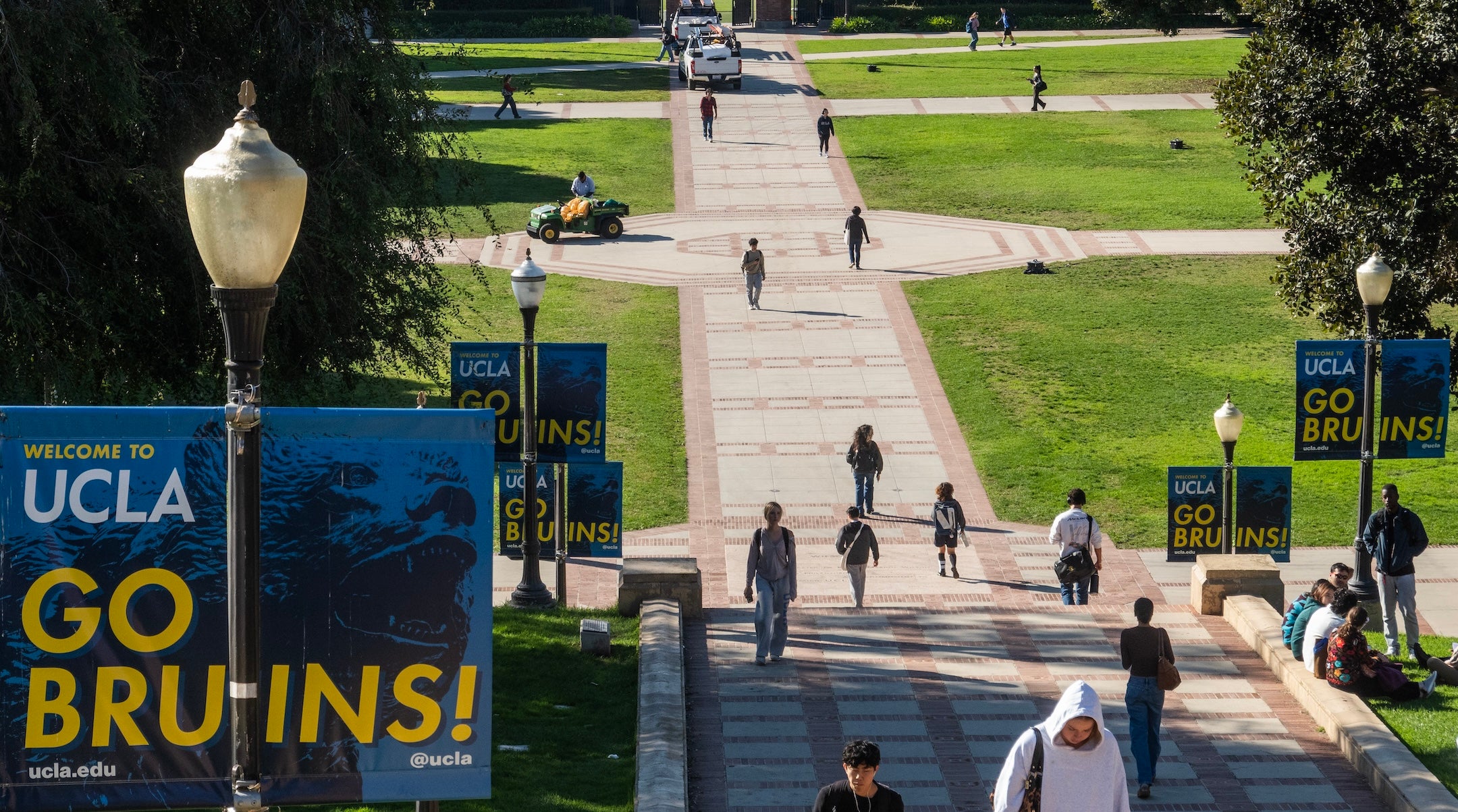
The UCLA campus seen Nov. 19, 2025. Photo by Myung J. Chun/Los Angeles Times via Getty Images
(JTA) — Universities that reached settlements with the Trump administration last year to preserve federal funding mostly received higher marks on the Anti-Defamation League’s campus antisemitism “report cards,” released this week.
Columbia, Brown, the University of Pennsylvania and the University of Virginia, all of which struck deals in order to end federal civil rights investigations and some in exchange for large payouts, all saw their ADL grades boosted.
This was the ADL’s third year of grading how universities have handled antisemitism, and the first to reflect the Trump administration’s campus antisemitism policies — which have been hailed by some Jewish groups as necessary and criticized by others as using antisemitism as a pretext to crack down on academic freedom.
“I think some of those policies may have affected what’s happening on campus, and therefore that impacts the grades.” Shira Goodman, head of the ADL’s Center to Combat Antisemitism in Education, told the Jewish Telegraphic Agency.
Goodman said that neither a university’s dealings with the government, nor litigation from private organizations including the ADL, affected a school’s grade. Instead, she said, such actions along with “Jewish communal pressure” were more likely to prompt a school to take antisemitism concerns more seriously, and some of the terms agreed to in the settlements “are the things we’ve been measuring, that we’ve been calling for since 2023.”
Cornell University earned its second C in a row despite agreeing to a $60 million payout to the administration. Penn, whose grade rose from C to B, struck a settlement involving transgender athletes rather than antisemitism and continues to fend off Trump legal action on antisemitism: This week it argued in court against a federal demand to turn over a list of Jewish faculty and staff as part of an ongoing investigation.
Overall, Goodman said, schools have improved significantly in their handling of antisemitism in the three years the ADL has been tracking them.
The report card project has been criticized by several Jewish campus groups as over-simplified and unnuanced, but schools are taking it seriously. The ADL said that 89% of universities it graded this year “engaged with ADL during the assessment process,” including by providing documentation about their handling of antisemitism. And some schools are trumpeting improved grades.
“Our efforts and actions to fight antisemitism are being seen,” Julio Frenk, the Jewish chancellor of the University of California-Los Angeles, said in a statement celebrating UCLA’s upgrade from a D to a B.
Goodman noted that Jewish campus groups, including Hillel and Chabad chapters, continue to have mixed reactions to the report cards.
“Some of them think the report card makes their lives more difficult, makes their relationship with campuses more difficult,” she said. “And for some I think it helps them. We can be a little bit of the ‘bad cop.’”
Other notable ADL grades:
- The ADL handed out 23 “A” grades and four “F” grades.
- Additions to the “A” list include New York University, USC, Tulane, Johns Hopkins and American University.
- UCLA rose from D to B even as the Trump administration has gone after the school on several fronts.
- Harvard University, which is also engaged in protracted federal antisemitism litigation, saw its own C grade unchanged.
- Florida International University, where a recently revealed group chat of Republican leaders at the school last fall was rife with antisemitic language, maintained an A grade. Goodman said the chats were revealed too late to be reflected in the ADL’s grades.
- Few schools with major Jewish populations saw their grades decline. One exception: the University of Illinois Urbana-Champaign fell from a C to a D. Goodman said this was because the school had not fulfilled its promises under a 2024 agreement with Jewish groups.
This is a moment of great uncertainty. Here’s what you can do about it.
We hope you appreciated this article. Before you go, we’d like to ask you to please support the Forward’s independent Jewish news this Passover. All donations are being matched by the Forward Board - up to $100,000.
This is a moment of great uncertainty for the news media, for the Jewish people, and for our sacred democracy. It is a time of confusion and declining trust in public institutions. An era in which we need humans to report facts, conduct investigations that hold power to account, tell stories that matter and share honest discourse on all that divides us.
With no paywall or subscriptions, the Forward is entirely supported by readers like you. Every dollar you give this Passover is invested in the future of the Forward — and telling the American Jewish story fully and fairly.
The Forward doesn’t rely on funding from institutions like governments or your local Jewish federation. There are thousands of readers like you who give us $18 or $36 or $100 each month or year.
Support our mission to tell the Jewish story fully and fairly.