Berlin rabbi makes history as first European to head Conservative rabbis’ association
Rabbi Gesa Ederberg is also likely the first convert to Judaism to hold the role
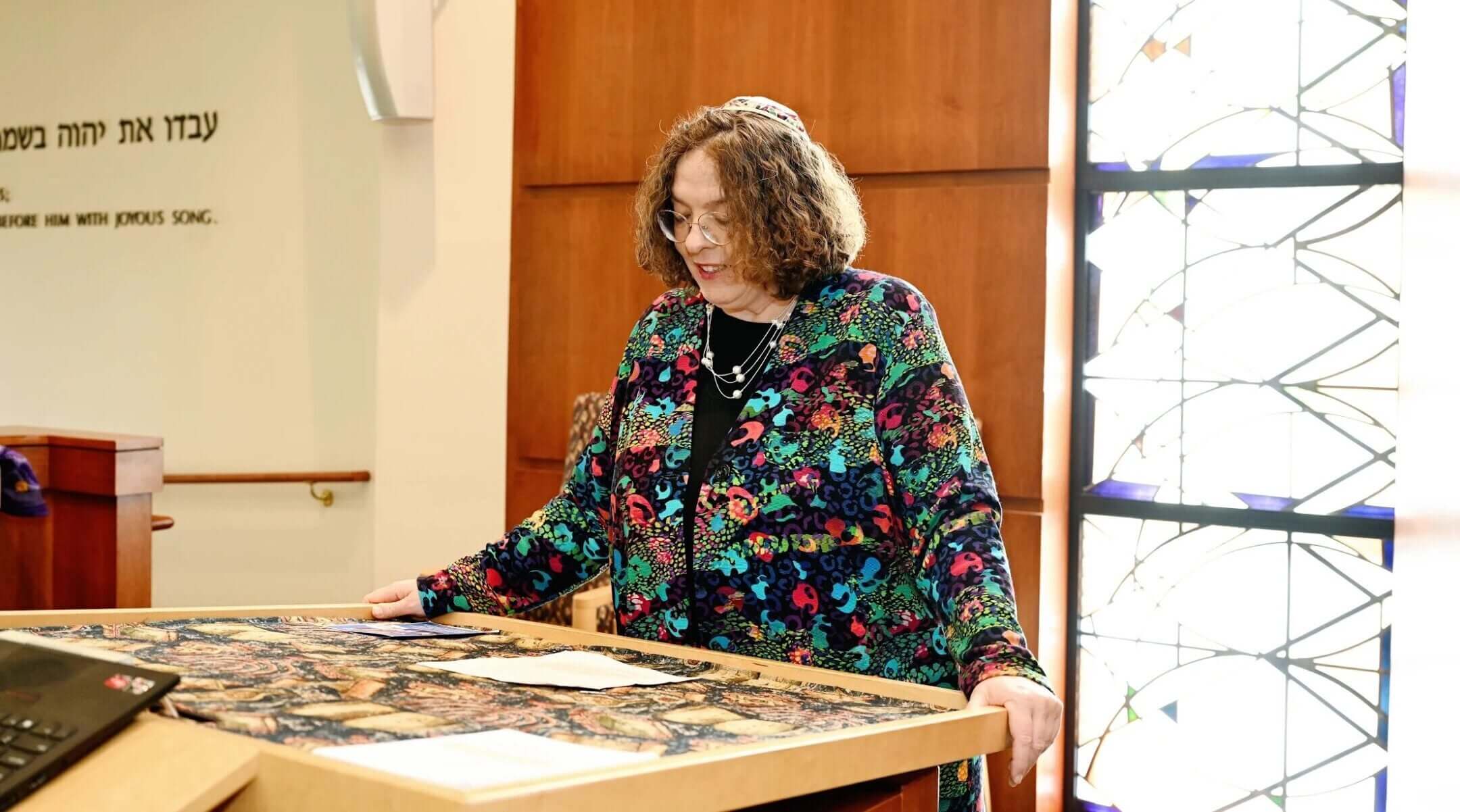
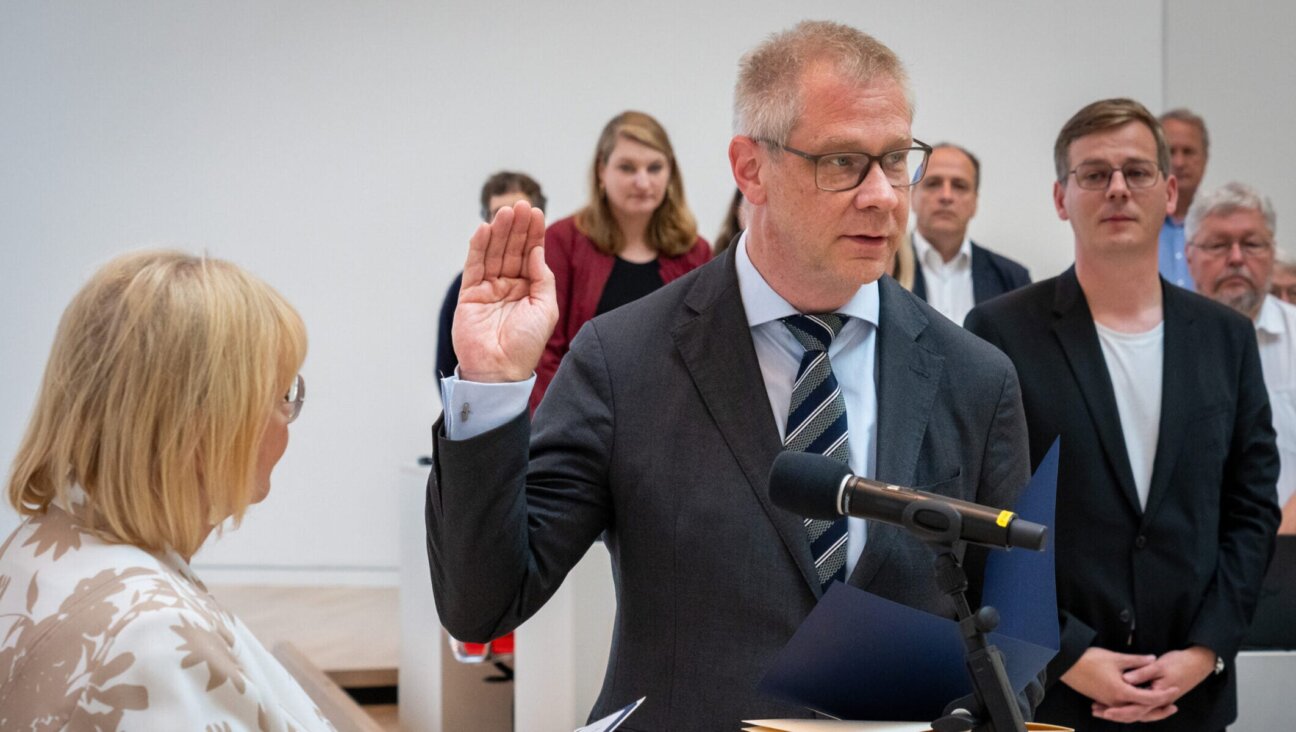
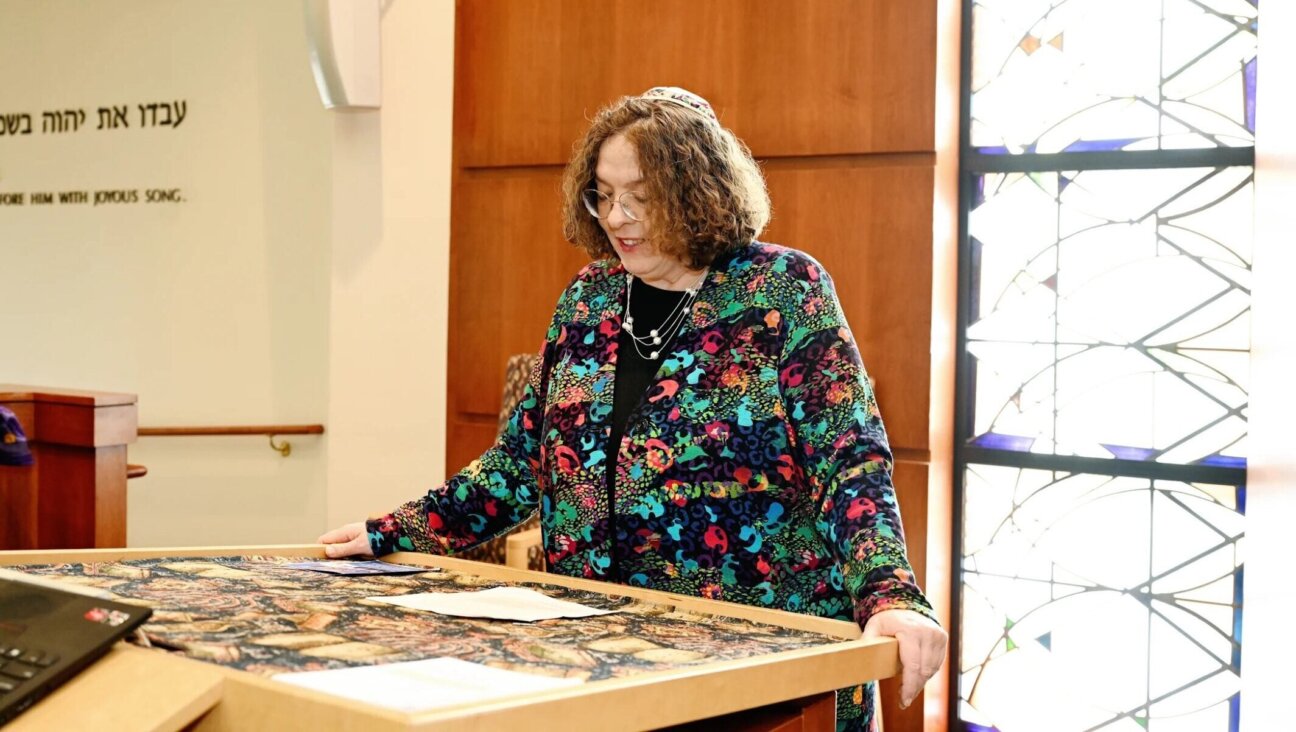
Rabbi Gesa Ederberg is installed as the president of the Rabbinical Assembly at Congregation Beth Sholom in Teaneck, New Jersey, March 11, 2026. Courtesy of Rabbinical Assembly
(JTA) — BERLIN — Gesa Shira Ederberg was not yet a rabbi when she was tapped to lead a seder, to teach Hebrew, and to organize an egalitarian minyan in her home city of Berlin. She happened to be in the right places when help was needed, recalls Ederberg, who was pursuing a degree in Jewish studies at the time. She wondered: Could she be doing more?
Three decades later, Ederberg is a veteran rabbi of Berlin’s first official egalitarian congregation on Oranienburger Strasse — and this month she reached a new milestone.
She was installed last week as the international head of the Conservative/Masorti movement’s Rabbinical Assembly, the organization representing more than 1,600 rabbis worldwide. For the first time, the group is being led by a European rabbi.
Her installation marks another milestone as well. “As far as the Rabbinical Assembly is aware — Rabbi Ederberg is the first Jew by choice to serve as president,” said a spokesperson for the organization.
For observers of Jewish life in Germany, the moment carries symbolic weight.
“This is quite an extraordinary deal, actually, because there’s never been a non-American or non-Israeli to head the Rabbinical Assembly,” said Deidre Berger, an American who has lived in Germany for more than 40 years and serves on the boards of both the German and worldwide Masorti organizations.
“It’s also a major step forward in relations between a broader group in the American Jewish community with Germany — with being willing to acknowledge that postwar Jewish life did get relaunched in Germany and is here to stay,” added Berger, the former head of the American Jewish Committee office in Berlin.
Rabbi Jacob Blumenthal, CEO of both the Rabbinical Assembly and the United Synagogue of Conservative Judaism, said Ederberg’s election also reflects the movement’s embrace of Jews by choice.
“Welcoming converts is one of the ways in which our communities are growing and thriving,” he said. “So to have a colleague who made this choice to lead a Jewish life and then to become a rabbi is certainly something to celebrate.”
Ederberg’s installation took place in two parts: last week at Congregation Beth Sholom in Teaneck, New Jersey, followed by a second ceremony on Tuesday in Berlin, where her synagogue received a Rabbinical Assembly Torah mantle that remains with each president during their term.
“I will see it every time we open the ark,” she said. “It will be a reminder of my new responsibilities.”
Born in 1968 in the German city of Tuebingen, Ederberg grew up in a Lutheran family. Her father was in charge of his church’ youth exchanges with Israel, and Israeli teenagers often visited the family home. She traveled to Israel for the first time at age 13, an experience that helped cement what she said was “a deep connection” with the country and its people.
Ederberg later earned a master’s degree in Protestant theology. But her involvement in Jewish-Christian dialogue deepened her interest in Judaism, leading her to pursue Jewish studies in Berlin and eventually convert in 1995 at the Jewish Theological Seminary there.
Her decision grew partly out of her fascination with Jewish texts. “I was loving the texts,” she recalled early in her rabbinic career.
But it was also theological. She had come to believe that “the anti-Jewish tradition was an intrinsic part of Christianity,” she said at the time, and rejected interpretations portraying Judaism as obsolete.
Conversion, she added, was “a long and difficult process. You only get there if you really want it.”
Ederberg was ordained in 2002 at the Schechter Institute of Jewish Studies in Jerusalem. Her husband, Nils Ederberg — whom she met when both were Protestant students of Jewish studies — is also a rabbi. Ordained at Berlin’s Abraham Geiger College in 2014, he now serves as a military chaplain in Hamburg. The couple has three children.
After serving her first pulpit in Weiden, Ederberg returned to Berlin in 2007. There she became the first woman to serve as a rabbi in the city since Regina Jonas, a Liberal rabbi ordained in 1935 who was murdered by the Nazis, and only the second woman to hold a synagogue pulpit since the Holocaust.
She has helped build institutions for Germany’s small Masorti movement, founding Berlin’s Masorti elementary school in 2018 and serving as a founding member of Germany’s General Rabbinical Conference for non-Orthodox rabbis. She also served as a rabbinic adviser to the Zacharias Frankel College Conservative seminary at the University of Potsdam.
At the same time, she rose through the leadership ranks of the Rabbinical Assembly, serving in several voluntary roles before being elected vice president two years ago. She was elected president in December, succeeding Rabbi Jay Kornsgold of New Jersey, becoming the third woman to hold the role.
Ederberg’s installation comes at a challenging time for what was once America’s largest Jewish denomination, but has for years faced declining membership. As a centrist movement committed to what has been called “tradition and change,” it sits between a growing Orthodoxy on one side and a liberal Reform movement that has historically been far swifter to innovate.
Her installation also comes as broader changes in attitudes toward Jewish life in Germany have shifted. For decades after World War II, many American Jewish institutions viewed Germany as an unlikely place for Jewish communal revival.
Ederberg’s mentor, Rabbi Ismar Schorsch, the former chancellor of the Jewish Theological Seminary of America who encouraged her to pursue ordination, described her as “both the agent and the symbol of the potential of Conservative Judaism to flourish once again in Germany.”
That revival has taken place alongside a transformation of Germany’s Jewish population. Before World War II, about 500,000 Jews lived in the country. After the Holocaust only a small community remained, but immigration from the former Soviet Union beginning in the late 1990s helped rebuild Jewish life. Today roughly 100,000 Jews belong to congregations in Germany, with a similar number unaffiliated.
There are currently two Masorti congregations in the country: Ederberg’s in Berlin and another in Cologne.
Her congregation meets upstairs in a chapel attached to the New Synagogue on Oranienburger Strasse in former East Berlin. The mid-19th-century building was heavily damaged during World War II; its windows overlook the empty courtyard that once held the synagogue’s Torah ark and pews. Today, congregants gather in restored spaces, including a hall above what once served as the women’s gallery.
While other synagogues now offer egalitarian services, Ederberg’s congregation once served as an incubator, giving many women their first opportunity to read Torah from the bimah.
“On the one hand, it’s an intimate setting in her synagogue,” Blumenthal said. “But also you see the depth of both knowledge and commitment of the folks who are part of her community.”
Ederberg knows that for some people, her German Christian background remains a hurdle. Jewish identity in Germany today often reflects complicated family histories shaped by the upheavals of the 20th century.
Not only are there numerous converts like herself; there also are many Jews with a mother or grandmother who survived the Holocaust and a father or grandfather who served in the Wehrmacht, she noted. The question of Jewish identity in Germany, Ederberg said, “is a broader question about individuals and their family history.”
Her own family history reflects that complexity: Both of her grandfathers served in World War II, one dying at Stalingrad and the other working as a mechanic.
Ultimately, she said, the mentorship she received from three German-born Jewish figures — Schorsch as well as Israeli educators Alice Shalvi and Zeev Falk — proved decisive.
Back when she was an accidental rabbi, called upon to lead seders and services and to teach in a pinch, Ederberg hadn’t made up her mind whether to pursue ordination. She might have chosen to become a diplomat, she says, if it had not been for those three mentors who took her by the hand.
“Their encouragement, their push towards rabbinical school, their push towards, ‘Yes, you should go back to Germany and do what you’re doing,’ was really crucial,” she said.