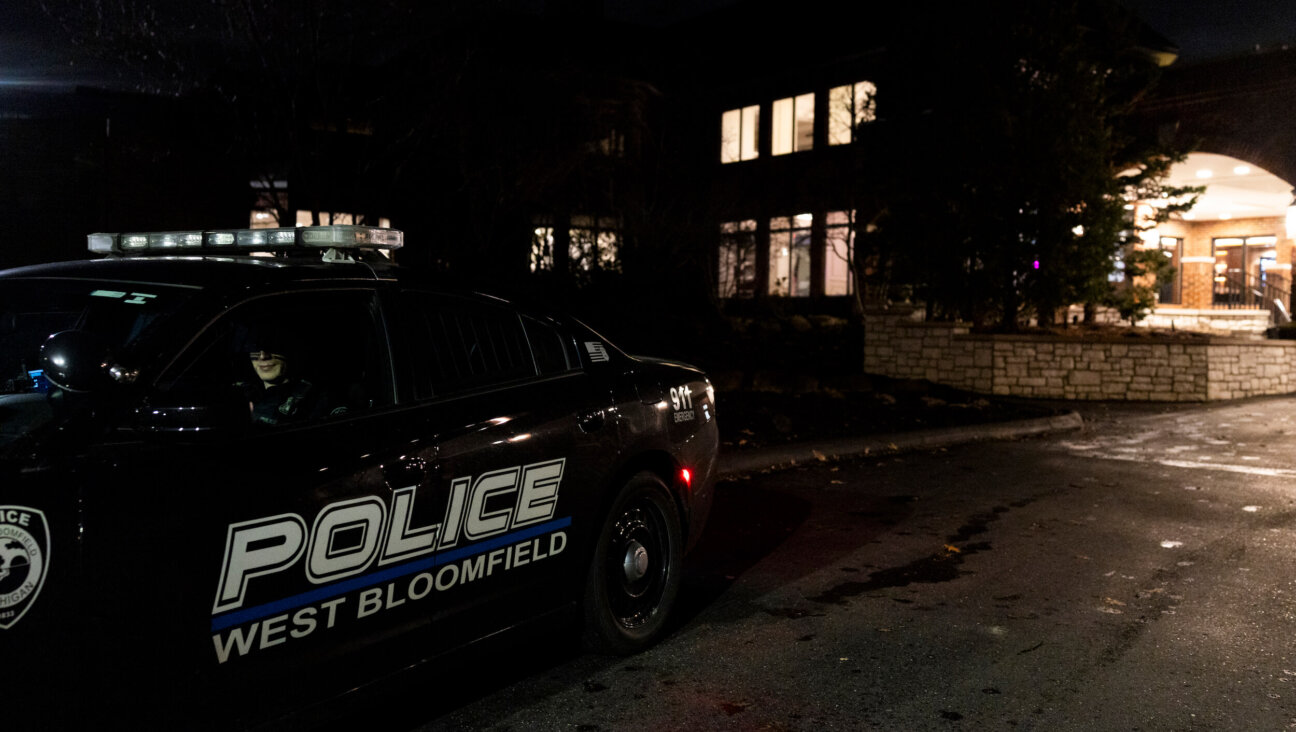
NYC synagogues boost security as DHS shutdown stalls federal funding
A Jewish security group is offering temporary assistance and recommending that Jewish institutions hire armed guards
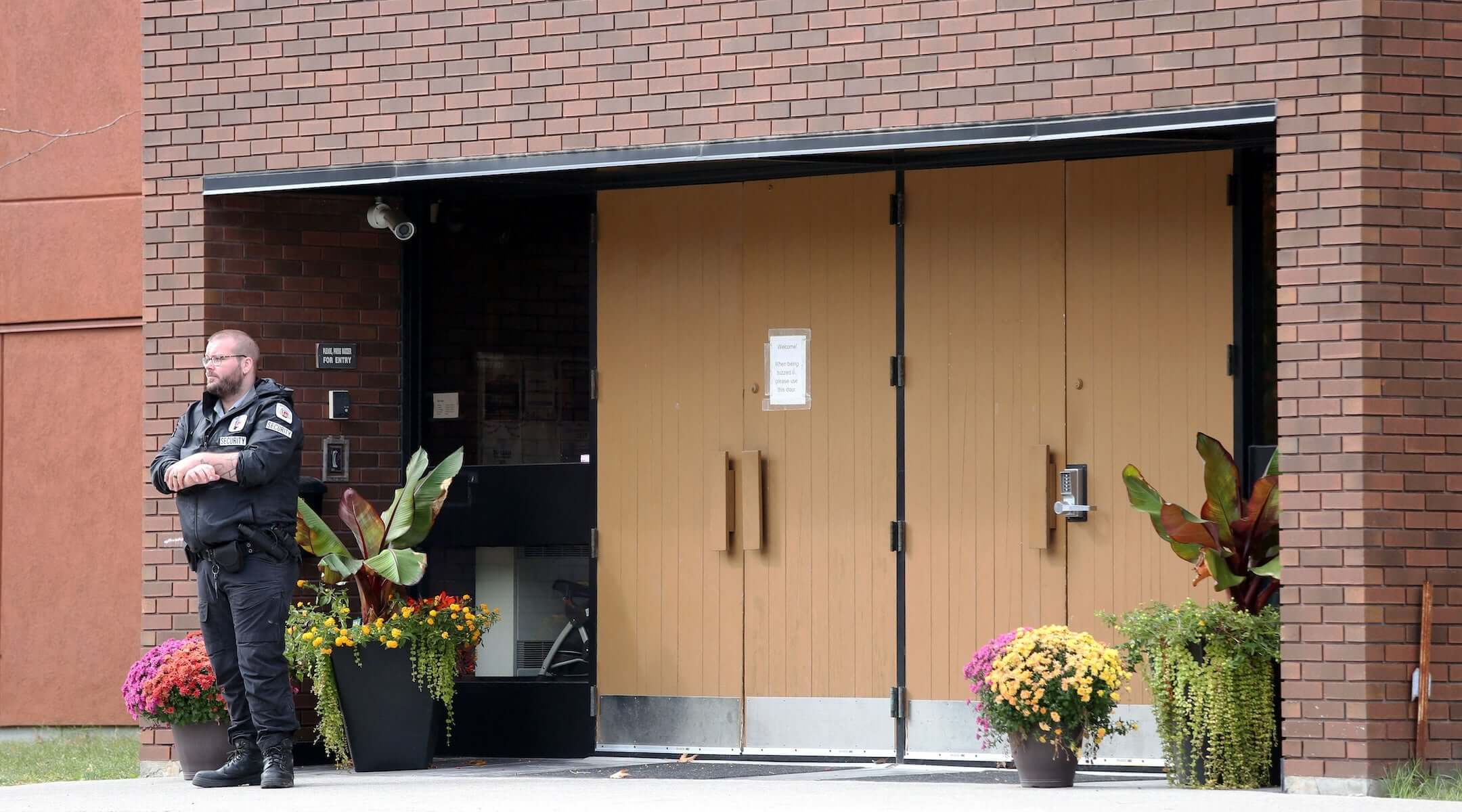
A security guard stands outside the front door of Machzikei Hadas Orthodox synagogue on Oct. 8, 2023, Ottawa, Ontario, Canada. Photo by Dave Chan/AFP
(New York Jewish Week) — When an attacker drove into Temple Israel in suburban Detroit last week, the synagogue’s security guards were ready to engage him. Soon after, the attacker was dead — with no serious injuries to anyone else.
But that was at the biggest congregation in the United States, with a large staff of full-time security officers — something few synagogues can muster.
Now, smaller congregations are scrambling to fortify themselves during what an official for the Secure Community Network, a national Jewish-run nonprofit, called “the most elevated and complex threat environment” in recent history.
In New York City, some are adding security guards through a new program that will cover additional labor costs, at least for a short time — while bemoaning a lack of federal funding due to a Department of Homeland Security shutdown.
Funding for the “Short-Term Security Guard Reimbursement Program” is coming from the Community Security Initiative, the UJA-Federation of New York and “key donors,” according to CSI’s CEO Mitchell Silber. It subsidizes New York-area Jewish institutions that only have one or no security guards and wish to add one or two for a four-week period.
The program is responding to a moment of acute alarm in the Jewish community: In addition to the Temple Israel attack, there were violent attacks at a Manchester synagogue last October, the Bondi Beach shooting over Hanukkah, and violent incidents in San Jose, California and Toronto.
Jewish institutions were already on alert after the Hamas’ Oct. 7 attack on Israel; Silber said that after the attacks, approximately 150 locations sought assistance from his group, a New York-based program founded in 2019. CSI said it issued its latest reimbursement program in response to “recent incidents and threats emanating from the war in Iran.”
This time around, there is a new wrinkle in the messaging: For the first time, the group recommends hiring armed security, in addition to securing entry points, strict entrance procedures and staff and volunteer training.
“I say this regrettably, but I think this is where we are in March 2026 — you probably have to have multiple armed guards,” Silber said in an interview. “Because both in [Manchester] and in Detroit, the car rammed into one of the guards and knocked them out of the picture. So if you don’t have armed guard number two in Detroit, this ends very differently.”
Rabbi Jonathan Leener, who leads Prospect Heights Shul in Brooklyn, said his synagogue is adding additional security through the program, which he called “incredibly generous and amazing.”
The cost of paying an armed guard for four weeks is approximately $3,200, according to Silber, though that figure rises to $14,400 for schools and $22,400 for JCCs, which require more staff shifts.
Leener also said there’s been a larger conversation around whether American synagogues will “evolve towards the European model” of tighter security for people entering the building. Saying that the Michigan attack had “struck a chord that brought that [discussion] further along,” he echoed long-standing concerns about balancing security and being welcoming.
“It’s a really hard balance to strike,” Leener said. “As a rabbi, I see my number one responsibility as the safety of the community. That has to be non-negotiable. At the same time, a shul is a beit knesset, literally a house of gathering.”
Other synagogues are adopting new measures.
In its own effort to minimize “the heightened risks facing Jewish institutions,” The Altneu, a Modern Orthodox synagogue on the Upper East Side, announced on Tuesday that it will limit attendance at this coming Shabbat service to members only.
“Thank G-d, we have been blessed with growing numbers coming to shul,” its Instagram story read. “As our crowds have grown, it has become increasingly important that we maintain clear visibility of everyone entering the synagogue.”
Leener said his synagogue, which is considerably smaller than The Altneu, is not limiting services to members. But he’s also unsure whether it will be able to retain its newly hired guard once the four weeks are up. The “major problem,” he said, is the DHS shutdown that has halted the review of millions of dollars in security funding for nonprofits, including Jewish institutions, since Feb. 14.
Applications for the federal Nonprofit Security Grant Program, which helps synagogues, schools and community centers pay for security upgrades through the Federal Emergency Management Agency, are frozen until a deadlocked Congress passes a new appropriations bill.
“It’s absurd that politics are interfering with much-needed funding for the Jewish community at such a critical time,” Leener said. “Every minute the shutdown drags on increases the pressure on institutions already stretched thin.”
At the city level, Phylisa Wisdom, the executive director of the Mayor’s Office to Combat Antisemitism, said in a statement that “Mayor Mamdani knows that the safety of our neighbors and our houses of worship is non-negotiable.”
“The Mamdani administration will take every necessary step to ensure synagogues — and all religious institutions and houses of worship — are safe, secure, and free from fear,” Wisdom said. The NYPD has maintained heightened visibility around prominent Jewish religious and cultural institutions since before the Michigan attack.
While the Temple Israel attack prompted a heightened sense of alarm among Jewish institutions, some argue that, after years of bolstering security, there is little left to reinforce.
Jacob Gold, president of the Fifth Avenue Synagogue on Manhattan’s East Side, said his congregation had in the last couple of years already installed cameras, bulletproof doors and a lockdown mechanism. The one change spurred by the Michigan attack was that guards will wear security vests, making them more visible.
“It’s sad that Michigan wakes people up,” Gold said. “There’s antisemitism on the rise — we’re already awake, we’re aware, we’re concerned.”