Birthright travelers look different after Oct. 7 — but the effect remains the same, study shows
Plus, those who didn’t end up traveling grew less connected to Judaism, an analysis found
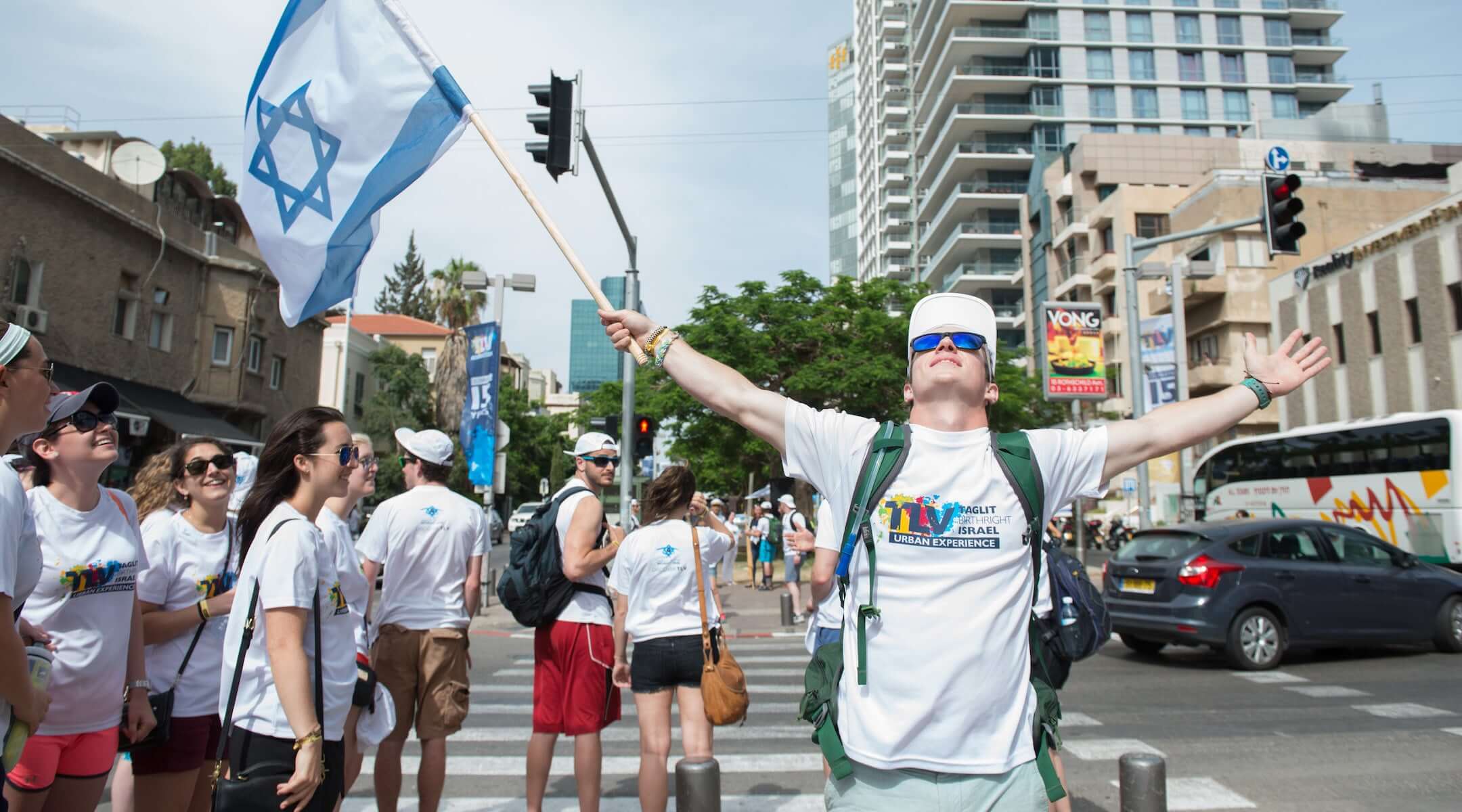
Participants on a Birthright Israel program. Courtesy of Birthright Israel
(JTA) — Len Saxe, a researcher at Brandeis University, has been studying the impact of Birthright trips to Israel since the initiative launched in 1999. Last year, he noticed something unusual in the data.
At a rate far outpacing anything he’d ever detected before, people who signed up for Birthright in summer 2025 but did not participate became less connected to Israel and less connected to their own Jewish identity in the months after.
Nonparticipants — whether their trips were canceled because of the June war with Iran, or they opted out on their own — reported a declining sense of connection to Jewish values, Jewish history, Jewish tradition and a “worldwide Jewish community.”
The study did not attempt to explain the change, but Saxe has a theory about what happened.
“Many of the applicants live in communities where they hear frequent criticism of Israel,” Saxe said. “Unlike the period on campuses pre-COVID, when Birthright was taking 35,000 North Americans a year to Israel, students don’t know many others who have experience in Israel and know Israelis.Their perspective on the conflict lacks context.”
The organization said 7,300 North Americans took a Birthright trip last summer, out of 10,000 total. (War with Iran disrupted some trips and canceled others.) Of the total, 65% were college-aged.
The survey detected other changes for Birthright since 2023, when Hamas’ Oct. 7 attack on Israel triggered the Gaza war and anti-Israel sentiment around the world.
More than half of last year’s participants, 54%, had already participated in some variety of Israel programming, up from 38% in 2023, according to Saxe’s report. (Birthright loosened its eligibility requirements in 2014 to allow students who had visited Israel in high school to go again.)
About 1 in 5 participants were Orthodox, a more than threefold growth from summer 2023, the last trips before the start of the Gaza war. And 38% of participants attended Jewish day school, up from 23% two years prior.
The survey also detected a rightward political shift among Birthright participants. Forty-two percent of 2025’s Birthright participants identified as conservative, and 34% as liberal, a dramatic shift from 2023, when 20% identified as conservative and 57% as liberal.
Those who do participate in Birthright still report that it deepens their connection to Judaism, and there is mounting evidence that connection is long-lasting. According to a recent survey by the Jewish Federations of North America, millennial Jews — the demographic where Birthright had the greatest penetration — were the only age group to have a majority identify as “Zionist.”
The analysis found that for self-identified liberals who did go on Birthright, the trip’s most important impact was on their conception of what it means to be Jewish.
Liberals reported large upswings in their sense of being Jewish as “extremely important to their identity” after their trips, the authors wrote — 48% after the trip, compared to 29% beforehand. Even Birthright participants who had to be sent home early due to fighting still overwhelmingly reported that the trip had made a difference in their understanding of their Jewish identity.
In other words, Saxe said, Birthright is still fulfilling its intended purpose: strengthening its participants’ Jewish identities more generally.
“Among those with the least prior connection to Judaism and Israel, including those politically liberal, they showed the largest increase in their connection to Israel, as well as other facets of their Jewish identities,” he said.
In statements accompanying the report’s release, Birthright’s leadership trumpeted the program as a necessary antidote to declining Jewish engagement.
“The cultural headwinds facing young Jews are real, and they are pushing Jewish connection and pride downward,” Gidi Mark, international CEO of Birthright Israel, said in a release. “But what this research makes unmistakably clear is that Birthright Israel moves participants in the opposite direction. The decline occurred only among those who did not go.”
Elias Saratovsky, president and CEO of the Birthright Israel Foundation, painted the situation in even starker terms.
“We are at a crossroads. If our community does nothing, we risk losing the younger generation,” Saratovsky said. “But if we invest in an effective intervention — Birthright Israel — we can win them back.”
This article originally appeared on JTA.org.
This is a moment of great uncertainty. Here’s what you can do about it.
We hope you appreciated this article. Before you go, we’d like to ask you to please support the Forward’s independent Jewish news. All donations are still being matched by the Forward Board - up to $100,000 until April 24.
This is a moment of great uncertainty for the news media, for the Jewish people, and for our sacred democracy. It is a time of confusion and declining trust in public institutions. An era in which we need humans to report facts, conduct investigations that hold power to account, tell stories that matter and share honest discourse on all that divides us.
With no paywall or subscriptions, the Forward is entirely supported by readers like you. Every dollar you give is invested in the future of the Forward — and telling the American Jewish story fully and fairly.
The Forward doesn’t rely on funding from institutions like governments or your local Jewish federation. There are thousands of readers like you who give us $18 or $36 or $100 each month or year.

Support our mission to tell the Jewish story fully and fairly.