These pro-Palestinian PACs are trying to beat AIPAC at its own game
A super PAC called American Priorities says it will spend “at least $10 million” on this year’s midterm elections to counter the pro-Israel lobby’s spending.
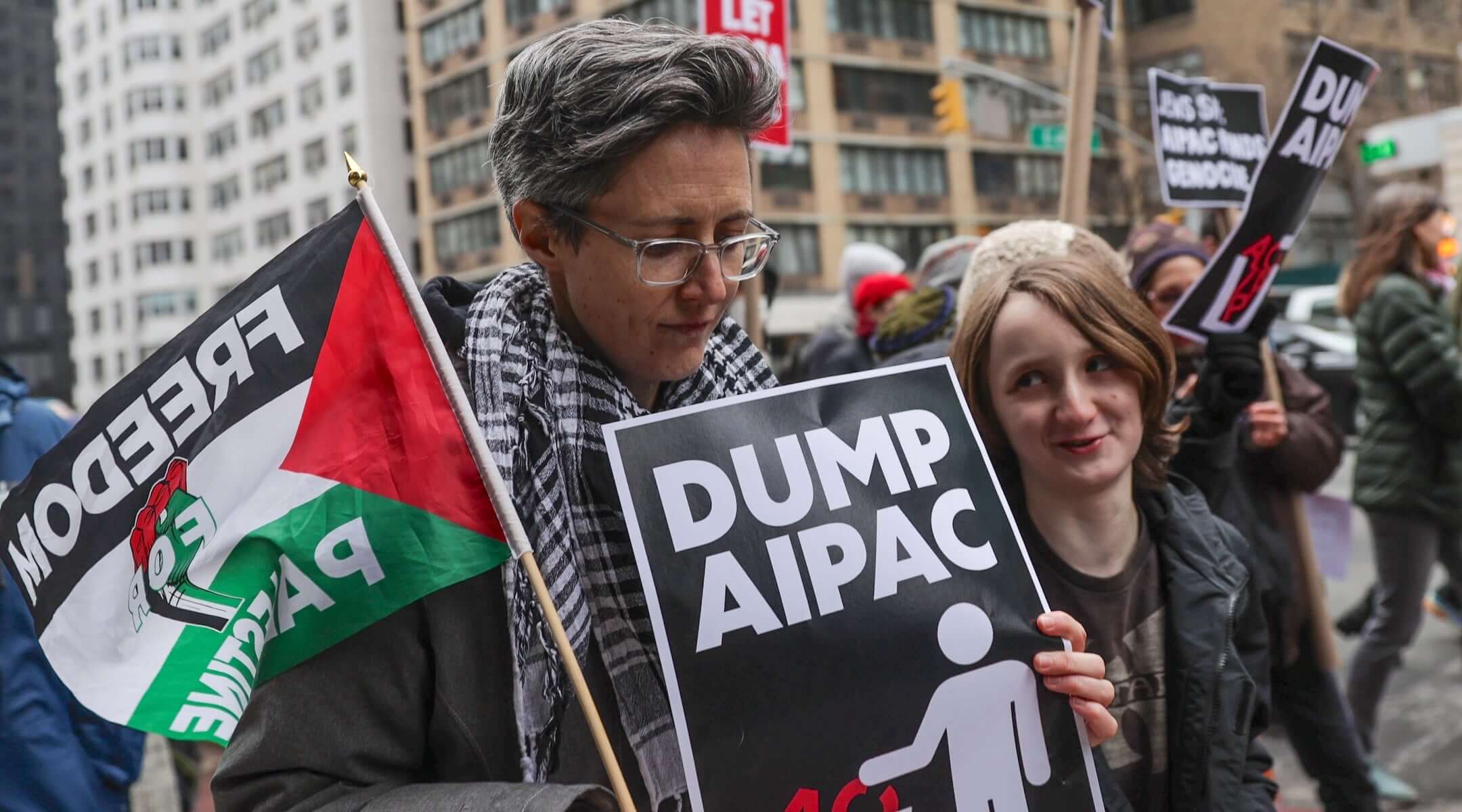
Pro-Palestinian demonstrators rally outside AIPAC headquarters and the offices of Sens. Chuck Schumer and Kirsten Gillibrand, who’ve both been endorsed by the group, in New York City, Feb. 22, 2024. Photo by Selcuk Acar/Anadolu via Getty Images
(JTA) — Some critics of AIPAC are calling for it to be excised from electoral politics. Others are working to beat the pro-Israel lobby at its own game.
At least three groups have entered the scene this year as hopeful counterweights to pro-Israel lobbying groups, with an eye on progressive candidates. And they’ve borrowed some of AIPAC’s playbook to do so.
The Peace, Accountability and Leadership PAC, or PAL PAC, was founded in February by Margaret DeReus, executive director of the Institute for Middle East Understanding. It has endorsed nine congressional candidates so far this year, and its website funnels visitors to donate to their campaigns.
A second group, American Priorities, is led by Hannah Fertig, a strategist who worked on Bernie Sanders’ 2020 presidential campaign and is Jewish. Founded in January, the super PAC plans to spend “at least $10 million” on the midterms, according to Fertig, on candidates “who are very strong on our issues, both foreign policy and domestic policy.” In picking which challengers to back, Fertig said they look for “strong, credible, progressive” candidates — and ones whose incumbent opponents have taken donations from AIPAC.
The third group makes its antipathy clear in name: Citizens Against AIPAC Corruption PAC was founded by the duo behind social media watchdog Track AIPAC, which posts candidates’ AIPAC donation numbers in order “to end AIPAC and the Israel lobby’s stranglehold on American Democracy,” according to its website. CAAC was founded in 2024, though it only spent about $14,000 that cycle, all against the Jewish Rep. Debbie Wasserman Schultz.
This year, CAAC is “actively fundraising and willing to spend as much as we can raise seeking strategic victories,” a spokesperson wrote to the Jewish Telegraphic Agency. Its candidates must meet a number of policy commitments that include recognizing “the genocide in Palestine,” supporting “recognition of the Palestinian state by the United Nations” and opposing policies that it says conflate “criticism of the government of Israel with antisemitism broadly.” The group has spent in two races this year, and with $273,000 in cash on hand as of the end of February, says it intends “to do more in upcoming races.”
Together, the PACs are trying to maximize the moment and elect pro-Palestinian candidates as Americans’ sympathy toward Israel wanes.
“We have a massive opportunity to be on the offensive this cycle, and increase the number of members of Congress who will challenge the status quo on Palestine,” Amira Hassan, PAL PAC’s political director, said in a recent radio interview. PAL PAC and American Priorities did not respond to requests for comment.
Patrick Dorton, a spokesperson for United Democracy Project, AIPAC’s super PAC, said in an interview that it’s “not good for American democracy” that these groups are popping up and “trying to silence pro-Israel voices in the Democratic party” — a critique that mirrors what pro-Palestinian activists say about AIPAC.
“This is the fringe left using dark money to advance an anti-Israel agenda,” he said.
Results of the groups’ spending so far have been mixed.
Two of the progressive groups’ handpicked candidates won primaries in New Jersey and Texas earlier this year, and another challenger in North Carolina narrowly lost after a wider defeat in 2022.
Last week, one of three PAL PAC endorsees in Illinois prevailed — as an unopposed incumbent. The group’s other endorsees fell short: Kat Abughazaleh, 26, finished second in the 9th Congressional District, although she drew more votes than the AIPAC-backed candidate, and community organizer Junaid Ahmed, who lost to AIPAC’s preferred candidate, Melissa Bean, in the eighth district.
The post-election quarterbacking had some critics of Israel wondering whether the new PACs could have done more.
Ryan Grim, a reporter for Drop Site News, which has an anti-Israel bent, called it a “huge miss” by American Priorities to resist “pressure to support” Ahmed. Grim suggested that it could have channeled more of AIPAC’s willingness to spend. The group had about $1.4 million in cash on hand as of Feb. 11, $1 million of which was spent in a North Carolina race.
“Results show they could’ve made a decisive difference,” he wrote about the race, which Ahmed lost by five points. “AIPAC almost never holds back, and didn’t here, and so notched the [win].”
Meanwhile, among the progressive groups’ candidates who did win, it’s not clear that the pro-Palestinian backing did anything to move the needle.
Analilia Mejia won a New Jersey special election and benefited from $35,000 in TV ad buys from CAAC PAC. But far more was spent in the campaign by the AIPAC’-affiliated United Democracy Project, which spent $2 million against the moderate Tom Malinowski because of his openness to conditioning military aid to Israel. That spending is widely seen to have inadvertently boosted Mejia, a former Bernie Sanders staffer.
CAAC PAC’s spending was modest compared to UDP’s in that race, but other groups are entering the midterms with deeper pockets.
American Priorities has pledged to spend at least $10 million boosting its preferred candidates this year.
“We want our foreign policy views to reflect where the Democratic base has moved, particularly on Gaza, and on unconditional U.S. military to Israel,” Fertig told Semafor.
A new NBC poll found that 57% of Democrats have a negative view of Israel, and 13% have a positive view of the country. In 2023, those numbers were just about dead even, with 35% of Democrats saying negative and 34% viewing Israel positively.
“We’re seeing this as a generational inflection point, and we launched because there’s a huge gap in the progressive spending ecosystem,” Fertig said. “We simply want to make sure that someone’s there to protect candidates who question these policies.”
As a super PAC, American Priorities’ role matches UDP’s. It cannot donate directly to campaigns or coordinate with them, but instead can make independent expenditures on things like TV ads and mailing fliers. Like UDP, its name indicates nothing about Israel or the Palestinians, and its ads focus on unrelated issues as opposed to the candidates’ views on Israel.
The first candidate to receive American Priorities’ support was Nida Allam, also a former Sanders staffer, who conceded after a tight race in North Carolina against incumbent Valerie Foushee. Allam’s campaign foregrounded her opponent’s past support from AIPAC and AI lobbies.
After getting about $1 million from American Priorities, Allam lost by less than 1% of the vote in a race that set records for outside spending in North Carolina. She had lost by 9 points to Foushee in 2022 and said “our movement sounded the alarm for future Democratic primaries throughout this cycle.” CAAC PAC also spent $23,500 in attack ads against Foushee.
On the same day as Allam’s race, the PAL PAC-endorsed Rev. Frederick Haynes III won the Democratic nomination in a Texas congressional primary. Haynes has praised Louis Farrakhan, the Nation of Islam leader who has a history of antisemitism, and criticized Israel for engaging in “apartheid” in a sermon the day after Hamas’ Oct. 7, 2023 attack.
“We are sending someone to Congress who had the moral clarity to give this sermon on October 8th, 2023,” PAL PAC’s Hassan wrote after Haynes’ victory. American Priorities also spent $100,000 boosting Haynes, who won the primary handily.
Track AIPAC has spent multiple years posting online against the pro-Israel lobby. But the advent of the PACs signals an escalation of strategy.
“The idea of PACs backing ‘Squad’-type candidates, anti-Israel candidates, candidates that say cut off all aid to Israel and ‘stop the genocide,’ I don’t think we’ve seen that before,” said Eric Alterman, a historian and journalist who himself has been critical of AIPAC and the Israeli government. “And that’s an outgrowth of Gaza, where this position all of a sudden has become a mainstream position in the Democratic Party.”
The groups will have additional chances to prove themselves in the coming months. Eleven states are holding primaries in May, and some candidates in those races are making their views on AIPAC known.
In Pennsylvania, progressive state Rep. Chris Rabb — who is racking up endorsements, though not from any of the anti-AIPAC groups — said “F— AIPAC,” during a candidates’ forum.
PAL PAC is still making endorsements on a rolling basis and American Priorities has not disclosed which races it will spend in. PAL PAC’s latest endorsees are both running in June primaries: political adviser Saikat Chakrabarti in California, and State Assemblymember Claire Valdez in New York.
PAL PAC, which describes itself as “an allied organization” of the Institute for Middle East Understanding Policy Project, has also endorsed incumbent Reps. Rashida Tlaib, Ilhan Omar and Summer Lee, who are all vocal critics of Israel and its U.S. support.
In New York City, it has endorsed Valdez as well as Darializa Avila Chevalier, who was a Columbia pro-Palestinian encampment organizer as well as an organizing lead for Zohran Mamdani during the mayoral election.
AIPAC is also likely to keep spending heavily in the coming months. Its super PAC had around $95 million in cash on hand at the end of January, and even the most expansive estimates of its spending since then leaves it with tens of millions of dollars to spend.
Alterman said he doesn’t expect the new pro-Palestinian PACs to receive “the kind of money that flows to AIPAC” — but he isn’t sure how much that matters.
“Whereas it could have some impact on a few local races, I don’t think money is the place where this position is going to make itself felt,” he said, referring to the groundswell of Palestinian support among Democrats. “I think it’s in volunteers and door-knocking and activists and social media.”
This article originally appeared on JTA.org.
This is a moment of great uncertainty. Here’s what you can do about it.
We hope you appreciated this article. Before you go, we’d like to ask you to please support the Forward’s independent Jewish news this Passover.
This is a moment of great uncertainty for the news media, for the Jewish people, and for our sacred democracy. It is a time of confusion and declining trust in public institutions. An era in which we need humans to report facts, conduct investigations that hold power to account, tell stories that matter and share honest discourse on all that divides us.
With no paywall or subscriptions, the Forward is entirely supported by readers like you. Every dollar you give this Passover is invested in the future of the Forward — and telling the American Jewish story fully and fairly.
The Forward doesn’t rely on funding from institutions like governments or your local Jewish federation. There are thousands of readers like you who give us $18 or $36 or $100 each month or year.
Support our mission to tell the Jewish story fully and fairly.