NYC Council approves ‘buffer zone’ legislation insulating houses of worship from protests
A separate law aimed at protecting schools could be subject to Mayor Zohran Mamdani’s veto.
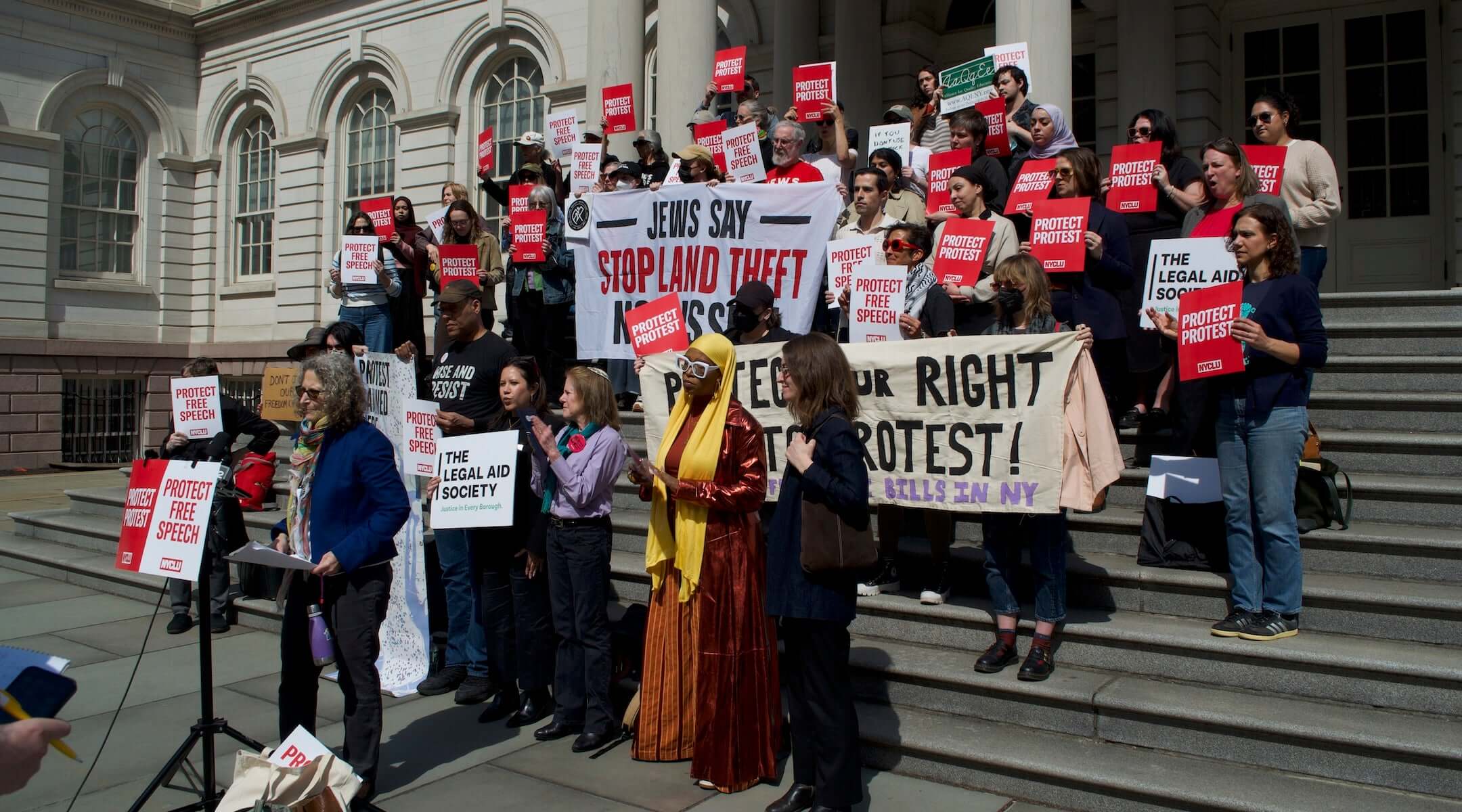
Protesters of the “buffer zone” legislation gather outside New York City Hall on March 26, 2026. (Jewish Telegraphic Agency)
(New York Jewish Week) — The New York City Council passed legislation on Thursday aimed at protecting synagogues from disruptive protests, marking a decisive victory following a months-long push by Jewish and local leaders to strengthen safeguards around houses of worship.
The “buffer zone” legislation for religious institutions, which was introduced by Council Speaker Julie Menin following a pro-Palestinian demonstration outside of Park East Synagogue in November, was passed with a vote of 44-5, reaching a super-majority that will make it immune from a potential veto by New York City Mayor Zohran Mamdani.
The bill, which was altered from its initial format to exclude any mention of distance following concerns from the NYPD, will require NYPD Commissioner Jessica Tisch to “establish a plan to address and contain the risk of physical obstruction, physical injury, intimidation and interference in places of religious worship, while preserving and protecting the rights to free speech, assembly and protest,” Menin said during the introduction of the legislation.
“The increase in hateful acts around the city is absolutely abhorrent, and we have to do something about it,” Menin said.
Another measure included in the package of legislation, which would establish buffer zones for protests outside of schools, was also passed with a majority of 30 to 19, making it subject to a potential veto from Mamdani.
Mamdani has not confirmed whether he will pass the legislation. Ahead of the vote, Dora Pekec, a City Hall spokesperson, told the Jewish Telegraphic Agency in a statement that the mayor “wants to ensure both the right to prayer and the right to protest are protected here in New York City.”
She continued, “The Mayor is keenly aware of the serious concerns regarding these bills’ limiting of New Yorkers’ constitutional rights, and he will keep these concerns in mind for any bills that land on his desk.”
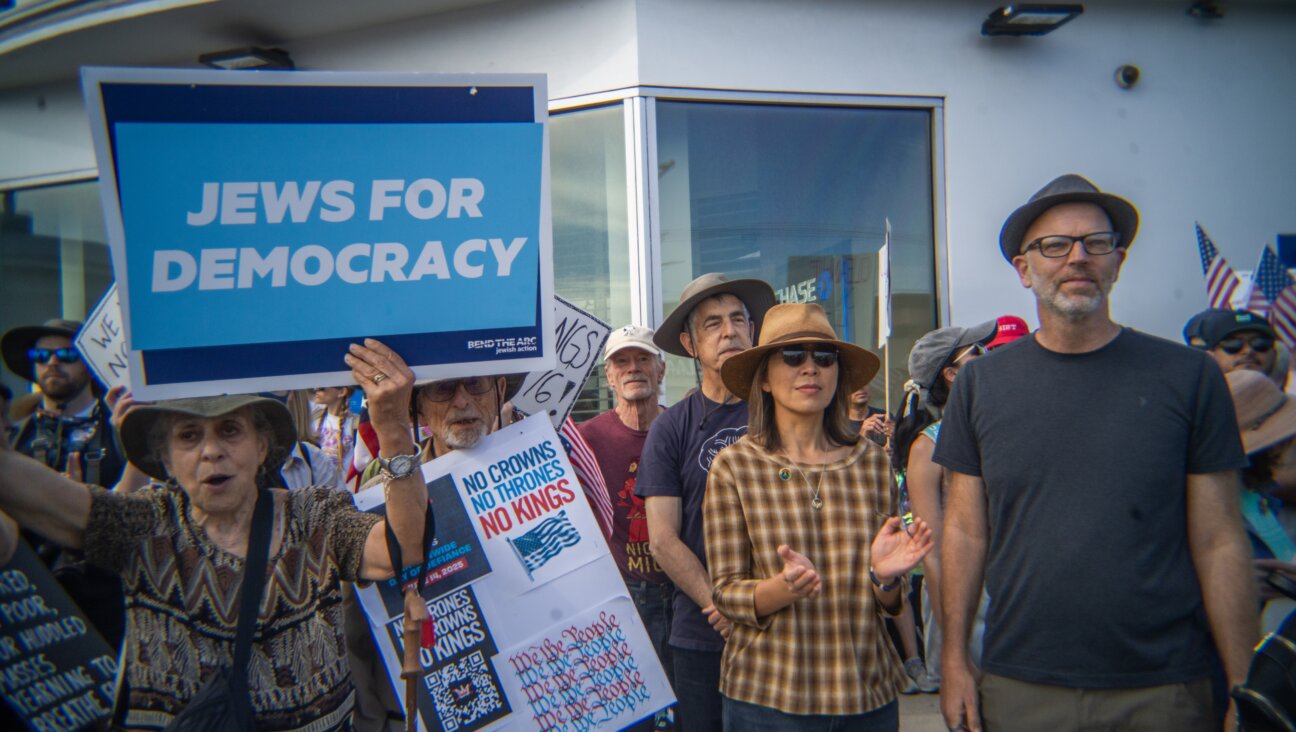
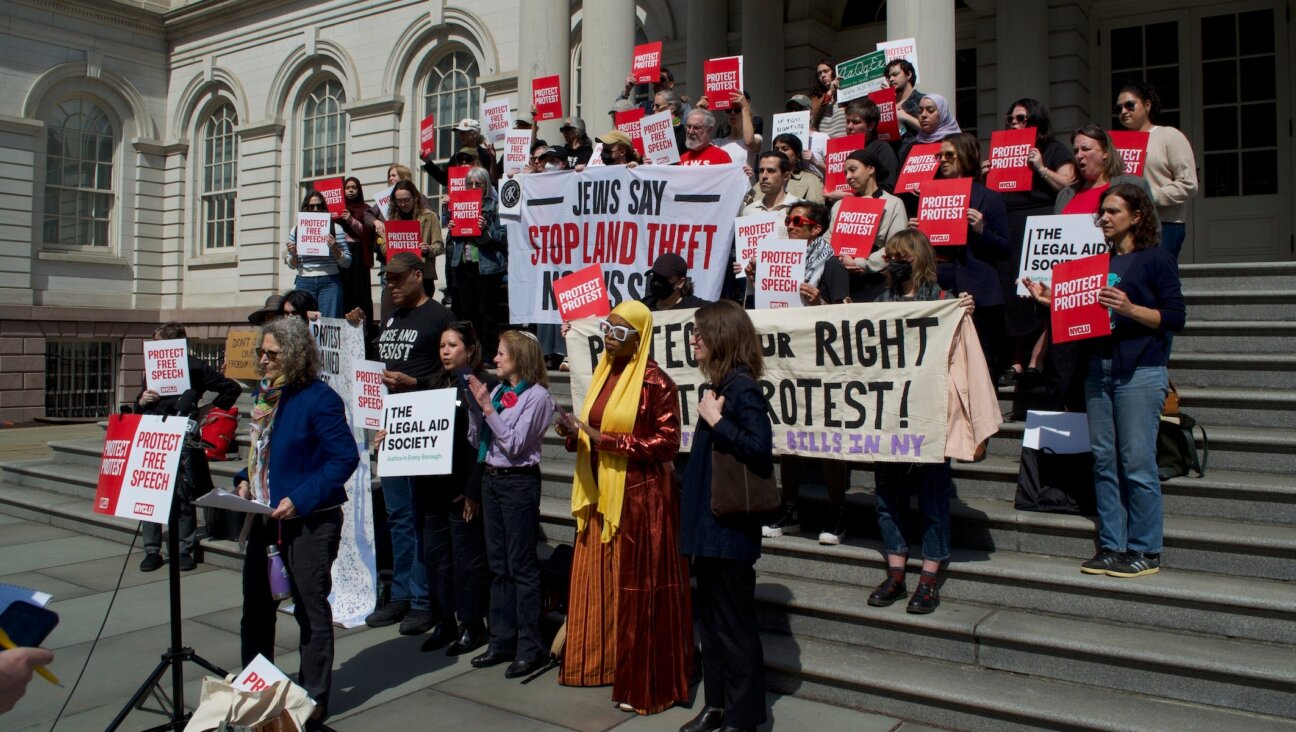
On the steps of city hall ahead of the vote, roughly three dozen protesters gathered as part of a demonstration organized by Jewish Voice for Peace NYC, Jews for Racial & Economic Justice and the New York Civil Liberties Union to object to the legislation.
Opponents of the legislation have said that it would have a chilling effect on First Amendment protections, including Donna Lieberman, the executive director of the New York Civil Liberties Union, who said during the demonstration that “this is no time for the political leaders of our city to be pressing for legislation that could put our right to protest in danger.”
“Let’s be clear, the rise of antisemitism is real, hate is real, and we must confront it,” Lieberman said. “But no speech zones, restricting speech and assembly are simply not the solution.”
Audrey Sasson, the executive director of Jews For Racial & Economic Justice, called on Mamdani to veto both pieces of legislation in a statement following the vote.
“We’re extremely disappointed that the City Council voted to pass Intros 001 and 175, bills that serve to generate headlines and convey concern, but not to materially make our city safer for all New Yorkers, including Jews,” Sasson said. “At best, the legislation changes little. At worst, it restricts New Yorkers’ free speech rights and empowers the NYPD to engage in discriminatory policing of protest outside houses of worship and educational facilities.”
But proponents of the bill have argued that it will offer an added layer of protection amid a rapidly escalating climate of antisemitism.
“The explosion of antisemitism in the past, let’s say four or five, six months, especially from Nick Fuentes becoming a major figure and Tucker Carlson going completely off on that has made the rhetoric so much more unstable that I think we just have to have a time where synagogues and all places of faith are protected,” Eitan Szteinbaum, a 25-year-old Jewish New York resident, said outside of City Hall.
Council Member Eric Dinowitz, who introduced the protest bill for educational sites, welcomed the outcome of the vote, saying, “I look forward to the conversation the mayor may want to have about how we protect our students’ safe access to schools.”
The passage of the bills was also welcomed by the Anti-Defamation League of New York and New Jersey, which wrote in a post on X that the measures were an “essential first step to keep Jews — and all New Yorkers — safe.”
“ADL’s most recent audit showed a record 976 antisemitic incidents in NYC, many of which targeted synagogues and Jewish institutions, demonstrating a clear threat to religious freedom,” the statement continued. ‘We are grateful to @SpeakerMenin not only for sponsoring this legislation, but for her entire five-point plan to combat antisemitism.”
Rabbi Marc Schneier, a vocal critic of Mamdani, also celebrated the vote in a statement.
“I am proud of NYC Council Speaker Julie Menin for taking action so quickly, especially as it was clear the mayor once again flip-flopped when it comes to protecting New York’s Jewish community, and New Yorkers of all faiths,” Schneier said. “No one should have to be worried about protesters harassing them when entering a house of worship.”
This is a moment of great uncertainty. Here’s what you can do about it.
We hope you appreciated this article. Before you go, we’d like to ask you to please support the Forward’s independent Jewish news this Passover.
This is a moment of great uncertainty for the news media, for the Jewish people, and for our sacred democracy. It is a time of confusion and declining trust in public institutions. An era in which we need humans to report facts, conduct investigations that hold power to account, tell stories that matter and share honest discourse on all that divides us.
With no paywall or subscriptions, the Forward is entirely supported by readers like you. Every dollar you give this Passover is invested in the future of the Forward — and telling the American Jewish story fully and fairly.
The Forward doesn’t rely on funding from institutions like governments or your local Jewish federation. There are thousands of readers like you who give us $18 or $36 or $100 each month or year.
Support our mission to tell the Jewish story fully and fairly.