For Passover, an interactive map brings the haggadah down to earth
Alon Gildoni and Ron Milo turned a Passover question into an interactive tool that traces the Exodus story across real-world locations
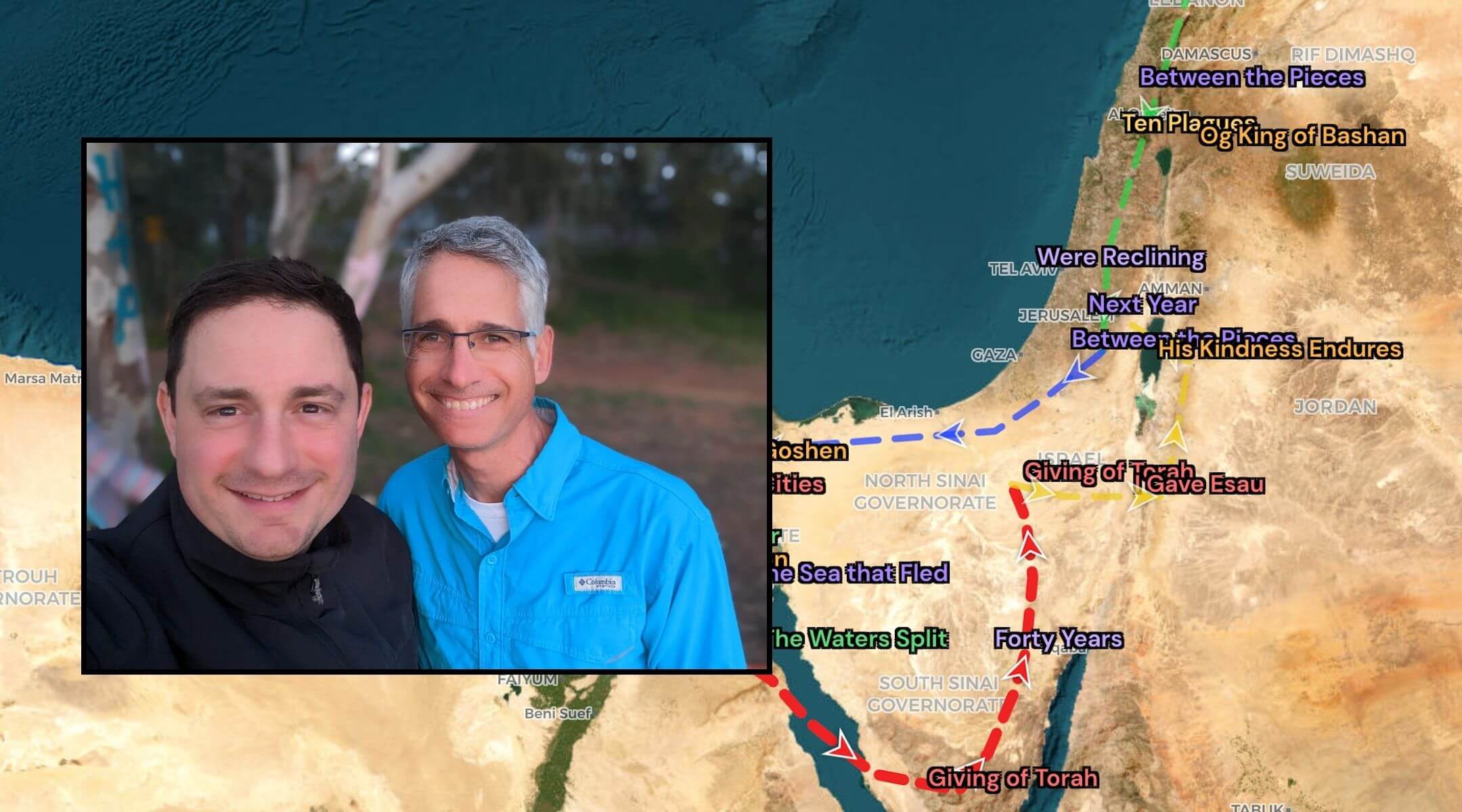
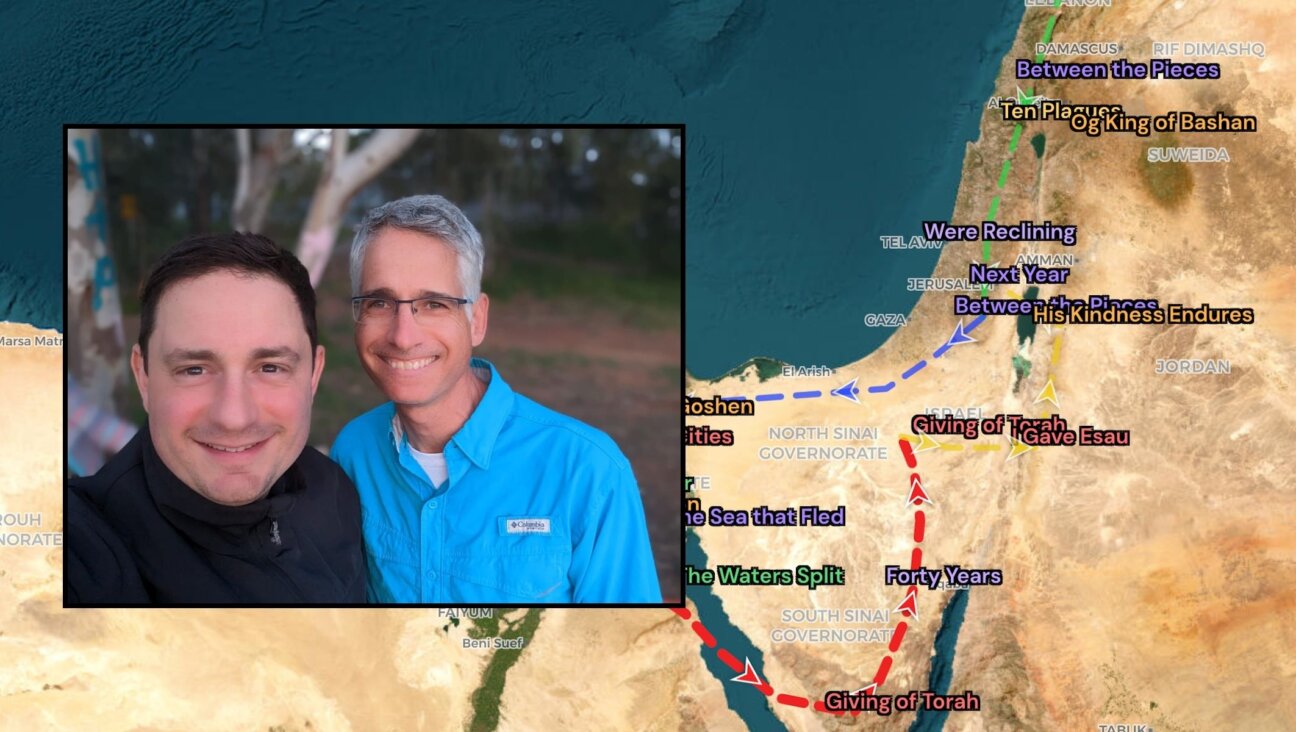
Alon Gildoni, left, and Ron Milo are the creators of “Haggadah on the Map,” which traces the Israelites’ journey as recounted in the Passover story. (Courtesy Alon Gildoni)
(JTA) — In 2024, as Alon Gildoni and his brother-in-law, Ron Milo, prepared for Passover in Israel, they asked themselves a puzzling question: Where did the events described in the haggadah actually take place?
But what started as a casual curiosity, including a rough sketch on the back of an envelope of the ancient Israelites’ exodus from Egypt, quickly took on a life of its own. With the pair drawing inspiration from the storytelling of Gildoni’s late father, Zvika Gildoni, they sought to bring the ancient narrative to life by mapping the Passover story onto real-world locations.
In the years since posing the question, Milo, a professor at the Weizmann Institute of Science in Israel, and Gildoni, a product management expert originally from Israel based in the Netherlands, have combined research, archeological experts and modern mapping technology to create “Haggadah on the Map,”
The free interactive website and printable PDF, Gildoni told the Jewish Telegraphic Agency, gives families an opportunity to deepen their understanding of the Passover story by showing children where, by their estimation, the Red Sea parted and Mount Sinai stands.
This conversation has been edited for length and clarity.
What was the inspiration for creating the map?
Gildoni: I have a brother in law who is a Weizmann Institute professor, and he deals a lot with numbers and biology, and he’s very kind of data driven. And a couple years back, he came to me and said, “you know, I’m super curious about places that are mentioned in the haggadah. Where exactly are they? What was the route? What was going on?”
One thing led to the other, and we started just with a Google Map, just trying to position things on the map, and before we knew it, we realized that there’s some merit to it, and it can actually be interesting, coupled with the fact that we felt that many people, youngsters, but not only, may feel a bit detached during the seder.
They’re not necessarily understanding the text in full and definitely not the context. And we thought that this can be a very cool way to connect them back to our shared roots.
And how did you go about creating the map?
There were two massive challenges. One is to try to kind of dig up locations in the haggadah. Some are quite trivial, you know: We went out of Egypt. But some are more challenging, right? Such as, let’s say, the covenant of Abraham, that happened somewhere, so trying to dig that up, that was one challenge.
The second challenge was actually trying to put it on the map. The most common example would be Mount Sinai. There are many traditions as to where Mount Sinai may be. So in this case, we’ve actually consulted with archeologists, we’ve done our own academic research, and we took the most prominent places… and we’ve actually positioned both of them on the map.
Same applies to the crossing of the Red Sea, where exactly that would have happened. So that led us down a marvelous rabbit hole of research, and we’ve tried to map it as eloquently as possible within the map, understanding that, in some cases, we might be looking at factual history, and in others it might be a myth. So we’ve tried to kind of converge all of these approaches into a coherent view.
What is the final product?
Essentially, [there’s] two options, and that has a lot to do with your level of observance, if you wish. So the traditional way is just a very nicely detailed printable PDF, which contains an aerial photo by NASA of the area from Egypt, including the Land of Israel and its surroundings.
On it, you actually see points of interest which are mentioned throughout the haggadah chronologically. So as you go through the text, you’ll be able to actually follow and see what happened, where, alongside the routes, where our forefathers went, Abraham from going down to Egypt, coming back to the Land of Israel, etc. And then there are all sorts of perks.
On the other side of the same printable page, there is a glossary with some more information and maybe things which might surprise certain people. So we just thought it’s a nice way to facilitate and make this kind of otherwise a bit of cryptic information accessible
There’s the word web version, which you could use prior, and some people would feel comfortable doing that during as well. And basically that will be a more interactive version of the same idea, allowing people who are used to swiping, to consuming information digitally, to do so effortlessly.
What was the goal of the project?
I think it’s worth giving credit to my late father, who passed in 2023. He was absolutely amazing at telling the story. As we grew and then later the grandchildren came, he adapted it himself and the narrative to make sure that he well accommodates for the people, and that was a wonderful lesson for us.
This map is also heavily inspired by his heritage, if you wish, of making information accessible, where sometimes it’s less about making sure that you read every single bit of the text, but rather understanding the essence of it.
I think that also for modern-day people, either who live in Israel or outside of Israel, the connection between those ancient texts and real life, real-time Israel and the land of it, whatever your political position may be, the fact that this happens there, and we’re able to actually connect the dots, is something special.
Could you expand on the political aspect you mentioned?
Pesach has been and obviously, hopefully will remain, time for unity. So we’re now experiencing some dramatic polarization in Israel and beyond, and I think that this is a great time for all of us to sit together and go back to the basics and the roots.
Essentially, this product is apolitical in a very deep sense of the word, in which it’s not taking any sides or not making any statements whatsoever, neither explicitly nor implicitly. And it’s, I hope, a great opportunity for all of us to sit together and have a meaningful conversation about where we came from.
Did you have any concerns publishing the project that it would fuel discourse about Jewish indigeneity?
How does [Taylor] Swift say that? Haters will hate? You know, I have no such concerns whatsoever. To be honest, I think that there’s even consensus around that aspect. And I know that the story of the Exodus has sparked the imagination of so many peoples to go for emancipation, and it has transcended way beyond our own people, and I think it’s something that we should be deeply proud of.
Tell me more about your father — who was he?
He was born in Tel Aviv. Both his parents fled the Holocaust, as many did, from Poland and Germany. And I always saw him as some sort of a connective tissue between the more traditional Israelis and the less ones.
He always found a way to connect people, regardless of their denomination and observances, and I think that this kind of approach is something that is extremely lacking in modern day Israel with the current polarity.
What are you hoping that kids and families are able to add to their seder with this new tool?
The seder is all about questions and answers. It’s all about education. We start the seder with the Four Questions, which are, I think, quite cryptic for most people. And then later on, we go into the four sons — the evil one, the smart one, and then the very last one is the one who doesn’t know how to ask. It says in the scriptures, the one who doesn’t know how to ask, you prompt, and you reach out to him.
I hope that this will help more and more children to ask questions and to raise curiosity, which I think nowadays is probably the most important trait we can think of. Surely, beyond the seder and beyond Judaism, it’s just super important to take nothing for granted and to be able to ask some smart questions. So if this project will prompt that, we would consider that a success.
This is a moment of great uncertainty. Here’s what you can do about it.
We hope you appreciated this article. Before you go, we’d like to ask you to please support the Forward’s independent Jewish news this Passover. All donations are being matched by the Forward Board - up to $100,000.
This is a moment of great uncertainty for the news media, for the Jewish people, and for our sacred democracy. It is a time of confusion and declining trust in public institutions. An era in which we need humans to report facts, conduct investigations that hold power to account, tell stories that matter and share honest discourse on all that divides us.
With no paywall or subscriptions, the Forward is entirely supported by readers like you. Every dollar you give this Passover is invested in the future of the Forward — and telling the American Jewish story fully and fairly.
The Forward doesn’t rely on funding from institutions like governments or your local Jewish federation. There are thousands of readers like you who give us $18 or $36 or $100 each month or year.
Support our mission to tell the Jewish story fully and fairly.