Seder under sirens: Israelis mark Passover in the shadow of war with Iran
“It’s certainly not the worst conditions for a seder our people have had to endure,” one Israeli said
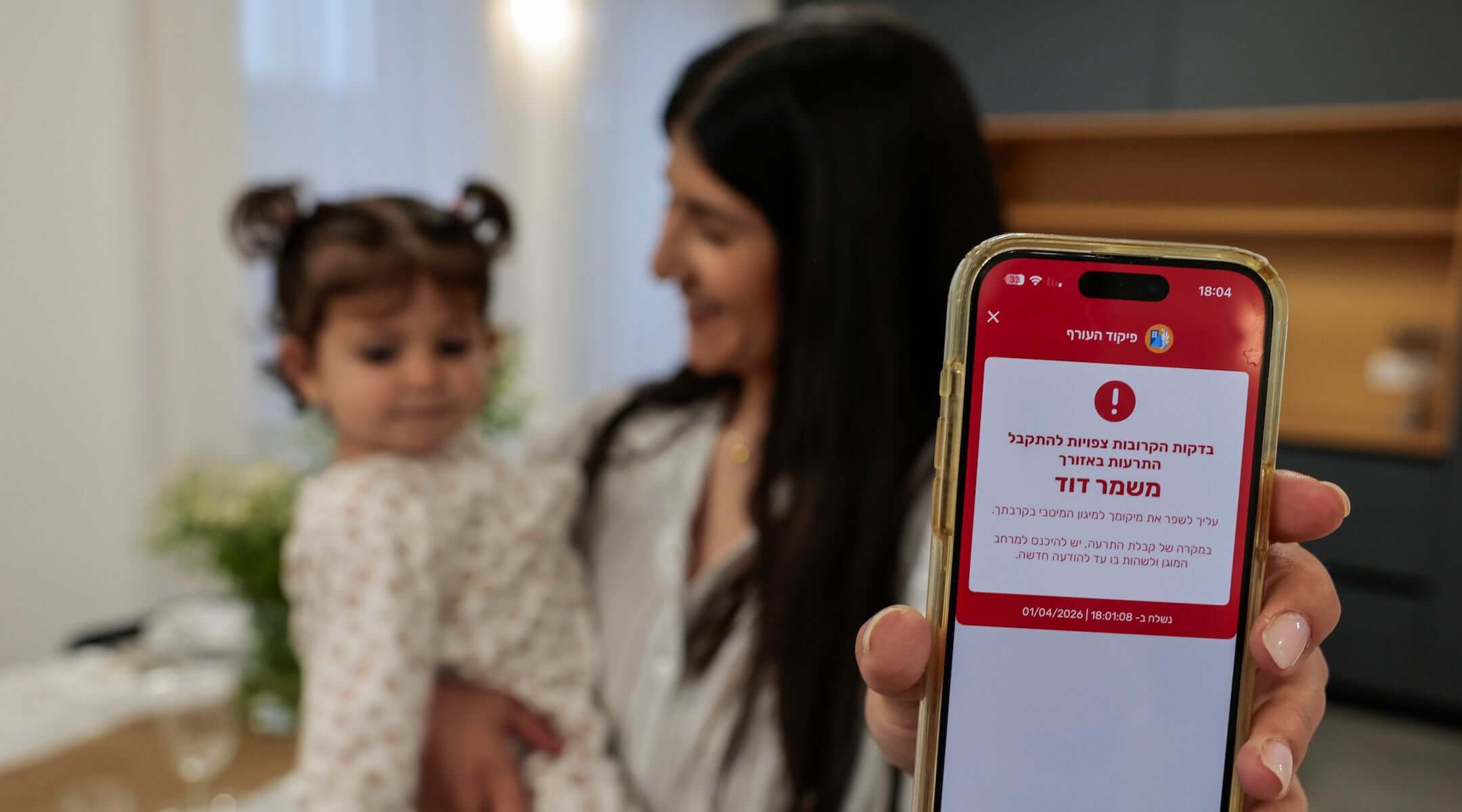
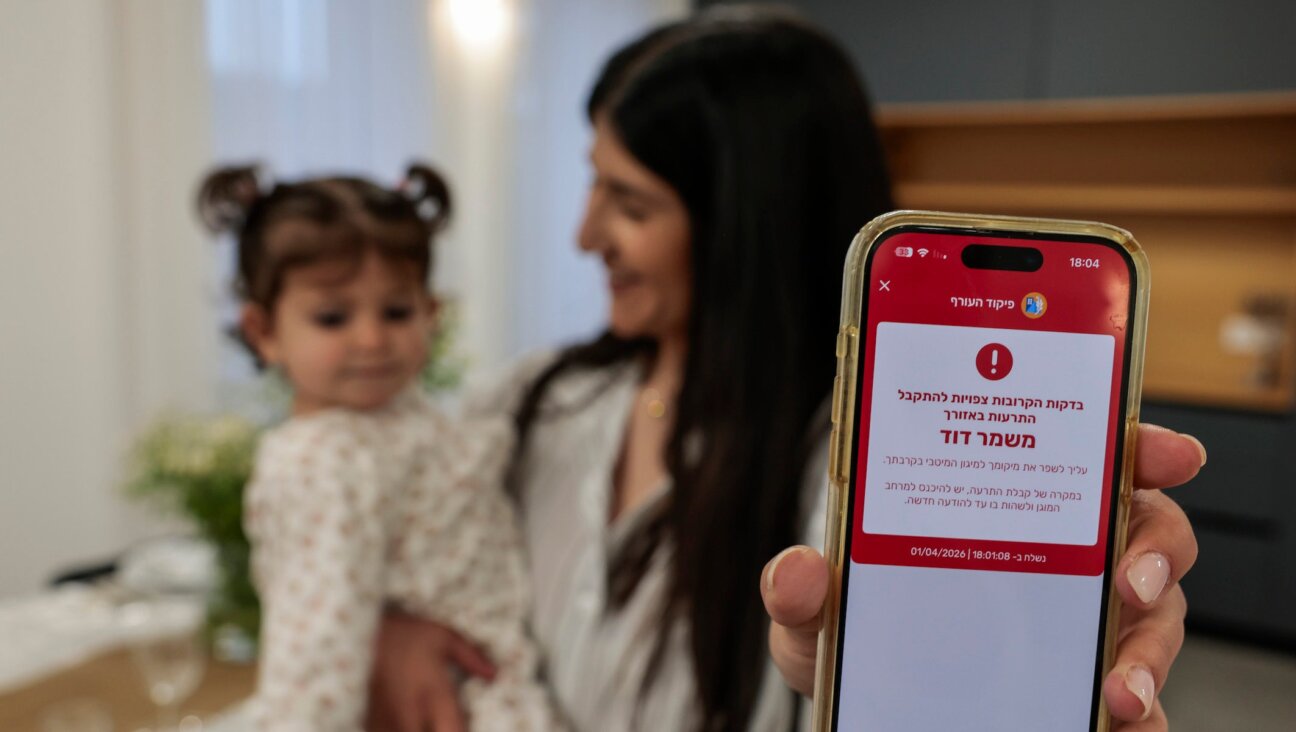
A woman shows a missile alert notification on her mobile phone as residents take cover indoors following missile fire from Iran toward Israel on the eve of the Passover, in Mishmar David, April 1. 2026. Photo by Nati Shohat/Flash90
(JTA) — TEL AVIV — The day before Yael Ben Cnaan was set to take over ownership of Bishvil Flowers, a corner flower shop located in the upscale Lev Hair neighborhood, an Iranian cluster munition landed on the street outside.
The March 9 impact shattered the store’s windows and left shrapnel holes in the walls. The flowers inside, which Ben Cnaan was unable to access due to police closure of the street, were left to wilt. “In the meantime, the shop was not operating. There was no income, but the expenses continue: rent, payments and commitments I already took on when entering the business,” Ben Cnaan said.
All of this took place in the lead-up to the Passover holiday, which, according to Ben Cnaan, is the most important time of year for flower shops like hers.
“We depend on the revenue during these weeks to keep us alive,” she said in an interview at her shop.
Ben Cnaan was seemingly undeterred by the strike and wasted no time setting up a crowdfunding campaign and posting on Instagram that she would soon reopen with a limited number of orders available for pickup ahead of the holiday. “I don’t have a choice. If I don’t manage to sell bouquets, we would have to close.”
An online fundraiser has raised 45,000 shekels (about $14,000), according to Ben Cnaan, allowing her to cover repair costs in the short term. But the long-term survival of the shop, which has become a community staple over its 17 years, remains uncertain.
In the Instagram post announcing the limited resumption of sales, she urged community members to consider purchasing bouquets or making donations to help sustain the business. “It will likely not be enough,” Ben Cnaan added.
Nearly four weeks into Israel’s war with Iran, which has quickly escalated into a regional conflict, stories like Ben Cnaan’s are commonplace. Businesses are struggling due to widespread closures and damage from Iranian missiles, which have killed at least 18 Israelis since the start of the war on Feb. 28.
Now, Israelis are starting the Passover holiday under wartime, with the conflict casting a somber shadow on the celebrations. Iran launched the largest missile salvo since the start of the war as families sat down to their seders on Wednesday night.
Earlier in the morning, as Iran launched another barrage of missiles toward central Israel, one man was killed, and at least 11 others were injured.
The missiles punctured efforts to approximate normality in the hours leading into the holiday. Early Wednesday morning, Orthodox families gathered to burn chametz, or leavened grains prohibited during the holiday, before the deadline to sell or discard it, while more secular families walked their dogs just hours after multiple sirens sounded due to incoming missile attacks. Throughout the day, Israelis preparing their meals had to pause cooking and cleaning to run to their shelters multiple times.
With a ban on large public gatherings still in place, major public seders, such as those typically hosted by synagogues in Tel Aviv, had waiting lists hundreds of people long.
And hotels hosting Passover retreats saw widespread cancellations as travelers from abroad were unable to get to Israel, and as families changed their plans to stay closer to home.
The war has also prompted new reflections on the meaning of the holiday. “We know there were Passover celebrations in all kinds of surreal circumstances. My grandmother told stories about celebrating Passover during the Holocaust,” said Avital Rosenberger, head of the emergency unit at the Israeli branch of the Joint Distribution Committee. “It’s still our mission to remember, to maintain routine and to ask what freedom really means.”
The JDC has been on the front lines of assisting Israelis affected by the war, including residents of Beit Shemesh, Arad, and Dimona whose homes were destroyed by ballistic missile strikes.
Those involved in relief efforts fear the full scale of the damage will only become clear after the war ends.
“We are so deep in it, and I’m not sure we’re seeing the whole picture,” said Rosenberger. “Some of the damage, especially the mental and emotional toll, will only emerge at the end. We already understand what’s coming.”
The growing human toll is one dimension of the damage. Ben Cnaan’s example underscores the financial toll of the ongoing war, as well.
On the morning of Passover, while many other stores on Lincoln Street remained closed, Ben Cnaan was still at work taking orders and assembling bouquets for last-minute shoppers.
A concept and tattoo artist who lives in Tel Aviv, she has worked on films including “Beirut,” starring Jon Hamm, Ben Cnaan worked in the flower shop for years before taking ownership. Because her business sustained physical damage due to the war, she is eligible for state compensation to offset losses and fund limited repairs. But she still fears that she will need to close down if business does not pick up soon.
According to estimates from Israel’s Finance Ministry, the economy is losing at least 4.3 billion shekels per week due to the fighting. As gas prices continue to rise following disruptions in the Strait of Hormuz, civilians, whether affected directly by missile strikes or rising costs, are bearing the burden of the war.
For Johnny, who is spending a year volunteering with the JDC on Kibbutz Rosh Hanikra in the north, the toll of the war ahead of the holiday is becoming increasingly stark.
“They’re exhausted. They’re absolutely exhausted. And the thought of several more months like this could really break their spirit,” she said.
Johnny, who is Israeli but has lived most of her life in the United States, returned before the current round of fighting. She said it has been reassuring to be closer to her mother in the Galilee while volunteering on the kibbutz.
“At the same time, the community is incredibly supportive and empowering,” Johnny added. “I know they’ll be OK.”
She said she knows her seder plans with a host family in Rosh Hanikra may be interrupted by incoming missiles from Lebanon but remains in good spirits.
“We may have to head to the shelter,” she said. “But it’s certainly not the worst conditions for a seder our people have had to endure.”
This article originally appeared on JTA.org.
This is a moment of great uncertainty. Here’s what you can do about it.
We hope you appreciated this article. Before you go, we’d like to ask you to please support the Forward’s independent Jewish news this Passover. All donations are being matched by the Forward Board - up to $100,000.
This is a moment of great uncertainty for the news media, for the Jewish people, and for our sacred democracy. It is a time of confusion and declining trust in public institutions. An era in which we need humans to report facts, conduct investigations that hold power to account, tell stories that matter and share honest discourse on all that divides us.
With no paywall or subscriptions, the Forward is entirely supported by readers like you. Every dollar you give this Passover is invested in the future of the Forward — and telling the American Jewish story fully and fairly.
The Forward doesn’t rely on funding from institutions like governments or your local Jewish federation. There are thousands of readers like you who give us $18 or $36 or $100 each month or year.
Support our mission to tell the Jewish story fully and fairly.