Emma Goldman, superstar? The Jewish anarchist has a surprising role to play in American musical theater
Goldman turns up a lot in musicals — what would she think of that?
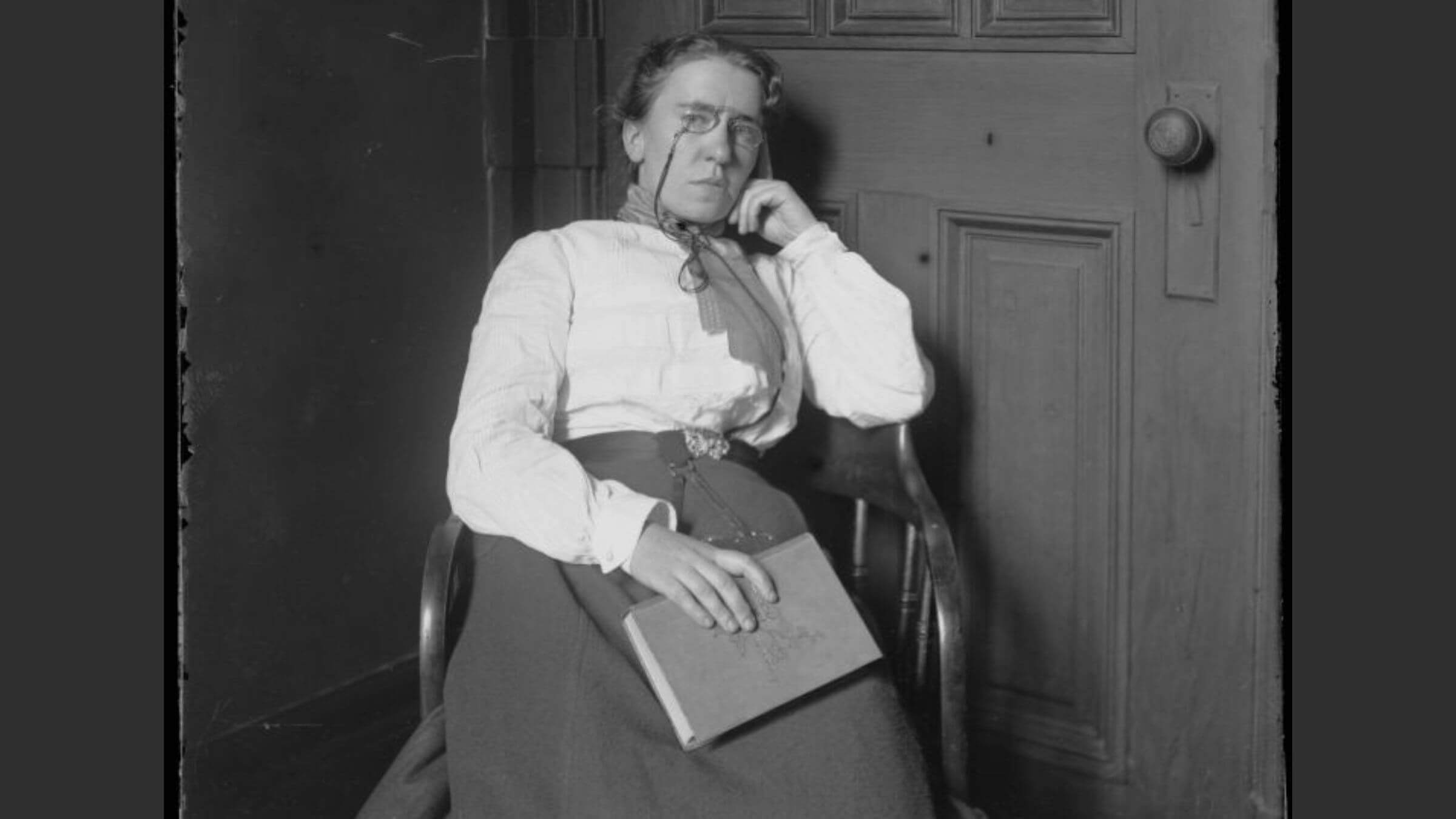
Emma Goldman in 1906. Photo by Chicago Sun-Times/Chicago Daily News collection/Chicago History Museum/Getty Images

By PJ Grisar January 9, 2026
Lately I’ve been thinking about Emma Goldman, the Russian-born Jewish anarchist who attracted droves of followers in her 30-plus years in the United States. I’ve not really been focused on her place in history writ large, more her surprisingly robust soap box in the world of musical theater. For all her import to the American left, on Broadway she’s mostly a bit part. And that bothers me.
Lynn Ahrens and Stephen Flaherty’s Ragtime, now in a lauded revival at Lincoln Center, devotes a song to her 1906 speech at Union Square. From there she interprets the subtext of a meeting between the WASPy, rich character “Younger Brother” and Black pianist Coalhouse Walker Jr. As a featured player, minus ensemble numbers, she’s in the mix for less than 10 minutes — she features more in E.L. Doctorow’s novel.
When I saw the Encores production at New York’s City Center last year, I remembered that Goldman has a cameo in Stephen Sondheim’s Assassins; in a brief encounter that would later haunt her, she hands a pamphlet to William McKinley’s future assassin Leon Czolgosz. Her role there, played by a member of the ensemble who doubles other parts, is even smaller.
While on vacation in Colorado over New Year’s (I skied; the chair lift conked me in the head), I got an email about an upcoming production of a chamber opera called E.G.: A Musical Portrait of Emma Goldman. I had to know more. Was she finally getting her due?
The piece, which began performances at Theater for the New City on Jan. 8, is by composer Leonard Lehrman and librettist Karen Ruoff Kramer. It’s actually not new at all, just the most recent production of a story they’ve been telling — or gospel they’ve been spreading — for over 40 years. To date they’ve presented the piece, together with educational slides, in five countries, at universities and synagogues, for groups like the Workers Circle and to mark important anniversaries, like the centennial of the Haymarket Riot that helped radicalize Goldman. They believe the work is more topical than ever.
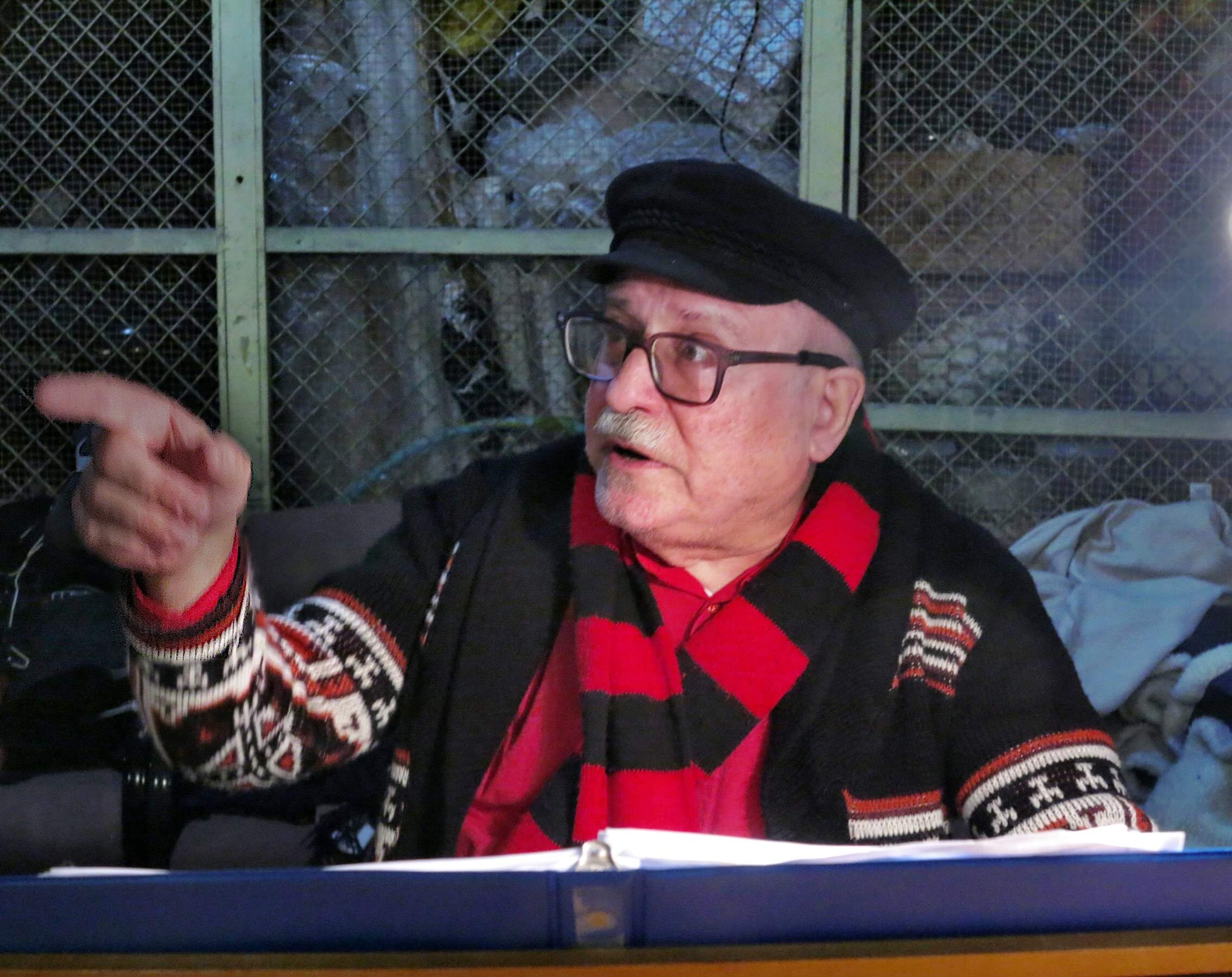
“She’s talking about how war drains the economy from everything else, and militarism, to stay alive, will look for an enemy or even create one artificially,” said Lehrman, whose piece features him on piano and acting as Goldman’s lover, friend and partner Alexander Berkman. (Caryn Hartglass plays the title role.)
“It’s happening right now,” added Lehrman, “the creation of an enemy in order to distract from domestic failure.”
Lehrman and Kramer began work on the musical in 1984, first basing it on historian Howard Zinn’s play Emma. As the pair researched Goldman’s life, the story took a different tack. The pair met as expats in Germany, and, given that connection, gravitated toward her life in exile, which began in 1919 when the U.S. deported her as a radical “alien.” The action of the piece tells her life story through the various parts of a visa application she filled out from St. Tropez in 1933. (The section on the form for “name” deals with identity and her marriages for which she took other surnames; for “sex” she offers the Austin Powers “Yes, please” — though Lehrman and Kramer wrote it first — and goes on like that, even covering her 1916 arrest at the Forward building for giving a talk about birth control.)
“I need America,” she says in the opening moments. “And I need to know: Does America need me now?”
It makes a certain sense for Goldman to express her ideas through song. Les Miserables, if nothing else, has shown the anthemic potential of staging a revolution. (Its signature anthem shows up in real-world protests with some regularity.)
Goldman is credited with saying, “If I can’t dance, it’s not my revolution,” a quotable that gets its own number in Lehrman’s musical. Speaking over Zoom, Lehrman wore a shirt with those words and a portrait of Goldman.
Lehrman noted that in addition to his opera, there are two other ones about Goldman they know of — one by Elaine Fine, made in collaboration with Zinn, and another by Canadian composer Gary Kulesha.
Given her radical bona fides and thoughts about capitalism, some may wonder if Goldman might clash with the format of musical drama. We don’t have too much to go on for musicals, as the form as we now know it arguably wasn’t established until around 13 years before her death, with Showboat (it debuted in 1927, after her deportation; one suspects she would approve of how it addressed racial prejudice).
In her time, opera for the bourgeois and Vaudeville for the masses were popular musical entertainment. While Goldman turned down offers to appear on Vaudeville stages, Samantha M. Cooper, professor of Jewish Studies at the University of Kansas, observed in a 2023 lecture, Goldman was a fan — if also a critic — of opera, writing about it with some frequency in her magazine Mother Earth, and even in a lecture notes in admiration of Richard Wagner.
Cooper argues that perhaps Goldman’s most pivotal reference to opera comes in her memoir, Living My Life. In it Goldman recounts how, after watching a performance of Carmen at the Met, her mentor Johann Most asked her to recall her first experience at the opera in Königsberg.
She vividly recounted seeing Il trovatore as a school girl, where she “first realized the ecstasy music could create in me.” Hearing her impassioned reflection, Most told Goldman she had talent and must “begin soon to recite and speak in public.”
“He grinned and emptied his glass to my ‘first public speech,’” Goldman recalled.
Could it be that we have opera, then, to thank for Emma Goldman’s oratory, and so, her future presence in musicals?
E.G. makes clear that the firebrand activist is not so uni-dimensional as Ragtime and Assassins make her seem. Her life was limned with contradictions. She enjoyed the finer things — and also railed against fatcat industrialists up to the point of attempted murder.
Drawing from letters historian Candace Falk found in the back of a record store — the owner showed them to her when she learned her dog was named “Red Emma Goldman” — Lehrman and Kramer’s piece reveals Goldman as a sexual creature with a biting wit. And it makes the case that while she was condemned to a life away from America for her so-called subversion, she was nonetheless a patriot.
“It’s important that people see that there was a courageous way of being very much American that was not the same thing as just buckling under when McCarthy comes and says, ‘You guys have to shut up now,’” said Kramer.
Though the portrait in E.G. makes for a more comprehensive profile than the one now at Lincoln Center, it also presents something larger in its invitation to consider her legacy.
“E.G. means ‘For example, take this example,’” said Kramer. “Not in the sense of cloning Emma in all respects, but certainly the insistence on understanding and the courage to push for things that are right, even if they’re not popular, and that others should do that too.”
In the canon of musical theater, there are many examples to choose from. I like the one who dances. Sign me up for a shirt.
This is a moment of great uncertainty. Here’s what you can do about it.
We hope you appreciated this article. Before you go, we’d like to ask you to please support the Forward’s independent Jewish news this Passover. All donations are being matched by the Forward Board - up to $100,000.
This is a moment of great uncertainty for the news media, for the Jewish people, and for our sacred democracy. It is a time of confusion and declining trust in public institutions. An era in which we need humans to report facts, conduct investigations that hold power to account, tell stories that matter and share honest discourse on all that divides us.
With no paywall or subscriptions, the Forward is entirely supported by readers like you. Every dollar you give this Passover is invested in the future of the Forward — and telling the American Jewish story fully and fairly.
The Forward doesn’t rely on funding from institutions like governments or your local Jewish federation. There are thousands of readers like you who give us $18 or $36 or $100 each month or year.
Support our mission to tell the Jewish story fully and fairly.