I’m probably going to be on the government’s list of Jews at UPenn
The recent ruling could well revive campus-wide anxieties that have been dormant for some time
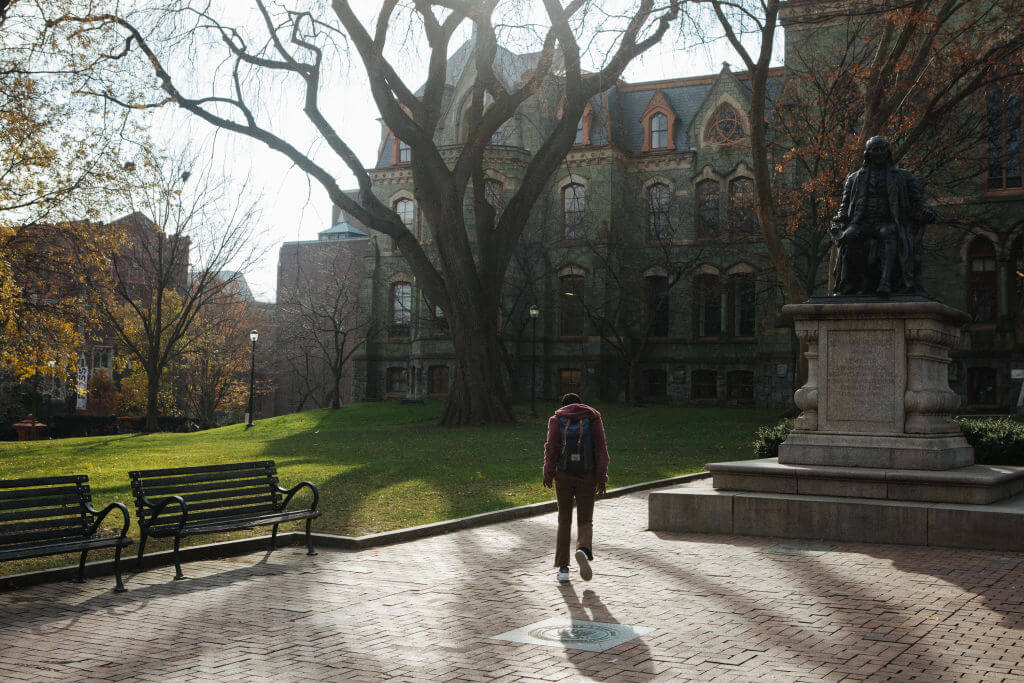
The University of Pennsylvania campus, in Philadelphia Photo by Michelle Gustafson/Bloomberg via Getty Images

By Olivia Haynie April 12, 2026
When I graduated from the University of Pennsylvania in 2024, tensions on campus about Israel and Gaza felt hotter than ever. Nearly every week of my senior year, another student or faculty member was being doxxed online for their politics. In the middle of spring finals, police forcibly disbanded the pro-Palestinian encampment in the center of campus. A week later, and four days before graduation, pro-Palestinian activists occupied a campus building, leading to another confrontation with law enforcement and arrests. At graduation, several students whipped out Palestinian flags and signs about justice for Palestine as they walked the stage.
I will once again be a Penn student come fall, having been accepted to the school’s sociology Ph.D. program. Last month, when I returned to campus for the department’s open house, I was surprised that I didn’t notice even a trace of the conflict I had left behind. The fences that had been erected around College Green to prevent a second encampment were gone. There were no cardboard signs about Palestine or Israel on Locust Walk. Talking with my professors and friends still at Penn, they confirmed that pro-Palestinian activism on campus had died down, likely due to a mix of intimidation on the part of the school administration — which only got more intense after the federal government got involved — and a loss of energy in activist spaces.
It’s not that students became completely disconnected: The university still offers clubs for students with a wide range of political perspectives, and courses on Israel and Gaza. But it seemed like the Penn I would be returning to in August had established some semblance of calm, albeit in part due to the university restricting open expression.
Now, the recent ruling that Penn must comply with the federal government’s demand for a list of students and faculty affiliated with Jewish groups and organizations — a sweeping categorization that could include anyone involved in Jewish Studies or Jewish associations regardless of their actual identity — could threaten to bring back the campus wide anxieties when doxxing and harassment were at their highest.

The Equal Employment Opportunity Commission’s investigation began in December of 2023, with a stated goal of determining if the university was failing to properly protect Jewish employees from discrimination and harassment. In March 2025, the EEOC asked Penn for membership lists of Jewish campus groups and names of Jewish Studies employees. Penn refused, instead offering to inform all employees about the investigation and how to contact the EEOC if they felt like they had an incident to report. This didn’t satisfy the EEOC, leading to subpoenas, lawsuits and countersuits. And it’s not over yet: Penn has indicated the school plans to appeal the decision forcing the handover of student and faculty names.
Although the EEOC’s jurisdiction is workplace discrimination, some of the lists the EEOC are asking for include students. One such group is those who were involved in confidential listening sessions conducted by the university’s antisemitism task force where Jewish students shared their experiences on campus.
I’ll go ahead and get ahead of the EEOC and make it known that I attended one of these listening sessions. Their confidentiality made them one of the few places on campus where Jewish students could feel comfortable openly discussing their feelings about the situation in Israel and Gaza as well as events at Penn. It was the administration’s way of giving Jews room to be vulnerable — and now the government is weaponizing it against the university.
The irony is stark. Under the auspices of protecting the interests of Jewish students and faculty, the EEOC is threatening the sanctity of the spaces where Jewish students and faculty feel safe.
For me, it’s hard not to feel like part of how we got here is that different political camps of the Jewish community could never seem to figure out how to speak to one another after Oct. 7. There was never really a clear idea of what Jewish students wanted political activity on campus to look like, with some advocating for a complete ban of encampments and anti-Israel referendums and others fully supporting them. Ultimately, I think what most people wanted on campus was a sense of civility, the feeling that screaming matches between pro-Israel and pro-Palestinian students wouldn’t constantly erupt in the middle of campus, but different factions were too busy arguing with each other to make a well-thought-out plan for how to achieve that.
The faculty who originally complained to the EEOC clearly thought getting the federal government involved was the catch-all solution. But instead, after two of the four classes of undergraduate students who lived through the conflict have graduated, and students are talking to each other in organized dialogue, the EEOC wants to revisit old wounds. The EEOC has discretion when it comes to what steps they choose to take, including issuing a subpoena and determining how to gather information they believe is necessary to their investigation. They have decided to use that discretion to gather information in a way that resurfaces generational trauma for Jews.
After such a period of divisiveness at Penn, it’s telling that an unidentified professor told the student paper The Daily Pennsylvanian that “a remarkably ideologically, religiously, and politically diverse array of organizations and individuals have united” against the subpoena. I didn’t always see eye to eye with the Penn Hillel leadership while I was an undergraduate student, but I agree with their assertion, in the statement they released last week that, “accountability in the face of discrimination is essential, but it must not be achieved by compromising the security of any minority community.”
Despite all the anxiety and frustration this development has provoked, I am choosing to look on the bright side: It seems like Penn’s Jews have finally found something they can unite over.
This is a moment of great uncertainty. Here’s what you can do about it.
We hope you appreciated this article. Before you go, we’d like to ask you to please support the Forward’s independent Jewish news. All donations are still being matched by the Forward Board - up to $100,000 until April 24.
This is a moment of great uncertainty for the news media, for the Jewish people, and for our sacred democracy. It is a time of confusion and declining trust in public institutions. An era in which we need humans to report facts, conduct investigations that hold power to account, tell stories that matter and share honest discourse on all that divides us.
With no paywall or subscriptions, the Forward is entirely supported by readers like you. Every dollar you give is invested in the future of the Forward — and telling the American Jewish story fully and fairly.
The Forward doesn’t rely on funding from institutions like governments or your local Jewish federation. There are thousands of readers like you who give us $18 or $36 or $100 each month or year.

Support our mission to tell the Jewish story fully and fairly.