Catholic Activist: Extremist Comparisons Unfair
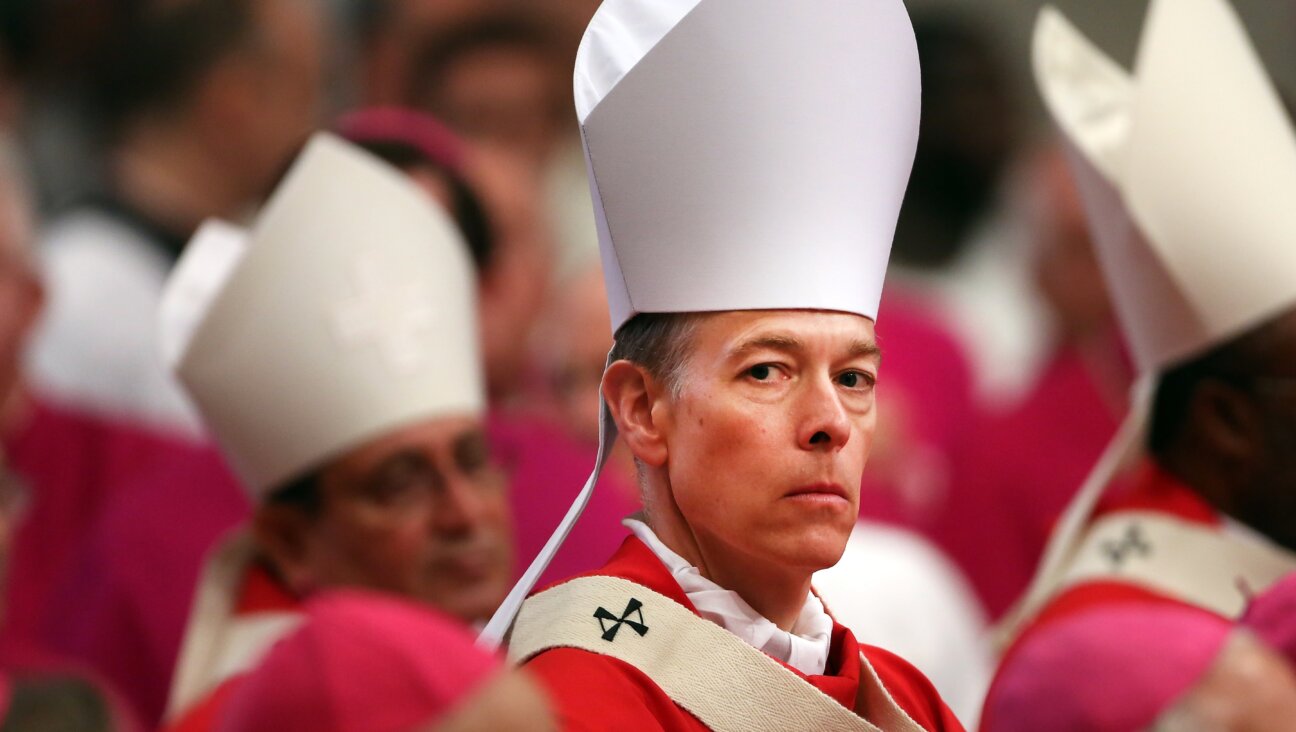
This week, William Donohue, president of the conservative Catholic League for Religious and Civil Rights, received an e-mail comparing his organization to the Muslims rioting across the world.
Donohue has not led the charge against the cartoons of the Prophet Muhammad that first appeared in a Danish newspaper. But he has a long track record of criticizing movies, art exhibits and television programs that his organization deems offensive to Christians.
Citing one of those past campaigns, a self-described Catholic from Frisco, Texas, sent an e-mail to Donohue comparing his group’s past conduct to the Muslim response to the Muhammad cartoons. The writer mentioned the Catholic Legaue’s role in prompting Comedy Central to pull an episode of “South Park,” the raunchy adult cartoon program.
“Your actions were the same as the outraged Muslims and differ only by degree,” the letter writer argued.
Donohue told the Forward that he bristles at such comparisons between Christian activists like himself and Muslim hard-liners.
“We’re just like them? Why? Because I protest?” he said. “There’s a difference between my free speech… and someone who calls for beheading.”
This is not the first time that Donohue and other American Christian activists have found themselves compared to Muslim extremists. Such comparisons have been used to criticize Christian opposition to the 1988 movie “The Last Temptation of Christ”; an allegedly homosexual character on the late-1990s children’s show “Teletubbies,” and an exhibit at the Brooklyn Museum in the late 1990s that featured portraits of the Virgin Mary smeared with elephant dung.
While Christian activists and groups were accused of attempting to censor the disputed materials, their tactics included lobbying and boycotts, not threats of violence or actual rioting.
Liberal critics have compared the Christian reaction to “The Last Temptation of Christ” to the Muslim reaction to Salman Rushdie’s 1989 novel, “The Satanic Verses,” despite the different tactics employed by the two religious camps.
In the United States, the release of “The Last Temptation of Christ” — directed by Martin Scorsese and intended to portray the “earthly” temptations that Jesus faced — was protested by Christian activists, 25,000 of whom gathered at the headquarters of Universal Pictures the day before the release. Ultimately, both United Artists and General Cinemas, now owned by AMC, refused to screen the picture in thousands of movie theaters across the country.
A year later, Rushdie’s “The Satanic Verses,” was published and banned in several countries, including India, Saudi Arabia and South Africa. Iran’s supreme leader, Ayatollah Ruhollah Khomeini, issued a fatwa calling for Rushdie’s death and offered a $3 million reward to the killer. Although Rushdie eluded harm, the book’s Japanese translator and Norwegian publisher were slain. Also, several facilities linked to the book were firebombed, including a bookstore at the University of California, Berkeley.
This is a moment of great uncertainty. Here’s what you can do about it.
We hope you appreciated this article. Before you go, we’d like to ask you to please support the Forward’s independent Jewish news this Passover.
This is a moment of great uncertainty for the news media, for the Jewish people, and for our sacred democracy. It is a time of confusion and declining trust in public institutions. An era in which we need humans to report facts, conduct investigations that hold power to account, tell stories that matter and share honest discourse on all that divides us.
With no paywall or subscriptions, the Forward is entirely supported by readers like you. Every dollar you give this Passover is invested in the future of the Forward — and telling the American Jewish story fully and fairly.
The Forward doesn’t rely on funding from institutions like governments or your local Jewish federation. There are thousands of readers like you who give us $18 or $36 or $100 each month or year.
Support our mission to tell the Jewish story fully and fairly.