The last presidential debate changed history. Here’s what Jews should watch for in the next
Some American Jews feel ‘torn’ between the candidates, said historian Jonathan Sarna
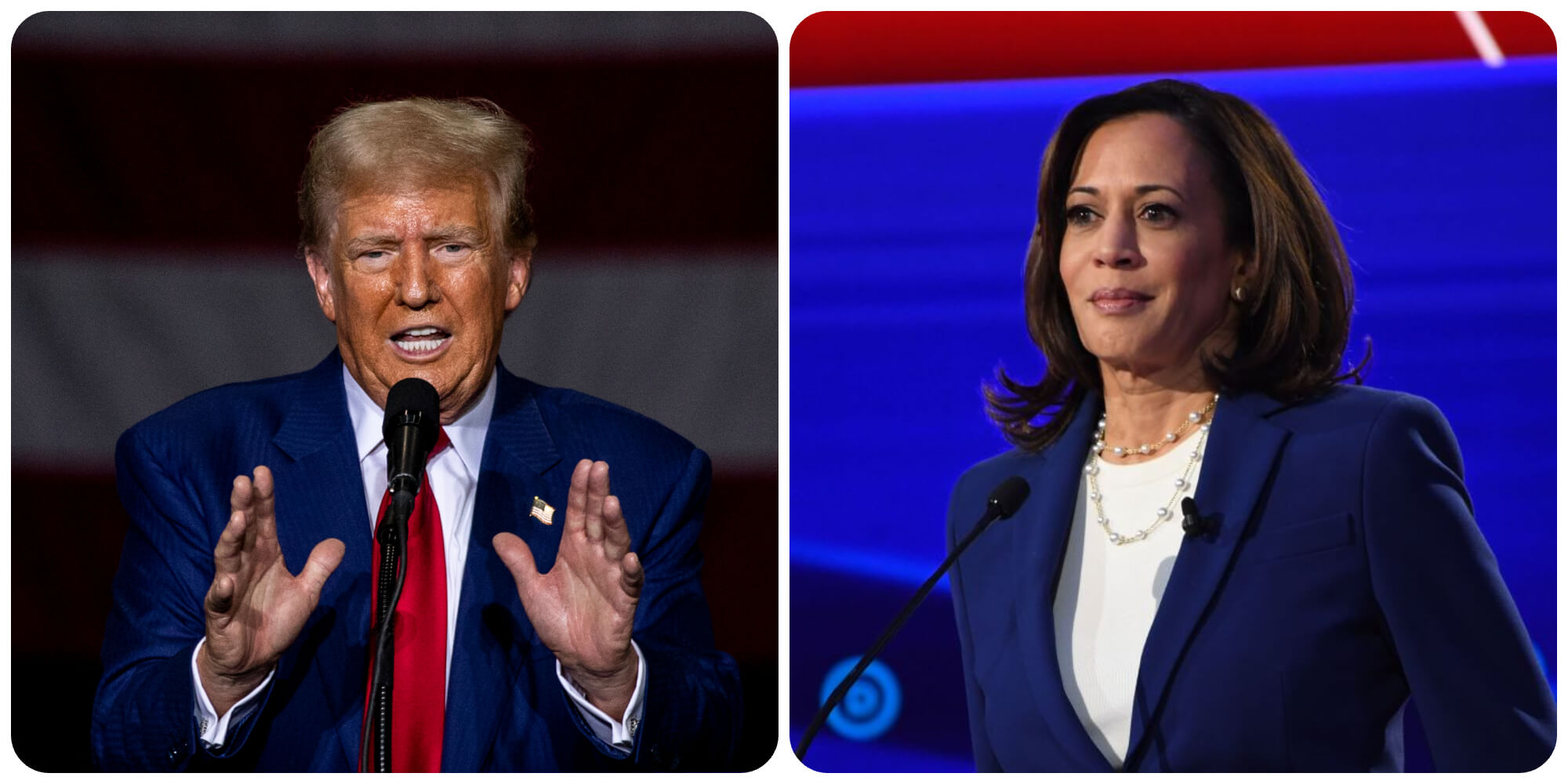
Former president Donald Trump at a campaign event in Michigan in August and Vice President Kamala Harris during a presidential primary debate in Oct. 2019. Photo by Saul Loeb via AFP/Getty Images; Emily Elconin via Bloomberg/Getty Images


By Lauren Markoe and Jacob KornbluhSeptember 7, 2024
As Joe Biden’s wobbly performance at his June matchup against Donald Trump proved, sometimes presidential debates really are consequential.
In the since-reconfigured and exceedingly tight race between former Trump and Kamala Harris, a meaningful number of voters are still on the fence. But even Jewish voters who made up their minds long ago will be tuning in to hear more from both the former president and the vice president on Israel and antisemitism.
Those issues, surveys have long indicated, are usually secondary for Jewish Americans. This year, they loom larger.
“We’re almost a year out from Oct. 7, the worst attack on Jewish lives most of us have seen in our lifetimes, and we’re seeing now a resurgence of open antisemitism,” said Ann Lewis, co-chair of the Democratic Majority for Israel and a former White House official. “So the stakes are currently higher.”
The debate, which is likely to be the only matchup between Trump and Harris before Election Day, will be hosted by ABC News in Philadelphia at 9 p.m. ET. ABC anchors David Muir and Linsey Davis will moderate.
Vice presidential candidates Sen. JD Vance of Ohio and Gov. Tim Walz of Minnesota will debate on Oct. 1.
Watching through Jewish eyes
American Jews will be watching with concerns, said Jonathan Sarna, professor of American Jewish history at Brandeis University.
They worry about Trump and Vance “kowtowing to well-known antisemites on the right,” such as Tucker Carlson, said Sarna, referring to the informal adviser to the campaign and former Fox News host.
Watching Harris and Walz, he said, some will ask to what extent they’re catering to the progressive or the “woke left.”
“Many American Jews, at least those who haven’t made up their minds, feel torn,” he said, unsure of which party they trust more to stand by them. “There are problems on the right. There are problems on the left.”
Tevi Troy, senior White House aide to President George W. Bush, said he’s heard Harris back Israel strongly at times, as she did last week after Hamas killed Israeli-American Hersh Goldberg-Polin and five other hostages. But he’s also heard her offer sympathy to Israel’s critics, particularly when she speaks extemporaneously. “That loses Jews,” he said.
Debate moderators haven’t asked much about Israel in the past because there’s been bipartisan support for it, “but now it’s obviously a big issue,” Troy said. “I was surprised it didn’t come up more in the first debate, and I would be surprised if it doesn’t come up in this debate.”
Polls show Jewish voters feel an attachment to Israel, though that connection is weaker among younger American Jews.
Lewis said American Jews will watch the debate looking for a leader who emphasizes common themes for the nation and not one who “sets people against each other.”
“That is particularly important for Jews,” she added, “because we’re always going to be the minority.”
This is a moment of great uncertainty. Here’s what you can do about it.
We hope you appreciated this article. Before you go, we’d like to ask you to please support the Forward’s independent Jewish news this Passover. All donations are being matched by the Forward Board - up to $100,000.
This is a moment of great uncertainty for the news media, for the Jewish people, and for our sacred democracy. It is a time of confusion and declining trust in public institutions. An era in which we need humans to report facts, conduct investigations that hold power to account, tell stories that matter and share honest discourse on all that divides us.
With no paywall or subscriptions, the Forward is entirely supported by readers like you. Every dollar you give this Passover is invested in the future of the Forward — and telling the American Jewish story fully and fairly.
The Forward doesn’t rely on funding from institutions like governments or your local Jewish federation. There are thousands of readers like you who give us $18 or $36 or $100 each month or year.

Support our mission to tell the Jewish story fully and fairly.