Synagogue protests have shocked NYC and LA. This Michigan congregation has faced them for 22 years
At Beth Israel Congregation in Ann Arbor, protests have become a weekly reality
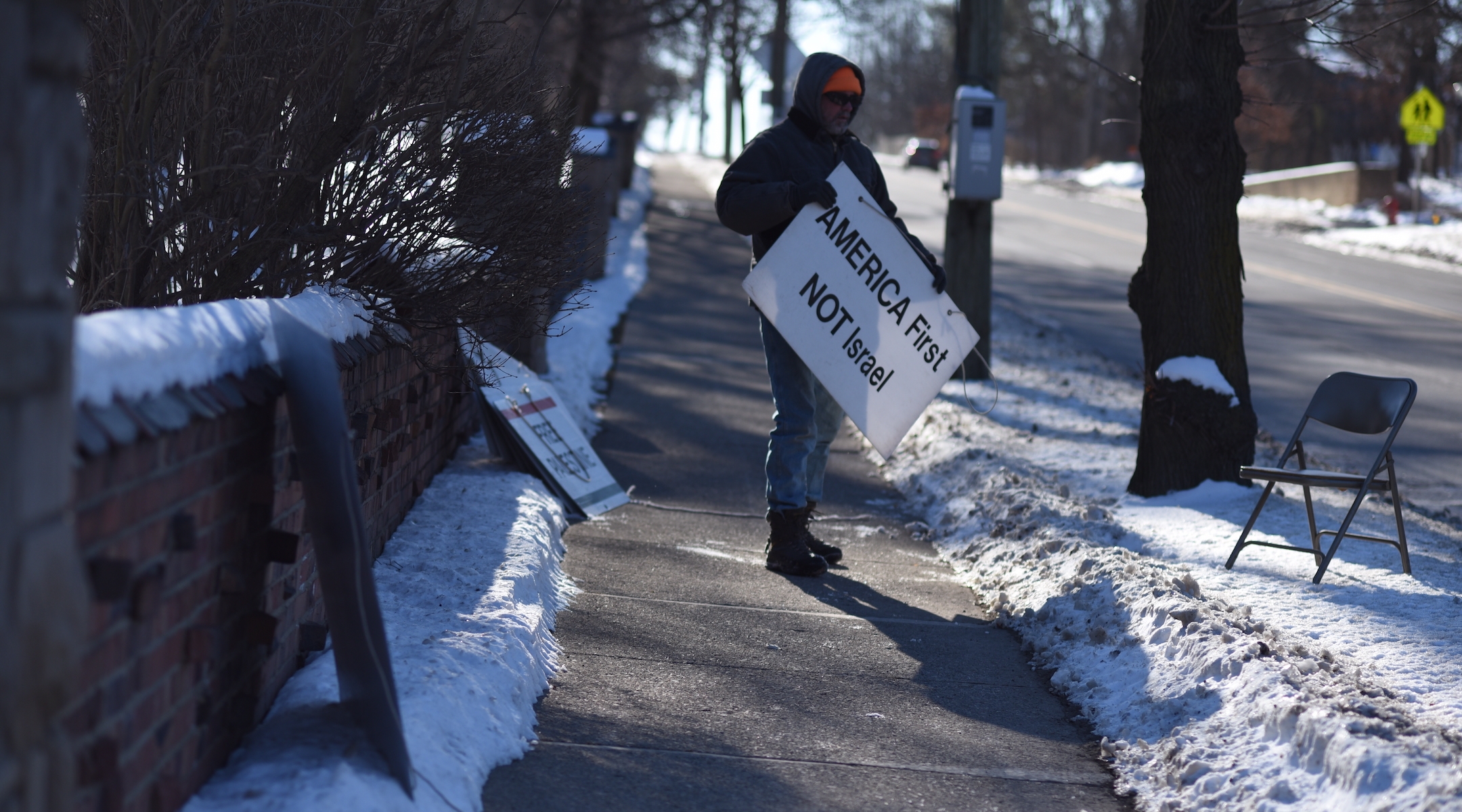
A protester stands outside Beth Israel Congregation in Ann Arbor, Michigan, in 2020. Photo by Alex Sherman/Jewish Telegraphic Agency

By Hannah Feuer December 4, 2025
Protests outside prominent synagogues in New York City and Los Angeles have roiled the Jewish community in recent weeks, prompting scrutiny of how authorities respond when demonstrators at a house of worship frame their actions as Israel-related political speech.
Rabbi Nadav Caine of Beth Israel Congregation in Ann Arbor, Michigan, has some experience with that: Every Shabbat for the past 22 years, protesters have shown up to Beth Israel holding signs with slogans like “Jewish Power Corrupts” and “No More Holocaust Movies.”
After years of legal battles that consistently sided with the protesters, Caine has been forced to accept that the courts view their actions as protected speech. More than two decades on, he has come to terms with the protesters’ enduring presence.
“There are longtime members who come as little as possible, or who left the congregation, but for the most part, people have learned to ignore it,” Caine said.
‘Unseemly and distasteful’
The man behind the protests, Henry Herskovitz, was raised Jewish, had a bar mitzvah, and even attended Beth Israel for years. But he later adopted conspiracy theories blaming Israel for 9/11, became a Holocaust denier, and openly expressed hatred for Jews.
Starting in 2003, Herskovitz and a small group began protesting at the synagogue weekly during Shabbat, brandishing signs like “Antisemitism is earned, never given.”
In 2019, fed up with passing the demonstrators, a congregant and local Holocaust survivor sued the protesters and the city, arguing that their First Amendment rights to safely practice their religion were being violated. The American Civil Liberties Union filed a brief in support of the protesters’ rights, acknowledging the speech was “unseemly and distasteful” but legally protected nonetheless.
Ultimately, the courts sided with the ACLU: A lower court dismissed the case, the Supreme Court declined to hear it on appeal, and a district judge ordered the congregants to pay nearly $159,000 in legal fees to the protesters — prompting the congregants’ lawyer, Marc Susselman, to accuse the judge of antisemitism.
Now, while the number of protesters has dwindled — it’s typically two people nowadays, Caine said — they still show up, week after week.
Caine said the sustained protests have affected membership, particularly as newcomers weigh which synagogue to attend. Some longtime members avoid in-person events, and others have left entirely. The display can also shock unsuspecting visitors attending bar or bat mitzvahs.
“Before you get used to it, it’s a little traumatizing and triggering,” he said.
‘A community issue’
Caine said he isn’t surprised by recent protests outside Park East Synagogue in Manhattan and Wilshire Boulevard Temple in Los Angeles. At Park East, demonstrators were protesting a synagogue event promoting immigration to Israel, chanting “death to the IDF” and “globalize the intifada.” At Wilshire Boulevard Temple, protesters took issue with the synagogue hosting speakers from the Israeli defense firm Elbit Systems.
Protesting at a synagogue is “not meant to raise consciousness about a human rights issue,” Caine said. “It’s about harassing a group.”
His advice for synagogues facing persistent protests: don’t engage. Beth Israel does not organize counterprotests, and Caine avoids posting about the protests on social media.
“These kinds of activists, they thrive on publicity. It’s their oxygen,” he said.
Still, Caine said he understands the desire to respond. One idea he finds promising: In New York City, two Jewish lawmakers introduced a bill that would ban protests within 25 feet of houses of worship. Mayor-elect Zohran Mamdani has reportedly been receptive to the legislation.
Caine also cautioned against turning the protests outside synagogues into a political debate.
“I wouldn’t make it about the Israel issue,” he said. “I would make it about the fact that it’s a community issue.”
Correction: A previous version of this article misstated the ACLU’s role in the case. The ACLU filed an amicus brief in support of protesters’ rights but did not represent them as counsel.