Australia’s Jewish community is defined by Holocaust survivors, Yiddishkeit and immigrants
The attack on a Hanukkah celebration in Sydney targeted a thriving Jewish community
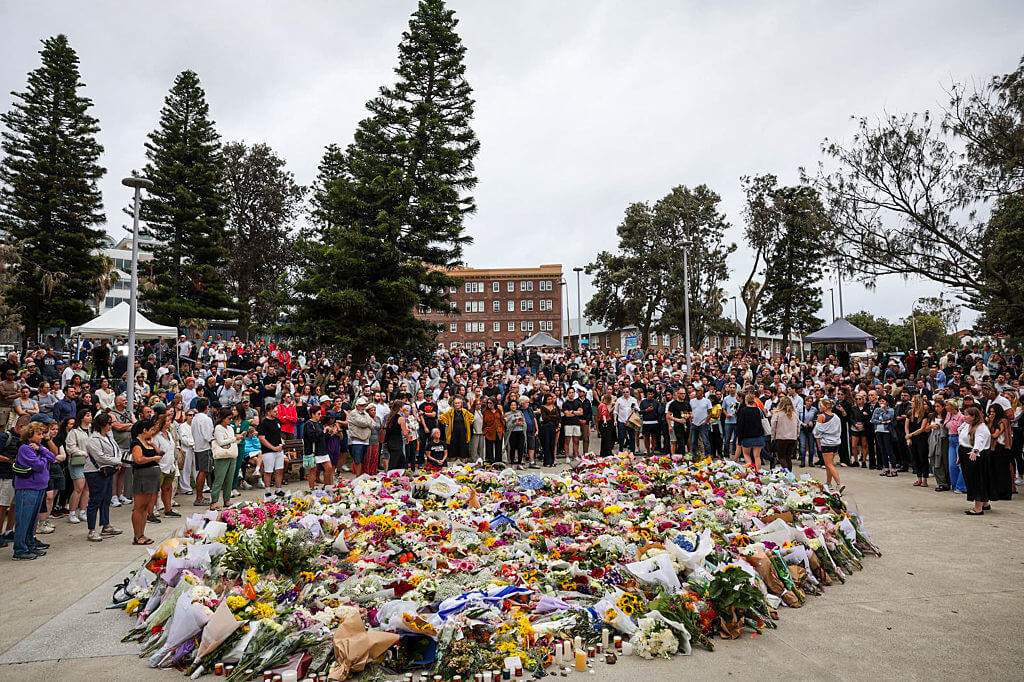
Mourners gather to lay flowers at Bondi Beach in Sydney. Police say 15 people were killed and more than 40 others injured when two attackers opened fire near a Hanukkah celebration at Bondi Beach. Photo by Izhar Khan/Getty Images

By Hannah Feuer December 15, 2025
An attack on a Hanukkah celebration at Bondi Beach in Sydney on Sunday killed 15 people and left Jewish communities reeling worldwide. The violence has also drawn attention to the resilience of Australia’s distinctive Jewish community, shaped by the world’s largest concentration of Holocaust survivors outside Israel, a thriving Yiddish scene, and a large number of South African Jewish immigrants.
Demographics and culture
About 117,000 Jews live in Australia, according to 2021 Census figures adjusted for likely undercounting. The community is largely urban, with 84% living in either Melbourne or Sydney.
Just over half of Australian Jews were born in the country. Among those born overseas, the largest immigrant groups come from South Africa and Israel.
Religious practice within the community is diverse, with roughly 4% identifying as Haredi, 18% as Modern Orthodox, 33% as traditional or Conservative, 11% as Reform, and 21% as secular. In other respects, the community is uniquely cohesive: About half of children attend Jewish day schools — the highest rate for Jewish day school attendance outside of Israel.
Australia has a longstanding, active Yiddish-speaking community. Yiddish is a required daily subject at Melbourne’s Sholem Aleichem College, a secular day school with roots in the Jewish Labor Bund founded in 1947. Kadimah, a Jewish cultural center and library in Melbourne founded in 1911, stages plays in the language. The annual Australian “Sof-Vokh Oystralye” retreat, founded in 2004, immerses attendees in 48 hours of speaking Yiddish exclusively. In recent years, a revival of Yiddish language and culture among young Australians has also drawn attention, with some embracing it as a “language of protest.”
Being in the Southern Hemisphere, Australians celebrate Hanukkah during their summer, taking pride in being among the first in the world to light the holiday candles due to their early time zone.
A destination for refugees
The Australian Jewish population nearly tripled in size from 1938 to 1961. The influx was driven by Holocaust survivors, Hungarian refugees who arrived after the Hungarian Uprising of 1956, and British Jews who migrated under the “Ten Pound Poms” program, which allowed them to move to Australia for just 10 pounds.
In the aftermath of World War II, Australia accepted Holocaust survivors who were living in displaced persons camps, at a time when many countries either refused to take them or imposed strict quotas — including the United States.
Not only was Australia one of the few countries willing to accept survivors, it was also just about as far from Europe geographically as one could get, offering a sense of safety in its isolation.
Yet the acceptance of Jewish refugees was at times begrudging. Minister for Immigration Arthur Calwell sold large-scale immigration in the aftermath of World War II not as a humanitarian concern, but under the slogan “populate or perish,” reflecting the need for population growth to boost the economy and enhance national security.
Calwell also covertly introduced bureaucratic measures to limit the number of Jewish Holocaust survivors allowed to enter Australia, including restricting the number of Jewish survivors permitted on ships leaving Europe to a quarter of all passengers.
But Calwell’s efforts to limit Jewish immigration ultimately fell short. In the aftermath of the war, roughly 27,000 Holocaust survivors settled in Australia. As of 2023, about 2,500 of those survivors were still living.
One of them, Alexander Kleytman, who immigrated to Australia from Ukraine, was killed in Sunday’s attack at Bondi Beach while protecting his wife.
Australia’s relationship with Israel
Relations between Israel and Australia have been increasingly strained in the past year. Prime Minister Anthony Albanese had been sharply critical of Israel’s conduct in Gaza, calling Israel’s “excuses and explanations” for blocking aid to Gaza “an outrage.”
Tensions further escalated in September, when Australia was one of about 150 countries that moved to recognize a Palestinian state. In response, Israel revoked the visas of Australian representatives to the Palestinian Authority.
Yet Australia and Israel have historically been strong allies. Australia’s first external affairs minister, Herbert Vere “Doc” Evatt, played a key role in the United Nations partition plan for Palestine and the creation of the Jewish state.
In 2017, Israeli Prime Minister Benjamin Netanyahu became the first incumbent Israeli leader to visit Australia, and former Australian Prime Minister Scott Morrison had said he was considering recognizing Jerusalem as the Israeli capital. But that position was reversed in 2022 after Albanese, a member of the Labor Party, took office.
Relations deteriorated further after an arson attack on a historic synagogue in Melbourne in December. Netanyahu sharply criticized Australia’s government, saying, “It is impossible to separate the reprehensible arson attack from the federal government’s extreme anti-Israeli position.”
Following the attack on a Hanukkah celebration at Bondi Beach, Netanyahu doubled down, saying he had warned Albanese that “your call for a Palestinian state pours fuel on the antisemitic fire.” Albanese rejected any link between the two, arguing that support for a two-state solution is a widely held position.
Clarification: This article has been updated to clarify that interest in Yiddish extends beyond a recent revival among young people and reflects a community sustained over time.
This is a moment of great uncertainty. Here’s what you can do about it.
We hope you appreciated this article. Before you go, we’d like to ask you to please support the Forward’s independent Jewish news this Passover. All donations are being matched by the Forward Board - up to $100,000.
This is a moment of great uncertainty for the news media, for the Jewish people, and for our sacred democracy. It is a time of confusion and declining trust in public institutions. An era in which we need humans to report facts, conduct investigations that hold power to account, tell stories that matter and share honest discourse on all that divides us.
With no paywall or subscriptions, the Forward is entirely supported by readers like you. Every dollar you give this Passover is invested in the future of the Forward — and telling the American Jewish story fully and fairly.
The Forward doesn’t rely on funding from institutions like governments or your local Jewish federation. There are thousands of readers like you who give us $18 or $36 or $100 each month or year.
Support our mission to tell the Jewish story fully and fairly.