Why Venezuela’s Jews are optimistic about their country’s future — even as the government promotes anti-Israel conspiracies
Venezuelan acting president Delcy Rodriguez said Maduro’s capture had ‘Zionist undertones’
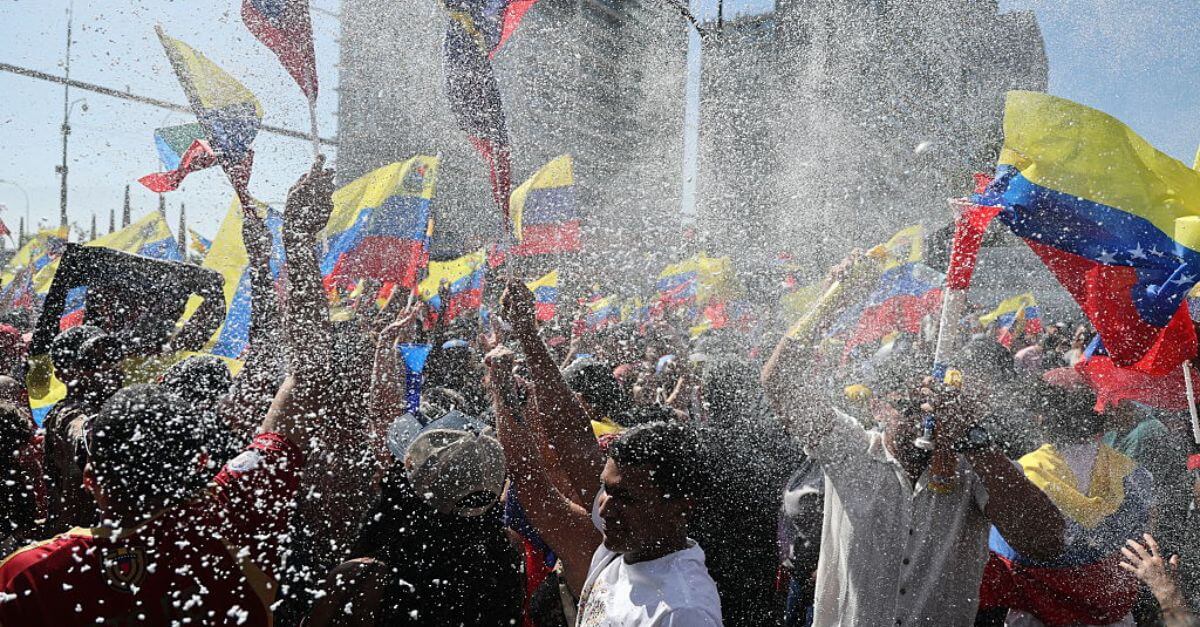
Venezuelans living in Chile celebrate in Santiago, after U.S. forces captured Venezuelan leader Nicolas Maduro. Photo by Javier Torres/AFP via Getty Images

By Hannah Feuer and Simone SaidmehrJanuary 6, 2026
In Venezuela, where the citizenry has largely been supportive of Jews but the government has embraced anti-Zionist rhetoric, the shrinking Jewish community is watching closely as the country enters a period of political uncertainty.
Once a community of 25,000 Jews at its peak in the early 1990s, today there are between 3,000 and 5,000 Jews living in Venezuela. Many emigrated in the early 2000s, fleeing not because of antisemitism, but due to political and economic turmoil, according to Rabbi Pynchas Brener, the former Ashkenazi Chief Rabbi of Caracas, who lives in Miami.
Now, there is hope that the country’s government could move toward democracy — and even the possibility that some of the many Jews who fled the country might return, Brener told the Forward.
Still, it is a cautious optimism, with uncertainty surrounding who will permanently succeed Maduro to lead the government.
‘Zionist in character’
For Venezuelan Jews, that hope may be tempered by recent comments from Venezuela’s acting president, Delcy Rodríguez, who described the U.S. military intervention as “without a doubt, Zionist in character” — promoting a conspiracy blaming Israel for Maduro’s capture.
But some Venezuelans say that’s the kind of rhetoric they’ve come to expect from their government.
After being accused of stealing the 2024 presidential election, Maduro blamed “international Zionism” for the protests that erupted in its aftermath. In November, he declared that “the far-right Zionists want to hand this country over to the devils.”
“It’s nothing new,” said Samy Yecutieli, a Venezuelan Jew who immigrated to Israel in 2017 to give his kids a better life. “The Venezuelan government is against the State of Israel. Venezuelans, the common people, are not antisemitic, like you see in other places.”
Before 1999, the Jewish community “was very much respected in Venezuelan society,” according to Dina Siegel Vann, director of the Latino and Latin American Institute of the American Jewish Committee. “You had some really outstanding professionals, intellectuals, etc. And until Chavez came to power, that was the case. There was almost no antisemitism.”
Relations between Israel and Venezuela soured when former President Hugo Chávez took office in 1999, and Venezuela openly aligned itself with Iran and became a ripe environment for Hezbollah-linked financial and logistical networks.
Under Chávez, Jewish institutions were subjected to police raids, including two operations at the Club Hebraica Jewish community center in 2004 and 2007. In 2009, Chávez severed diplomatic ties with Israel over Israel’s treatment of Palestinians during that year’s Gaza war and publicly implored Venezuela’s Jewish community to rebuke Israel for its actions.
Jewish life in Venezuela, however, has persisted — despite roughly 20,000 Jewish Venezuelans leaving the country over the past decade alone.
There are estimated to be 15 Orthodox synagogues in Venezuela. There are also Jewish schools, community centers, and a Jewish home for seniors, according to Brener.
The community is “very tight knit, very well organized, all sorts of institutions — even though they’re so reduced in numbers,” Brener said.
Venezuela’s Jewish community is also characterized by its strong support for Israel, according to Siegel Vann, who described Latin American Jewry as “mega-Zionist.” However, she said, Venezuelan Jews must express their connection to Israel “under the radar.”
For the past 20 years, the regime has used antisemitism strategically, she said, “either when they want to divert attention or to send messages to the United States.” “The Jewish community is always trying to react on a case-by-case basis,” she said. “They understand that any activity or any position that they can take on behalf of Israel can be misconstrued, so they have to be very careful and cautious.”
Optimism is tempered for a community that has borne the brunt of such tactics. “They’re hopeful, but right now, it’s very difficult to dismantle a state that was run a certain way for 25 years,” Brener said. “But for the first time in over two decades, it’s finally in the right direction.”
Correction: A previous version of this article misspelled the name of Samy Yecutieli.
This is a moment of great uncertainty. Here’s what you can do about it.
We hope you appreciated this article. Before you go, we’d like to ask you to please support the Forward’s independent Jewish news this Passover. All donations are being matched by the Forward Board - up to $100,000.
This is a moment of great uncertainty for the news media, for the Jewish people, and for our sacred democracy. It is a time of confusion and declining trust in public institutions. An era in which we need humans to report facts, conduct investigations that hold power to account, tell stories that matter and share honest discourse on all that divides us.
With no paywall or subscriptions, the Forward is entirely supported by readers like you. Every dollar you give this Passover is invested in the future of the Forward — and telling the American Jewish story fully and fairly.
The Forward doesn’t rely on funding from institutions like governments or your local Jewish federation. There are thousands of readers like you who give us $18 or $36 or $100 each month or year.
Support our mission to tell the Jewish story fully and fairly.