‘From a shtetl to a diaspora’: After the fire, a Palisades synagogue forges through a year in exile
One year after the Palisades fire, Kehillat Israel’s congregants — and its rabbis — await their return home
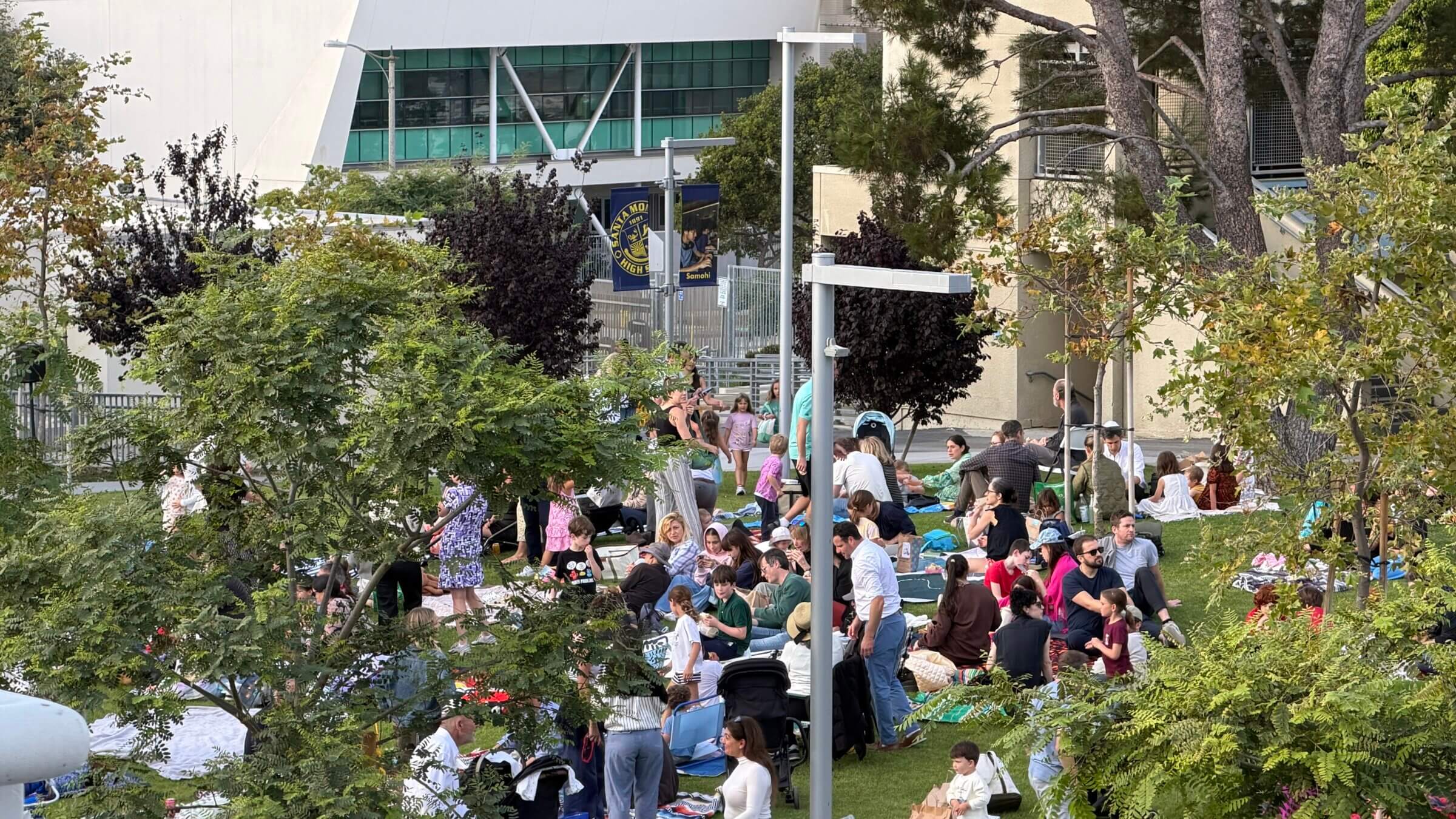
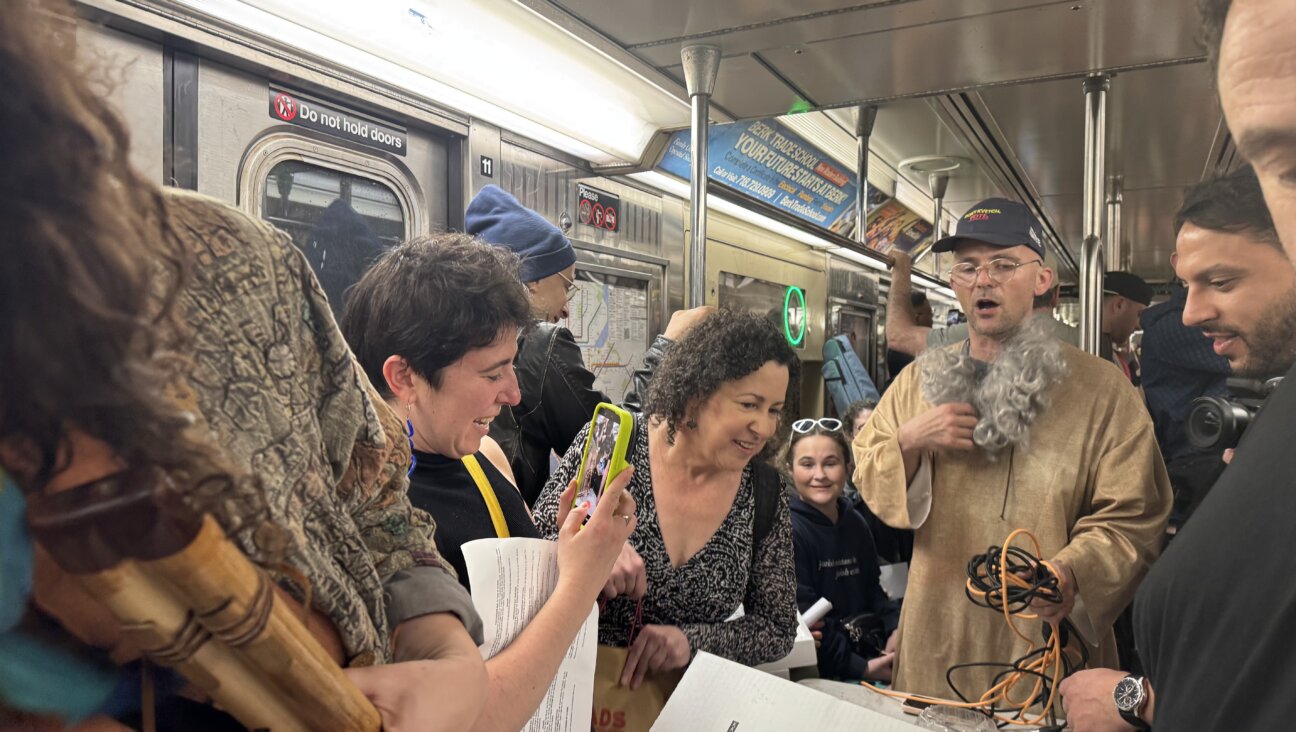
A year away from their synagogue forced Kehillat Israel to hold events in esoteric, often far-flung locations. Above, the congregation gathers after Rosh Hashanah services at a high school in Santa Monica. Courtesy of Kehillat Israel
By Louis Keene January 7, 2026
Jewish tradition carves grief into discrete periods of time. Shiva lasts a week. Shloshim — the post-funeral period when one does not receive a haircut — is 30 days. For the death of a parent, one says kaddish for 11 months. After a year, mourning officially concludes.
But what of the destruction of a home — or a whole neighborhood? At Kehillat Israel, some 250 families lost theirs in the Palisades fire that ignited last Jan. 7, among them three members of the synagogue’s clergy team. Another 250 or so families were temporarily displaced. And as the first anniversary of the fire arrives, the vast majority remain dispersed across Los Angeles County and beyond, unsure if or when they will return to the place they call home.
“The pace of healing is different in a situation in which we haven’t been able to fully move on,” Rabbi Daniel Sher, Kehillat Israel’s associate rabbi, said in an interview. “When you add infrastructure and city conditions and all the different nuances and circumstances, a year becomes very short.”
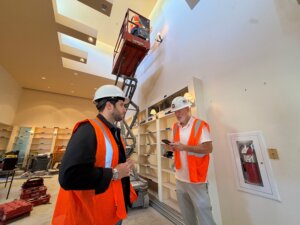
One of the few Pacific Palisades institutions spared by the flames was the synagogue, a fixture of the seaside community since the 1950s. But it, too, has been inaccessible to the congregation; with the building closed anyway for smoke damage remediation, Kehillat Israel — formerly Reconstructionist, now unaffiliated — underwent a planned interior renovation that is expected to be complete in March.
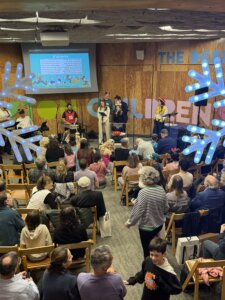
So for the last year, as hundreds of congregants wrangle with insurance companies and homeowner associations, await construction permits or weigh rebuilding, they have met in smaller, often makeshift settings. Weekly services are held in a children’s museum in nearby Santa Monica; a synagogue close by has been hosting KI’s religious school. Sher and senior rabbi Amy Bernstein, both of whom are still living with their families in temporary housing, have traveled around town to serve — and preserve — their community.
“We went from a shtetl to a diaspora,” Sher said. “So our members are still members, but our gathering points feel different.”
An unimaginable disaster
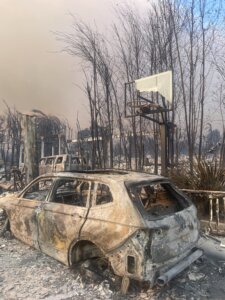
The blaze, one of the largest in the history of L.A., killed 12, destroyed nearly 7,000 structures and left the Pacific Palisades, an upscale town known for its coziness and exclusivity, virtually unrecognizable. Whole neighborhoods were wiped out, with countless iconic local landmarks badly damaged or reduced to rubble. KI members who lost their homes will never recover the ketubahs, menorahs and kiddush cups that infused their Jewish lives with meaning.
Yet the people whose homes were damaged, but not destroyed, have struggled as well. Thousands of Palisades residents had their insurance policies canceled months before the fire after the California insurance commissioner blocked an attempted rate hike; In lieu of private insurance, those homes were covered under the California FAIR Plan, the state’s last-resort insurer, which covers physical damage but not smoke damage, debris removal or alternative living expenses.
“Almost everybody was underinsured,” said Matt Ross, the president of KI’s board of trustees. “It’s a much more expensive process to rebuild than I think almost anybody realized.”
In the first days following the fire, the synagogue was able to help cover incidentals for congregants who were struggling to get money from their insurers. And with the financial backing of members and the local Jewish federation, KI covered membership dues this year for everyone displaced by the fire.
Still, the months that followed have been an ongoing nightmare for many congregants. People described fighting with their insurance adjusters, navigating inscrutable municipal bureaucracy and being at the mercy of their neighbors — who hold the power to block new construction in some HOAs.
While Kehillat Israel escaped the flames, it did not dodge insurance trouble. Ross said that last summer, with remediation ongoing — and with the synagogue’s claim still open — the building’s insurer informed KI that it would not renew its policy. The synagogue’s replacement coverage was many times more expensive, Ross said, taking a five-figure annual premium well into the six figures.
“These are the kinds of challenges that not only individuals, but a synagogue or other house of worship faces,” Ross said.
Community in exile
With congregants spread out across the Southland, the synagogue’s programming has moved to meet them, often in far-flung or esoteric locations.
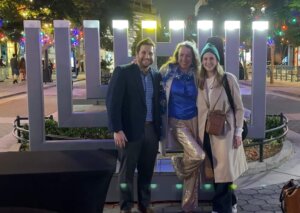
A congregant hosted a Sukkot gathering in Hermosa Beach — nearly 20 miles away (and a lifetime in traffic) from KI’s main sanctuary — and other events as far east as Hollywood and north in the San Fernando Valley. The synagogue threw a Purim party at a bowling alley and celebrated Hanukkah at a brewery. It didn’t hide from joy.
“There are moments where you’re laughing,” Bernstein said, “and actually for a second forget that you’ve been through this horrible, horrible ordeal.”
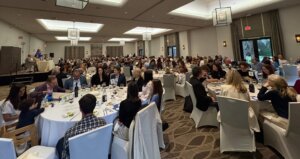
The most emotionally fraught Jewish event on the calendar was Passover. “I think for a lot of our folks, they had hosted Seder in the past, and they weren’t quite ready to figure out how to host not in their home,” Sher said. The synagogue hosted a Seder at a Bel Air hotel, where 300 people ate matzo and maror and shared the story of Jewish redemption.
And while no family heirloom can ever be replaced, new ones were being created. A national Judaica drive allowed L.A. wildfire victims to pick out ritual items from a veritable trove of donated candlesticks, prayer shawls and mezuzahs. Separately, KI organized a ketubah-and-vow-renewal ceremony, in which around 20 couples who had lost their Jewish marriage contracts in the fire signed new ones — and bore witness to each other’s marital vows.
That event was hosted at Leo Baeck Temple, one of countless local synagogues that have lent support to KI and other affected congregations in the past year. Sher said he and Bernstein had helped lead bar and bat mitzvah ceremonies in more than a dozen different sanctuaries in the last year.
“Anyone who’s going to pretend that this year hasn’t been weird, they’re being inauthentic,” Sher said. “But the fact that I still get to see that same bar and bat mitzvah family — just a different location, in a different venue, at a different moment — shows that we’re not going to be held back from these limitations. We’re still going to find ways to be together.”
Grieving alone, together
For the rabbis of Kehillat Israel, the scale of the tragedy could be hard to wrap one’s head around. On the one hand, no congregants perished in the fire — a clear blessing, or even a miracle. But there were well over a thousand who needed comforting — as did the rabbis themselves, who had been rendered homeless.
Bernstein, the synagogue’s senior rabbi, said that at first, she was just happy there was something she could do.
But days turned to weeks turned to months and she had barely been able to grieve her own losses: generations of family photos and correspondence; a lifetime of fine art collected from all over the world; a pair of shoes for every occasion and mood; and, of course, the home where she had raised her daughter.
When she finally took time off last August — seven months after the fire — she realized she had waited too long.
“When we’re being of service, that alleviates some anxieties and sense of vulnerability,” Bernstein said, “but it masks other ways that you’re exhausting what few resources you have left.”
For the last year, Bernstein, her daughter and their German shepherd have been living in Santa Monica, in the home of a generous congregant. The insurance money for her former home went to her HOA, which is approaching a vote on whether to rebuild it; Bernstein said even she wasn’t sure it made financial sense.
Like many congregants in the Palisades diaspora, she’s stuck in a holding pattern, wanting to buy new things but having nowhere to put them, as the rest of the world has seemingly moved on. The only people who get it are going through it themselves.
“There is this sense of belonging to a club no one wants to belong to,” she said. “But also it’s a real sense that we’ve been through something together, and we feel a little different than others who have no clue about what’s happened to us.”
Sher’s family, which has been living in Brentwood for the past year, is currently debating whether to rebuild on the lot that previously held their home, or find a different one.
He wasn’t sure how he’d be feeling on Wednesday, the first anniversary of the day he, Bernstein and so many others lost their homes.
Sher planned to take the day off work — attending a community gathering in the morning and spending the afternoon with his wife and three children.
“I’m going to give myself space for the fact that I’m not entirely sure where my head’s gonna be,” he said. “Again, this is a slow process, and it’s not over yet, but being gracious and kind to yourself along the way has been one of the main messages that we’ve really leaned on in order to have the wherewithal to do all of this.”
Plotting a comeback
Even as efforts to rebuild homes drag on, there is excitement about the future. Turnout at events has been strong all year, with more than 1,000 joining their High Holiday livestream, in addition to the hundreds who attended in person. In late May, Kehillat Israel will be marching their Torah scrolls back into the main sanctuary for the first time, honoring Cantor Chayim Frenkel’s 40th year at the synagogue.
No synagogue wants to be displaced from its sanctuary. But silver linings abound if you know where to look. The renovation was long overdue, and congregants who enter Kehillat Israel this spring will find a larger Torah ark and an entryway that, according to Sher, “really says you’re stepping into something special.”
Reopening their building will also afford KI another privilege — that of welcoming in Palisades faith communities whose buildings did not survive the fire.
To this day, it remains unclear how much of the congregation will eventually return to the Palisades. One longtime member estimated 80% would be back — another guessed closer to three-fifths. Considering the members who had moved away but wanted to remain part of KI, Bernstein said satellite events and Zoom offerings would likely become a fixture.
Having endured this trauma together, the congregation will benefit from a perspective they could not have gained otherwise. Bernstein and Sher both brought up the resilience they had seen develop in their children over the past year. And the community, pressed into action by their circumstance, had been brought closer to each other and, maybe, to something holy.
Sher joked that he used to see more congregants in line at the farmer’s market than in prayer services. Now, he said, “We’ve had people come to our big events more excited than ever before, because they want to spend that time together and because we understand each other’s hardship. And that is really profound.”
This is a moment of great uncertainty. Here’s what you can do about it.
We hope you appreciated this article. Before you go, we’d like to ask you to please support the Forward’s independent Jewish news this Passover. All donations are being matched by the Forward Board - up to $100,000.
This is a moment of great uncertainty for the news media, for the Jewish people, and for our sacred democracy. It is a time of confusion and declining trust in public institutions. An era in which we need humans to report facts, conduct investigations that hold power to account, tell stories that matter and share honest discourse on all that divides us.
With no paywall or subscriptions, the Forward is entirely supported by readers like you. Every dollar you give this Passover is invested in the future of the Forward — and telling the American Jewish story fully and fairly.
The Forward doesn’t rely on funding from institutions like governments or your local Jewish federation. There are thousands of readers like you who give us $18 or $36 or $100 each month or year.
Support our mission to tell the Jewish story fully and fairly.