How a Russian Jewish activist’s deportation case led to Mahmoud Khalil’s
In 1951, Dora Coleman faced deportation for past membership in the Communist Party
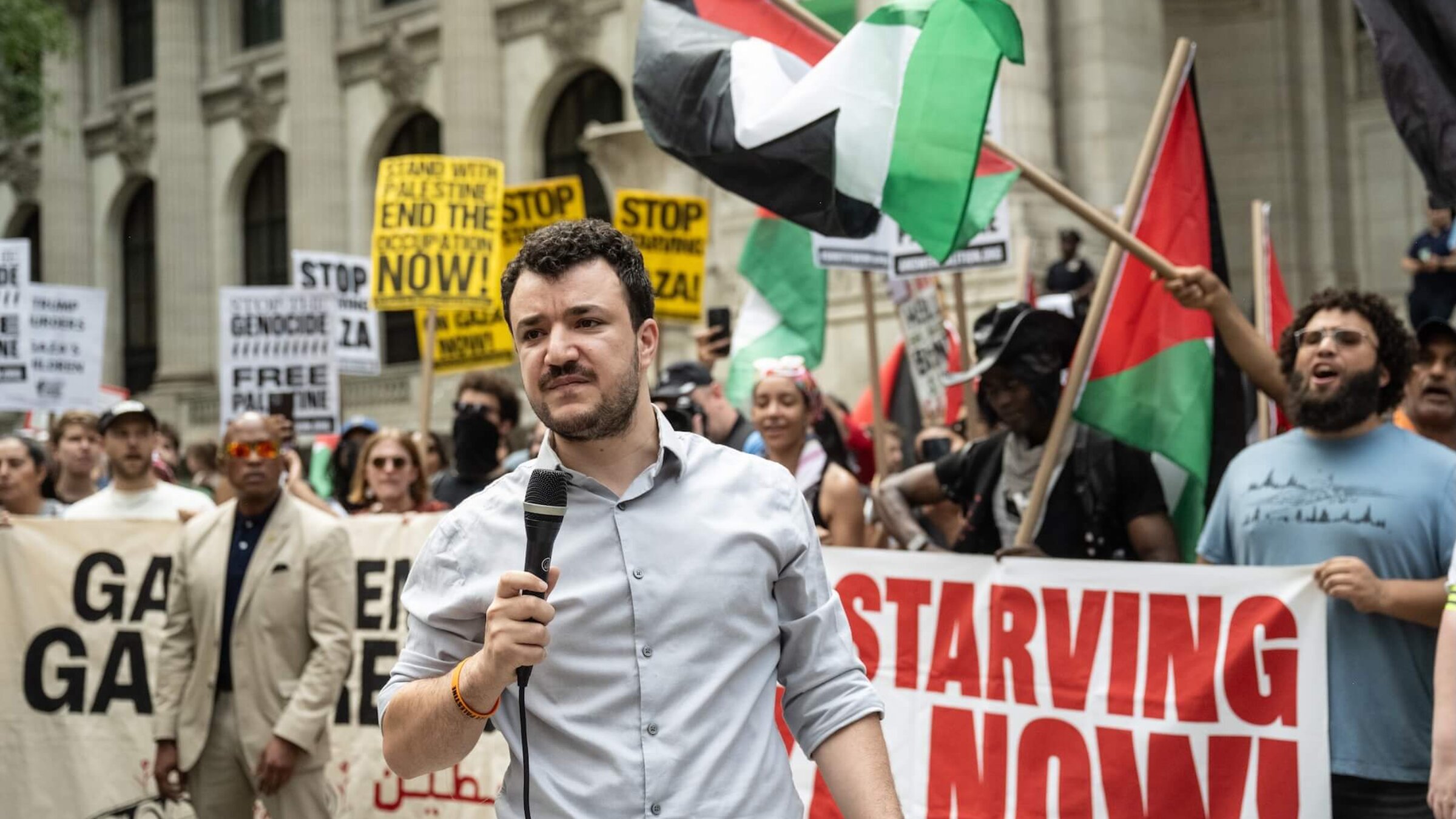
Mahmoud Khalil, who served as a negotiator for students participating in pro-Palestinian encampments at Columbia University. Photo by Stephanie Keith/Getty Images

By Hannah Feuer January 28, 2026
In 1951, Russian Jewish activist Dora Coleman, who was married to an American citizen and had lived in the United States for more than 30 years, was facing deportation. The Supreme Court was taking up the question of whether Congress had the power to deport lawful permanent residents for past membership in the Communist Party, and Coleman was one of the people named in the case.
That case, Harisiades v. Shaughnessy, has resurfaced in the legal fight over pro-Palestinian activist Mahmoud Khalil, who the Trump administration last week said it planned to rearrest and deport to Algeria. In prior court filings, the Trump administration cited the Harisiades decision to argue that green card holders like Khalil do not enjoy full First Amendment protections, and thus can be deported for political speech.
The case exemplifies how the Trump administration has had to rely on legal precedents from an awkward period of history while claiming to combat antisemitism: the Red Scare–era when Jewish immigrants were targeted.
Who was Dora Coleman?
Born in Russia in 1900, Coleman immigrated at the age of 13 to Philadelphia, where she worked in sweatshops. She became a union organizer in her teens and later owned a bric-à-brac shop, selling tchotchkes. She married an American citizen and had three children.
In 1940, Congress passed the The Alien Registration Act, which made past or present membership in organizations advocating for the violent overthrow of the U.S. government, including the Communist Party, grounds for deporting non-citizens.
That was problematic for Coleman, who had been a member of the Communist Party intermittently between 1919 and 1938, though “she held no office, and her activities were not significant,” according to court documents at the time. “She disavowed much knowledge of party principles and program, claiming she joined each time because of some injustice the party was then fighting.”
Despite that, Coleman was ordered deported because “she became a member of an organization advocating overthrow of the government by force and violence.”
Her case was combined with two others facing deportation for prior membership in the Communist Party, Italian immigrant Luigi Mascitti and Greek immigrant Peter Harisiades, for whom the case is named.
In 1952, the Court ruled that non-citizens could indeed be deported for past membership in the Communist Party, and Coleman was to be sent to the USSR.
At the same time, the dissenting opinion warned of the civil rights implications of holding lawful permanent residents to a different standard than citizens. “Unless they are free from arbitrary banishment, the ‘liberty’ they enjoy while they live here is indeed illusory,” wrote Justice William Douglas — who was handpicked by Justice Louis Brandeis, the Court’s first Jewish justice, to succeed him.
The Forward covered the case at the time, writing in March 1952 that the Supreme Court’s decision, along with another allowing communists to be held without bail, “are major defeats for the Communist Party in America.”
The USSR would not allow Coleman to return, though, so she remained in Philadelphia. She died of a stroke in her early sixties, having lived in constant fear of detention.
How has the case been applied?
The Trump administration has cited Harisiades v. Shaughnessy to argue that green card holders do not have the same First Amendment protections as citizens.
“The Court has already rejected a First Amendment challenge to a governmental effort to deport communists for being communists — i.e., an effort to prioritize immigration enforcement to combat a given political viewpoint,” the Department of Justice argued in an April legal brief. “There is no constitutional difference to an effort to expel Hamas supporters.”
But in June, a federal judge rejected that argument — including a lengthy discussion of why subsequent First Amendment case law should inform how Harisiades v. Shaughnessy is applied today.
According to Daniel Kanstroom, a law professor at Boston College and author of Deportation Nation: Outsiders in American History, that’s partly because at the time Harisiades was decided, our modern conception of the First Amendment did not yet exist. It would be another 17 years until the landmark Supreme Court case Brandenburg v. Ohio established that speech is protected unless it incites “imminent lawless action.” So it wasn’t that the justices deciding Harisiades thought the First Amendment shouldn’t apply to non-citizens; it’s that they were applying the First Amendment doctrine of that time.
The Trump administration “is reading as if it said non-citizens don’t have First Amendment protections, and in my opinion, that’s an incorrect reading of the opinion,” Kanstroom told the Forward.
The Trump administration has now largely abandoned its First Amendment argument, Kanstroom said, instead arguing that Khalil misrepresented himself on his green card application by failing to disclose an internship with the United Nations Relief and Works Agency for Palestinian Refugees, known as UNRWA.
Meanwhile, Khalil’s lawyers argue he cannot be deported while his case remains on appeal — and that the green card dispute is a pretext to continue to target him for constitutionally protected speech.
According to Kanstroom, Khalil’s case is likely to head to the Supreme Court, where the question of how to apply the Harisiades case may arise again.
“We’re at a point with the Khalil case where the courts are going to have to re-engage on the question of, To what extent does the First Amendment protect non-citizens who are resident in this country?” Kanstroom said. “It’s still something that the courts will have to wrestle with.”
Chana Pollack contributed research.
This is a moment of great uncertainty. Here’s what you can do about it.
We hope you appreciated this article. Before you go, we’d like to ask you to please support the Forward’s independent Jewish news this Passover. All donations are being matched by the Forward Board - up to $100,000.
This is a moment of great uncertainty for the news media, for the Jewish people, and for our sacred democracy. It is a time of confusion and declining trust in public institutions. An era in which we need humans to report facts, conduct investigations that hold power to account, tell stories that matter and share honest discourse on all that divides us.
With no paywall or subscriptions, the Forward is entirely supported by readers like you. Every dollar you give this Passover is invested in the future of the Forward — and telling the American Jewish story fully and fairly.
The Forward doesn’t rely on funding from institutions like governments or your local Jewish federation. There are thousands of readers like you who give us $18 or $36 or $100 each month or year.
Support our mission to tell the Jewish story fully and fairly.