When observant Jews gathered to challenge Israel orthodoxy, verbal sparring and walkouts ensued
At Smol Emuni’s second US conference in Manhattan, calls for a moral reckoning over Gaza collided with Holy Land doctrine
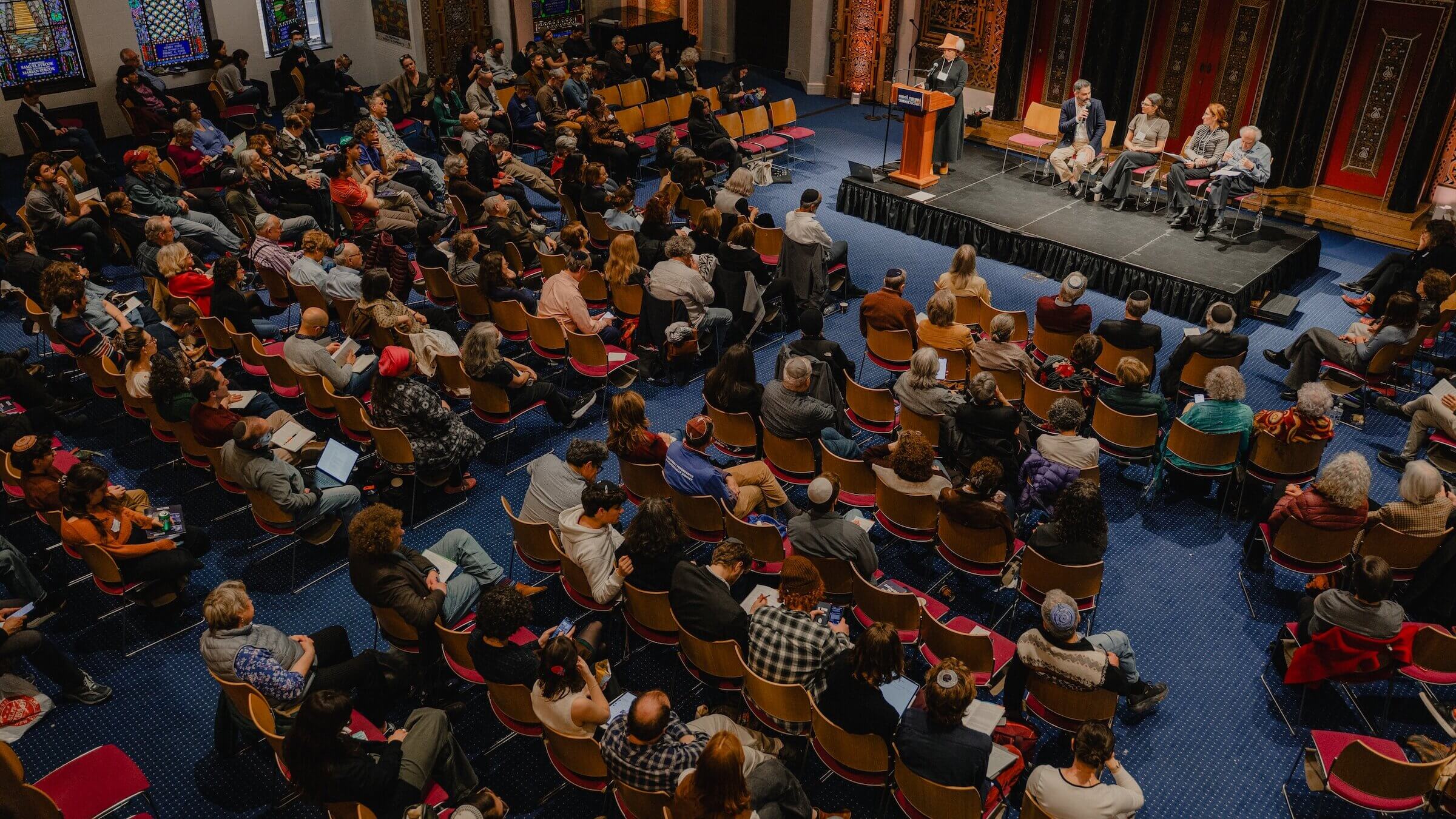
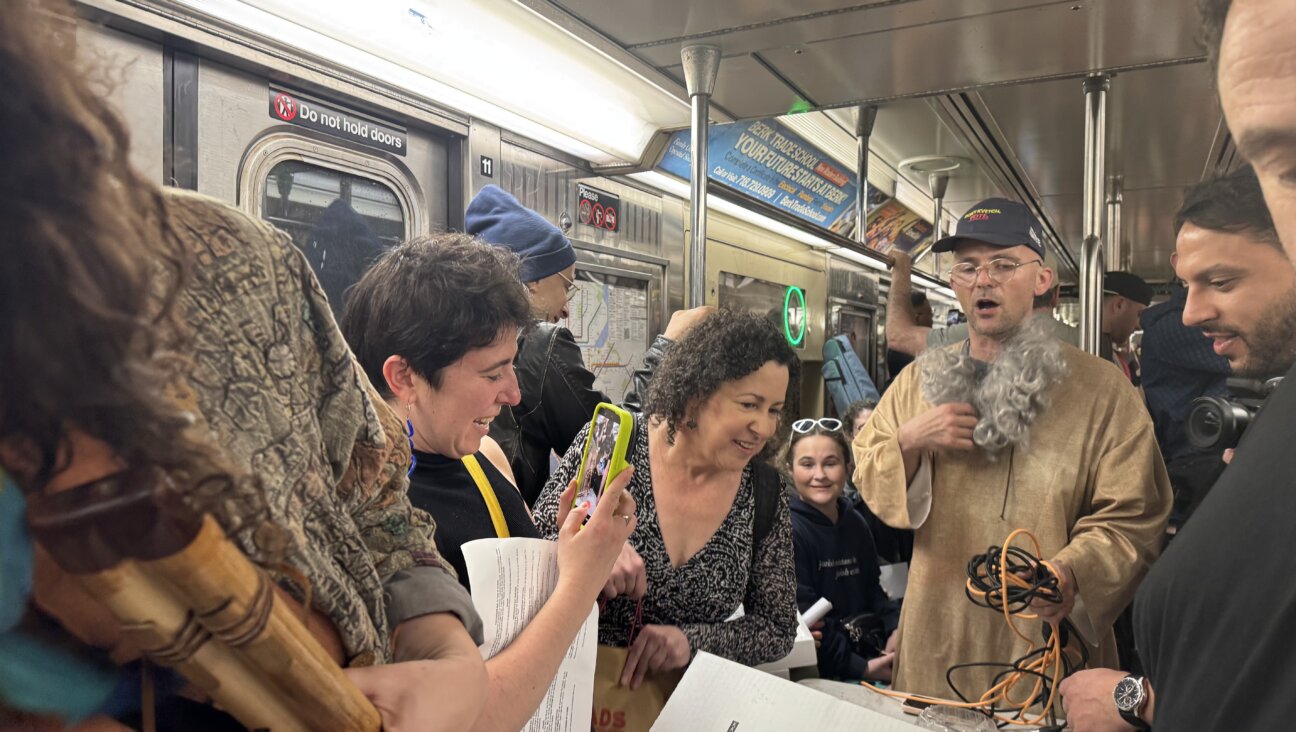
Smol Emuni’s second annual conference at B’nai Jeshurun in Manhattan. Courtesy of Liri Agami WIWA
By Hannah Feuer March 10, 2026
Hundreds of observant Jews convened at a Manhattan synagogue on Sunday to foster an alternative to the prevailing right-wing discourse about Israeli and American politics in the Orthodox world. But the conference also surfaced uncomfortable arguments within the dissent, with some attendees walking out of one session in protest.
The gathering at B’nai Jeshurun marked the second annual conference for the U.S. chapter of Smol Emuni, which translates as “the faithful left” — a counterpart to a group of the same name working in Israel and the West Bank. A diverse group of speakers that included both Zionists and anti-Zionists grappled with settler violence, humanitarian and spiritual crises sparked by the war in Gaza, and religious rhetoric surrounding the war in Iran.
The big-tent approach gave voice to Americans, Israelis and Palestinians frustrated with Israel’s political direction — and led to some pointed exchanges, including a conference organizer’s public rebuke of the event’s headliner, Rabbi Saul Berman.
Berman, an activist in the American civil rights movement and the former senior rabbi of the Orthodox Lincoln Square Synagogue, went off-topic during his keynote speech to deliver a broad critique of Islam in response to comments about Zionism made by a peace group leader in an earlier session.
For attendees who spoke with the Forward, the conference provided much-needed solidarity in a Jewish milieu that tends to sideline even mild criticism of Israel. It also showed the fledgling movement’s identity being worked out in real time.
“It’s very hard to thread the needle and say, “OK, I am progressive, and I am a Zionist, and I disagree with some things that the Israeli government is doing,” attendee Riva Atlas, a New Yorker who works as a financial researcher, told the Forward.
‘We respectfully disagree’
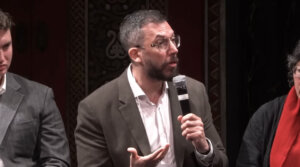
A morning panel about Gaza brought a few charged moments.
Among the panelists was Gregory Khalil, who co-founded the Israeli-Palestinian peacebuilding nonprofit Telos Group and advised the Palestine Liberation Organization on peace negotiations with Israel from 2004 to 2008.
In his remarks, he challenged the overwhelmingly Jewish audience to understand the situation of Palestinians in Gaza and the West Bank from their perspective — and to recognize that hard-line Zionism can be an obstacle to reducing conflict.
Khalil said that Palestinians have been treated as an exception when it comes to the principle of universal human rights, and that “resistance” was inevitable as a result.
“The world often operates in two plus two equals four,” Khalil said. “For years, starve them, bomb them, tell them that they’re the criminals. People are going to resist.”
Asked whether he saw the conflict as theological in nature, Khalil said it was a “semantic question,” but that “Zionism very much functions like a religion” because it is often framed as “an article of faith beyond critique.”
Moderator David Myers, a Jewish history professor at UCLA, urged Khalil not to discount that Zionism has theological underpinnings for many Jews — “to think very seriously about considering the theological something other than a sort of new semantics.”
Rabbi Mikhael Manekin, a founder of Israel’s Smol Emuni movement who was joining by Zoom, added that “no matter what word you use to identify yourself — Zionist, non-Zionist, anti-Zionist — at the end of the day, so much of our tradition centers the holiness of the land of Israel. So one still needs to have a conversation about that. A third of our Mishnah is about keeping commandments in Israel.”
Toward the end of the panel, Khalil said he “almost got up and left” because he felt that there was not enough time devoted to talking directly about the devastation in Gaza.
The exchange rankled Berman, who hours later brought it back up in his address to the general session.
The rabbi, who famously led a megillah reading in jail after he was arrested in 1965 marching for voting rights in Selma, Alabama, expressed disappointment in the morning panelists, diverging from his assigned topic of the struggle over ICE immigration raids in Minneapolis.
“I did not appreciate the assertion that somehow the Jewish passion for Israel need not be heard,” Berman said. “I didn’t appreciate the sense that the theological root of Zionism is the source of horror and enmity and evil.”
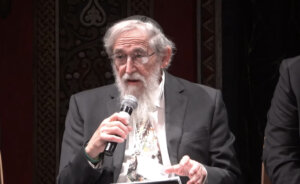
Berman added his view that the “theological position within Islam is fundamentally at the root of the incapacity of the Islamic world to recognize the rights of Israel to exist as a Jewish state,” and that idea is “taught actively by imams all over the world, including here in the United States.”
During Berman’s comments, several attendees walked out of the sanctuary. One audience member held up a “BOOO” sign, scrawled on a piece of paper.
One of the conference organizers took to the mic to publicly push back on the esteemed speaker.
“We invited you to speak about immigration and you expressed other views. We appreciate hearing them. As organizers of Smol Emuni, we want to say that we respectfully disagree, but we’re very glad to have you here with us,” Rachel Landsberg, Smol Emuni’s program director, said to applause.
Berman, a graduate of Yeshiva University’s Rabbi Isaac Elchanan Theological Seminary, had represented the Orthodox mainstream in a lineup that also featured Conservative rabbis and ex-Hasidic Jews, and had top billing on conference promotional materials.
Yet he had been an imperfect fit from the outset. In an interview after the conference, Smol Emuni executive director Esther Sperber said Berman had expressed prior to accepting an invitation to speak that he disagreed with the organization’s approach to Israel.
Sperber said she was honored that the rabbi — whom she described as “one of the luminaries of the Modern Orthodox world” — attended the whole day. But she took offense at his comments, which she felt painted all of Islam with a broad brush.
“Our intention was for the conference to focus on what we as Orthodox and observant Jews can do better,” Sperber said. “And I think our sense was that Rabbi Berman’s comments were more focused on what Palestinians can do better.”
Sperber added that the Smol Emuni movement is “not looking to include everyone in the Jewish world” but welcomes anyone who identifies with the religious left and supports universal human rights for Palestinians.
‘Whispered invitations’
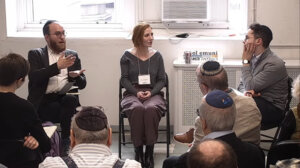
While the clashes punctuated the gathering, other sessions more quietly worked through challenging topics, including ICE and immigration policy, grounded in the Torah’s call to protect the stranger; a screening of Children No More, a documentary about activists holding silent vigils in Tel Aviv for children killed by the Israeli military in Gaza; a conversation about “Zionism and Nationalism in the Haredi Community”; and a session about creating more nuanced Israel curricula in Jewish schools.
Several speakers described the difficulty of challenging what can seem like a strong uncritically pro-Israel consensus in religious Zionist communities.
“Close friends in Israel — decent, religious, fair-minded and highly educated people — sent me the following reading on Purim. I shudder as I read the words: ‘In place of mishloach manot, a bomb has been dropped in Tehran in your honor. Purim Sameach,’” Rabbi Chaim Seidler-Feller told the crowd. “What an obscene perversion. A sickness has overtaken the religious Zionist community.”
Some spoke despite potential repercussions in their communities, while others remained silent observers. One conference attendee declined to speak with the Forward, citing potential backlash from his Israel-aligned congregation if they learned he had attended.
Gershon Rosenberg, a junior at the Modern Orthodox Jewish day school SAR Academy in the Bronx, said during the Israel education panel that he faced intense backlash from his community after writing an op-ed in his school newspaper arguing for a broader understanding of the conflict in Gaza. But he also found peers expressing support.
“A lot of people would reach out to me and say, ‘It was so meaningful for me to see someone else, a young person, show that I’m not alone, that there are a lot of other people out there in the Orthodox community who have these persuasions,’” Rosenberg said.
Rabbi Sharon Brous, who leads the unaffiliated Los Angeles synagogue Ikar, said a local Smol Emuni gathering, organized through “whispered invitations,” had helped attendees realize their views on Israel were more widely held than they had assumed.
Sperber, who grew up in Israel and now lives in New York City, said she felt like she was “living in a different reality” than her family due to their political differences.
Most troubling to her, she said, was leaders citing Jewish tradition to enact vengeance.
“The situation in Israel and the region is dangerous and combustible, but my other very deep, deep concern is not just the danger of war, but its corruption of our faith and our Judaism,” Sperber said. “Our tradition has been hijacked.”
This is a moment of great uncertainty. Here’s what you can do about it.
We hope you appreciated this article. Before you go, we’d like to ask you to please support the Forward’s independent Jewish news this Passover. All donations are being matched by the Forward Board - up to $100,000.
This is a moment of great uncertainty for the news media, for the Jewish people, and for our sacred democracy. It is a time of confusion and declining trust in public institutions. An era in which we need humans to report facts, conduct investigations that hold power to account, tell stories that matter and share honest discourse on all that divides us.
With no paywall or subscriptions, the Forward is entirely supported by readers like you. Every dollar you give this Passover is invested in the future of the Forward — and telling the American Jewish story fully and fairly.
The Forward doesn’t rely on funding from institutions like governments or your local Jewish federation. There are thousands of readers like you who give us $18 or $36 or $100 each month or year.
Support our mission to tell the Jewish story fully and fairly.