Synagogues size up security after Michigan attack amid intensifying risks
Many leaders say they already have defenses of the kind that saved lives at Temple Israel
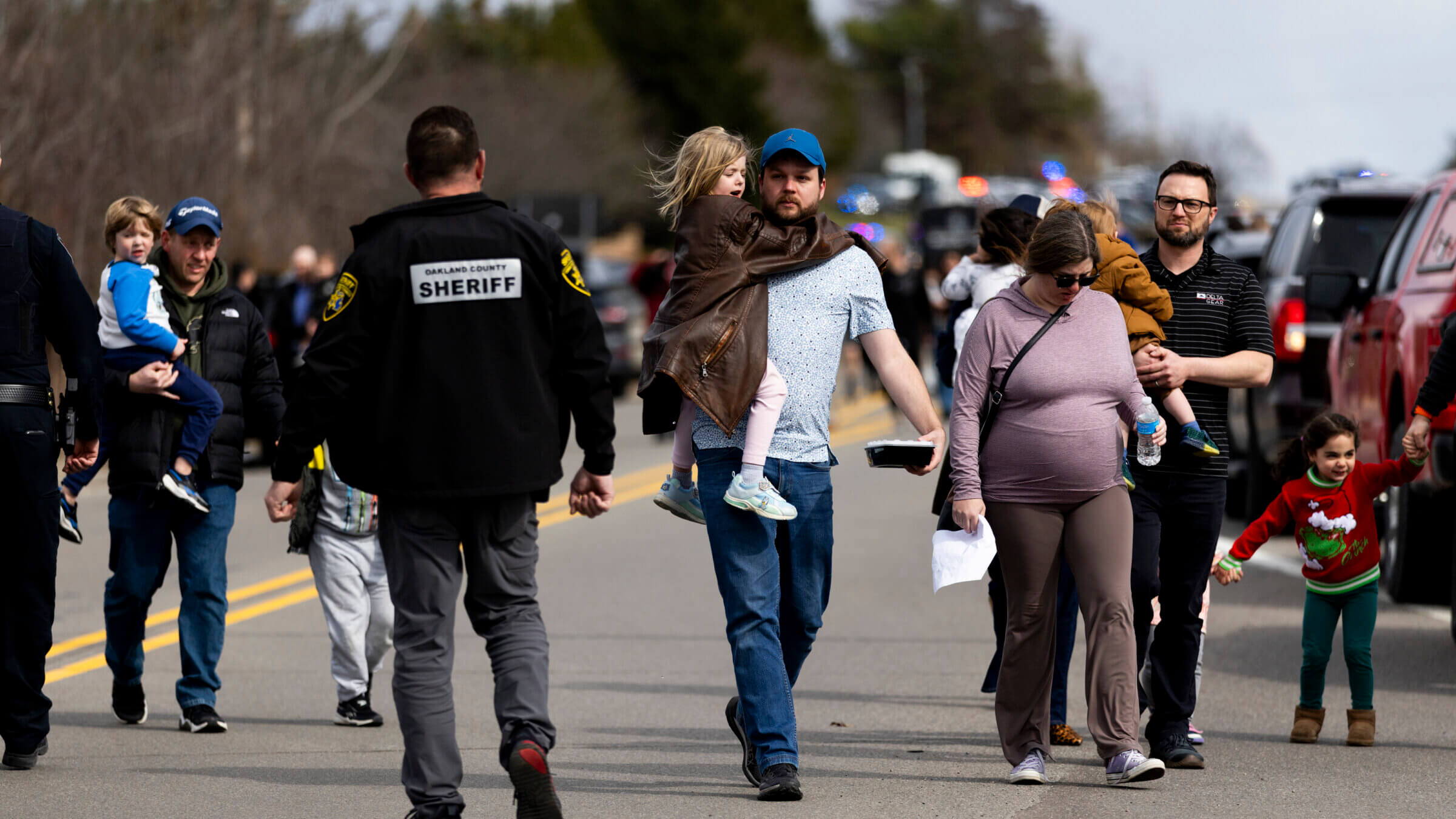
Parents carry their children to their cars as enforcement escorts families following an active shooter incident at Temple Israel in West Bloomfield, Michigan, on Thursday. Photo by Emily Elconin/Getty Images

By Hannah Feuer and Arno RosenfeldMarch 13, 2026
Jewish security professionals say the attack on Temple Israel in the Detroit suburbs Thursday highlights a need for Jewish institutions to prepare for more such “two-staged” assaults in which attackers use both a vehicle and weapons, as the threat of antisemitic violence grows following the Israel-U.S. launch of war on Iran.
“We crossed a threshold yesterday in terms of the way we think about Jewish security,” said Mitch Silber, who runs the Community Security Initiative in New York City. His organization is considering helping to pay for synagogues around the city to have at least two guards capable of stopping assailants who are carrying knives or guns.
Right now, some synagogues in the city only have a single unarmed guard intended to serve as a deterrent. “You need to have not one but multiple armed guards on the external part of the institution, certainly for as long as the war continues,” Silber said. “An unarmed guard is insufficient given the nature of the threats we seem to be facing.”
But following years of massive investments in security infrastructure and a rising number of antisemitic incidents, many Jewish leaders say they were saddened but unsurprised by the attack on Temple Israel, in which an assailant armed with a rifle and smoke bombs drove his truck into the building before being shot and killed by a security guard, and already feel prepared to address such threats.
“The Jewish people are constantly attacked,” said Rabbi Natalie Shribman of Temple Kol Ami in West Bloomfield, Michigan, located just half a mile from Temple Israel. “So unfortunately, my fear remains at the same level of heightened.”
Shribman is from Pittsburgh, where a mass shooting at the Tree of Life Synagogue in 2018 killed 11 congregants. At Temple Kol Ami, the congregation already has a security guard who carries a concealed weapon.
Shribman said she would follow the West Bloomfield police department’s guidance if it recommends additional security — but so far, it hasn’t recommended any changes.
Years of investment
One reason that more synagogue leaders may not be scrambling is that many already feel prepared. “The Jewish community has been at an 11 out of 10 for many years now,” said Rusty Rosenthal, a former FBI agent who runs regional security for the Jewish Federation of Greater Washington.
Adam Zimmerman has spent the past decade teaching Hebrew school at Temple Beth Ami in Rockville, Maryland — a job description that as of late includes running security drills with police officers and keeping a constant eye on the door.
When he enters the building, he passes multiple armed guards.
“We get so used to it that sometimes we don’t even notice. And the fact that we’re so used to it speaks to the type of environment we’re living in,” Zimmerman said. “What the incident in Michigan exposed yesterday is that every time Jews gather anywhere for any reason, we are at risk of harm.”
“Jewish life in America is now accompanied by security presence.”Rabbi Rick KellnerCongregation Beth Tikvah
The Jewish Federation of Detroit, which covers the region where both Temple Israel and Kol Ami are located, has one of the longest-running security programs in the Jewish community, spinning it off into an independent organization four years ago.
Temple Israel hired Danny Phillips, the guard who was injured in the attack, as its full-time security director in June. He oversaw a sophisticated operation that included a combination of an in-house security team with metal detectors, guards for hire, police and even overhead drones during events like High Holiday services.
Nationwide, the Jewish community spends an estimated $765 million each year on security, according to the Jewish Federations of North America — representing an investment that surged in the aftermath of the Tree of Life shooting.
Rick Kellner, senior rabbi at Congregation Beth Tikvah in Worthington, Ohio, also said that was when his synagogue increased its security. The congregation pays police officers who are regularly stationed outside the synagogue.
“Jewish life in America is now accompanied by security presence,” Kellner said. “That is a reality that we are facing and living with every day.”
Iran war prompted new measures
Even before Thursday’s attack, Kellner said his congregation had taken extra precautions in recent weeks amid heightened security concerns related to the Iran war. Secure Community Network, which coordinates nationwide security for synagogues and other Jewish institutions, said during a briefing on Friday that the number of violent social media posts aimed at Jews nearly doubled in the week after the U.S. and Israel began bombing Iran and has continued to grow.
“We’ve seen a significant increase in calls for acts of violence targeted at Israel and the American Jewish community not only by Iran but also on Russian-linked forums, on al-Qaida and Islamic State forums and white supremacist forums,” said Kerry Sleeper, chief of threat management at SCN, which sent a bulletin warning about these threats to its members on March 1.
Michael Masters, director of SCN, said that his main advice for Jewish institutions was to focus on maintaining the kind of active shooter training and “layered” physical security that has been encouraged for years — including bollards, window film and limiting public access — while increasing communication with local law enforcement.
Cost a consideration
But all these steps can come at a steep cost. Temple Israel advertises itself as the nation’s largest Reform synagogue, with more than 3,000 families, but smaller congregations and Jewish nonprofits can struggle to afford the $90,000 to $160,000 it can cost each year for an armed security guard or director.
Even properly installed bollards meant to stop vehicles can cost thousands of dollars and require government approval to be installed on sidewalks outside of buildings.
A poll of Conservative synagogues last year found that most congregations assessed a separate fee to members for security costs, and some charged participants for security at life cycle events like bar and bat mitzvahs.
Millions of dollars in security costs are covered by the federal government in the form of grants from the Department of Homeland Security, but those dollars have been repeatedly tied up during the second Trump administration. They were initially frozen as an apparent cost-cutting measure, before being partly released last June after the shooting at the Capital Jewish Museum in D.C. and the fire attack in Boulder, Colorado.
The federal government subsequently added restrictions to the grants, including a requirement that synagogues receiving the funding eliminate diversity programs and cooperate with immigration enforcement — requirements some congregations have deemed intolerable — and they’ve again been frozen after Congress failed to fund DHS.
Gary Togrow, chair of the Jewish Federations of North America, said on Friday that the funds should be released and the total pool increased to $1 billion. He and other leaders have also called for more flexibility so synagogues can use them to pay for more security in addition to camera systems and physical infrastructure improvements.
While much of the conversation about security in the aftermath of Temple Israel has suggested a certain fatalism that threats of antisemitic violence will persist, some leaders have focused on a simpler appeal: discouraging the attacks themselves.
Rabbi Josh Weinberg, a vice president of the Union for Reform Judaism, wrote an article Friday titled “Stop Shooting at Synagogues,” referencing the Temple Israel attack in addition to those in Canada and Norway.
He said that while the Temple Israel attacker’s motive remains unclear, his assault felt like yet another sign that anger at the Israeli government is being directed toward Jews.
“Attacking synagogues is not OK. And don’t blame kids at preschool for war,” Weinberg said in an interview. “I mean, that’s not terribly profound.”
This is a moment of great uncertainty. Here’s what you can do about it.
We hope you appreciated this article. Before you go, we’d like to ask you to please support the Forward’s independent Jewish news this Passover. All donations are being matched by the Forward Board - up to $100,000.
This is a moment of great uncertainty for the news media, for the Jewish people, and for our sacred democracy. It is a time of confusion and declining trust in public institutions. An era in which we need humans to report facts, conduct investigations that hold power to account, tell stories that matter and share honest discourse on all that divides us.
With no paywall or subscriptions, the Forward is entirely supported by readers like you. Every dollar you give this Passover is invested in the future of the Forward — and telling the American Jewish story fully and fairly.
The Forward doesn’t rely on funding from institutions like governments or your local Jewish federation. There are thousands of readers like you who give us $18 or $36 or $100 each month or year.
Support our mission to tell the Jewish story fully and fairly.