Catholic Church urges clergy to address ‘misleading statements’ about Jews by far-right influencers
Ahead of Easter, the US Conference of Catholic Bishops says it wants to head off conservative pundits ‘claiming to be speaking on behalf of the church’
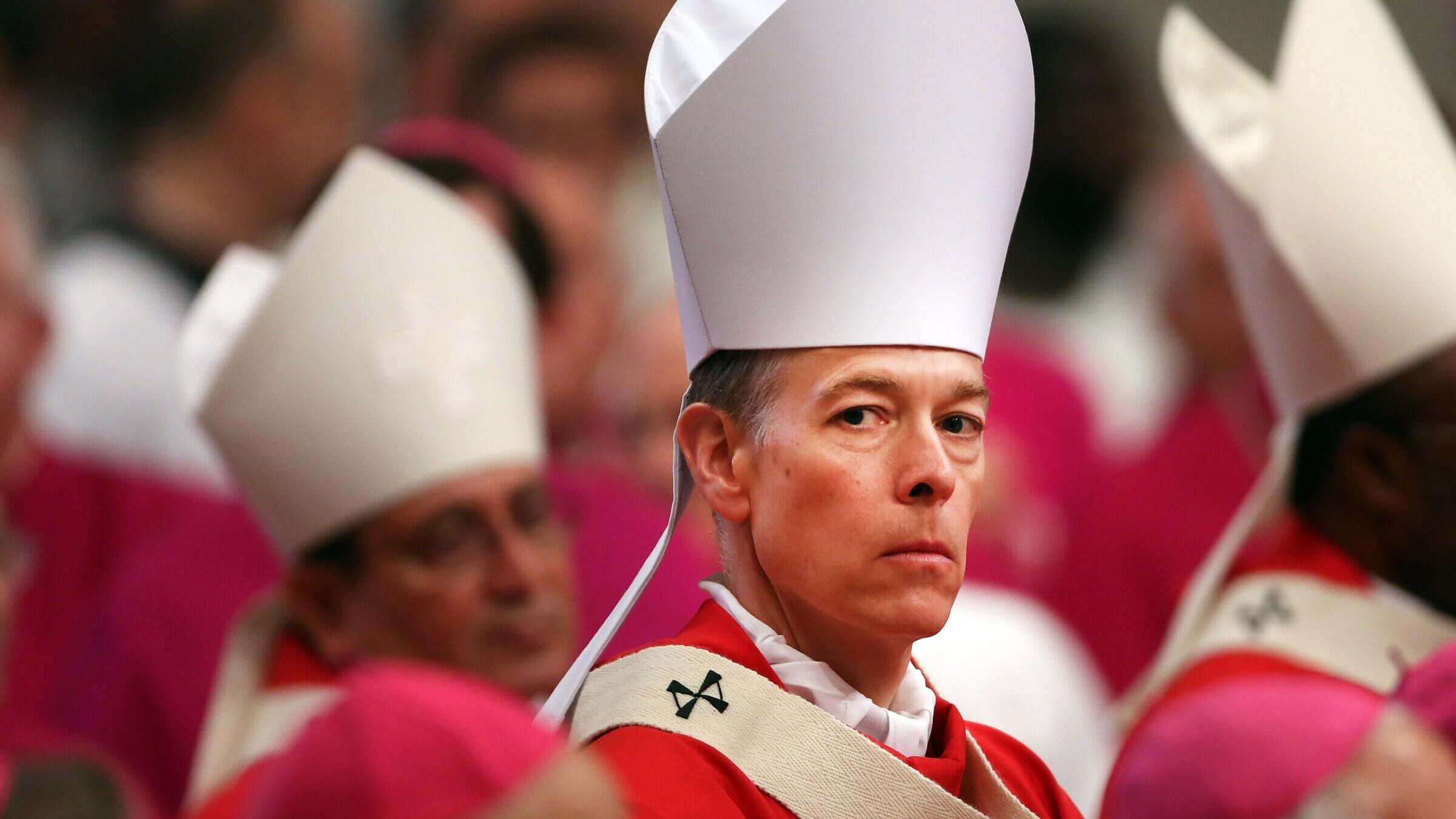
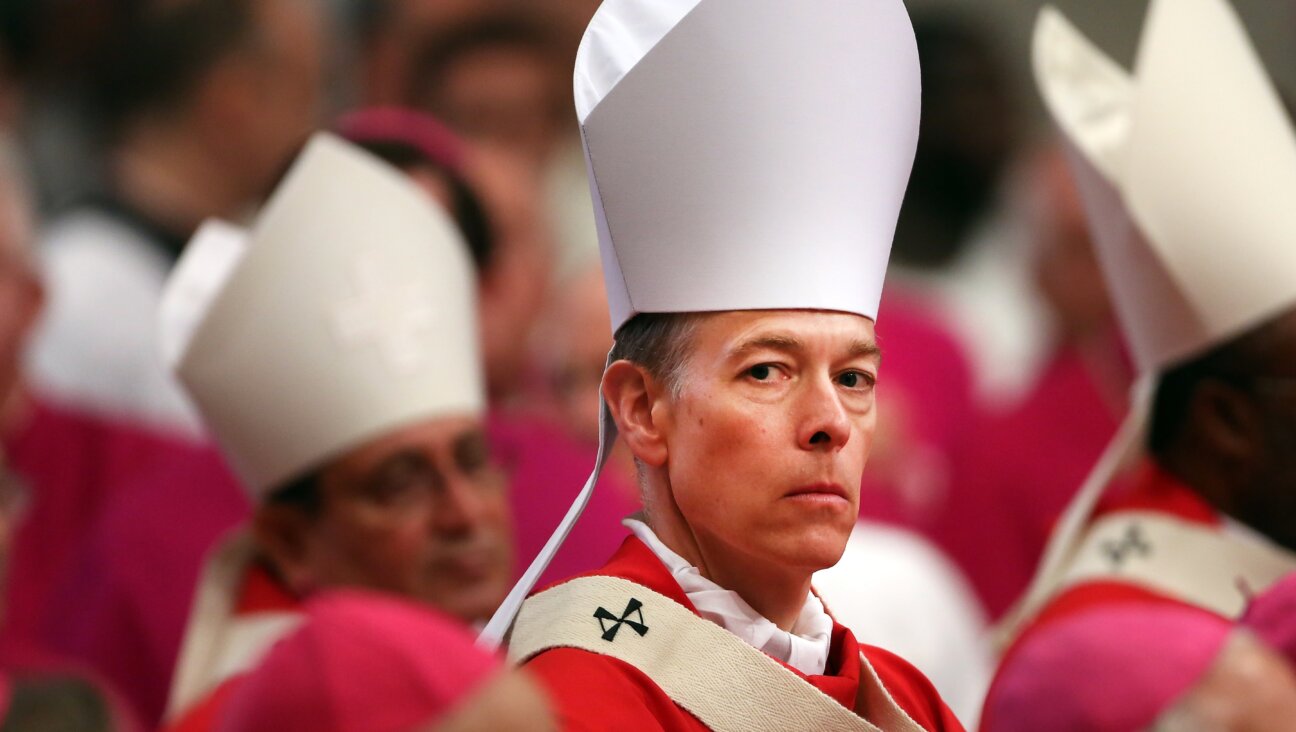
Archbishop Alexander K. Sample, pictured here in 2014, chairs the US Conference of Catholic Bishops’ committee for religious liberty and released a video last week titled “Catholics Must Reject Antisemitism.” Photo by Franco Origlia/Getty Images
By Arno Rosenfeld March 23, 2026
The United States Conference of Catholic Bishops cautioned its members in a recent memorandum that Catholic “media personalities” are distorting the church’s position on Jews and Israel, and said that priests should use Holy Week and Easter sermons to clarify these stances.
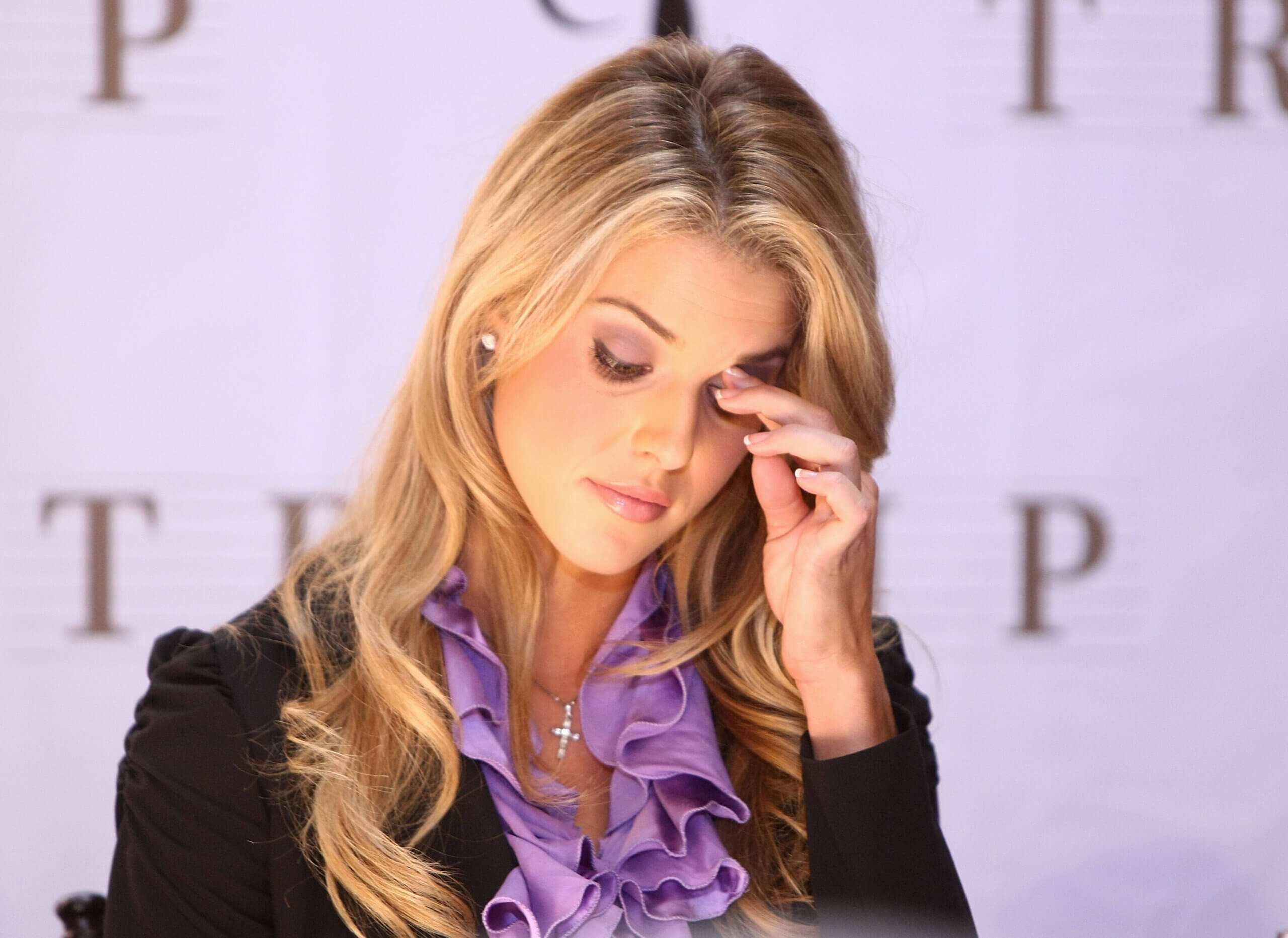
Bishop Joseph C. Bambera, who chairs the conference’s committee on interreligious affairs and authored the March 13 letter, specifically named Carrie Prejean Boller, a recent convert to Catholicism who was removed from the White House’s Religious Liberty Commission after a combative hearing in which she attacked Zionism, declaring it incompatible with Catholicism. In the same hearing, she also defended Candace Owens, the far-right influencer and a fellow Catholic with a long track record of offensive comments about Jews and Judaism.
Prejean Boller stated that devout Catholics were required to be anti-Zionist and should not be slandered as antisemites on that basis, and has argued elsewhere that Catholics have replaced Jews as “the new people of God.”
“There were witnesses at the hearing who rebutted Ms. Prejean Boller’s assertions about Catholic teaching, but it was her claims and not the rebuttal that have circulated in the media,” Bambera wrote in the confidential letter, which was first reported last week by Joe Enders, a conservative Catholic podcast host.
Rev. Russell McDougall, director of ecumenical and interreligious affairs at the conference of bishops, said that the memo was intended to help clergy facing questions from local members or journalists about the Catholic position on Jews and Israel.
It was accompanied by a public-facing video released last Wednesday that declared “Catholics must reject antisemitism.” McDougall said in an interview that the video was originally scheduled to be published at the start of Holy Week next Monday but was rushed out after Bambera’s memo was leaked and met with a hostile reaction from some right-wing Catholics.
“Media influencers are out there claiming to be speaking on behalf of the church,” McDougall said. “But practicing Catholics know that within the church it’s the Pope, in union with the College of Bishops, that are the teachers of the church.”
The controversy over Prejean Boller’s remarks came amid growing alarm by many Jews over far-right Catholic influencers, including Owens and Nick Fuentes, who have paired hostility toward Jews with opposition to U.S. government support for Israel, and often suggested their faith motivates both positions.
Joe Kent became the latest prominent figure to be caught up in the maelstrom when he resigned last week as director of the National Counterterrorism Center with a letter claiming that Israel had caused both the current U.S.-Israel war against Iran and the previous Iraq War.
He was quickly feted at a gala in Washington, D.C. hosted by Catholics for Catholics, a right-wing group, where he said he “was able to hear God’s voice” while deciding whether to resign from the Trump administration. Prejean Boller and Owens also spoke at the gala.
Bambera, who sent his memorandum to bishops three days before Kent’s resignation, wrote: “The misleading statements made by media personalities” about the Catholic position on Jews and Israel “have been troubling not only to us, but to our brothers and sisters in the Jewish community.”
The letter emphasized the positions detailed in Nostra aetate, a declaration made as part of the Second Vatican Council in 1965, a years-long assembly to modernize the church. Nostra aetate, one of the most significant parts of Vatican II, as the council is known, redefined the Catholic church’s relationship with Jews, holding that “the Jews” as a group are not responsible for killing Jesus Christ, that the Jewish people have a legitimate relationship with God even without accepting the salvation of Jesus and that Catholics should oppose antisemitism.
Bambera also cited a resource on countering antisemitism created in conjunction with the American Jewish Committee two years ago called “Translate Hate.”
Rabbi Noam Marans, the AJC’s director of interreligious affairs, praised the letter in a statement to the Forward: “With the growth of influencers who mistakenly use their Catholicism to spread antisemitic tropes, we need and appreciate responsible Catholic leaders who distance Catholicism from this hate.”
Theological spat over Zionism
Prejean Boller said during the religious freedom commission hearing in February that she opposed Zionism on theological grounds as a Catholic, a point that Bambera’s letter pushed back on.
It said that “Catholics can appreciate the religious attachment that the Jewish people have to the land of Israel, but interpret the reemergence in 1948 of a Jewish state in a historical rather than theological context.”
Some critics of the letter — including Enders, the podcaster who first posted a copy on X — argued that by acknowledging that Catholicism rejects “theological claims” related to Israel’s establishment, Bambera was essentially validating Prejean Boller’s statement that Catholics are required to be “anti-Zionist.”
“With all the preceding indignation toward Mrs. Prejean Boller earlier in this directive, it seems out of place to take this long to say she was right about the political state of Israel having “no biblical prophecy fulfillment,” Enders wrote before calling the letter “totally insane.”
McDougall said those who argued that the letter effectively endorsed Prejean Boller’s views on Israel were misguided. He noted that many, including Enders, also complained that the letter had rejected “supersessionism,” a doctrine that Prejean Boller has also expressed support for that holds Christianity had replaced God’s covenant with Jews.
“That’s something the church has repudiated — and quite clearly,” McDougall said. “The Catholic church may not take a theological position about the State of Israel but it does take a theological position about the people of Israel, and mentions that the permanence of Israel — when so many other ancient people have disappeared without trace — is to be considered part of God’s design.”
Prejean Boller referred the Forward to a social media post she’d made about the memorandum in which she wrote that “individual bishops do not enjoy the prerogative of infallibility every time they issue a statement” and suggested that Bambera’s letter was at odds with Catholic doctrine.
The dispute offers a peek into a roiling intra-Christian debate over Christian Zionism and whether the Bible contains support for Israel’s modern existence. It’s a debate obscure to most American Jews, who often think of Zionism as pertaining to political support for a Jewish state in Israel based on arguments like the need to prevent another Holocaust, rather than on religious grounds like God’s promise to Abraham, which Bambera’s letter references.
The letter was intended to inform sermons across the country during Holy Week, which begins on March 29, and asked bishops to share the contents of the memo with clergy in their respective diocese.
McDougall said the memorandum and letter were intended to reach the church’s core membership, even if they were unlikely to change the views of figures like Prejean Boller and Owens. “I’m not sure that there’s much the leadership of the church can do to reach some of these individuals and groups that think of themselves as more Catholic than the Pope,” he said.
This is a moment of great uncertainty. Here’s what you can do about it.
We hope you appreciated this article. Before you go, we’d like to ask you to please support the Forward’s independent Jewish news this Passover.
This is a moment of great uncertainty for the news media, for the Jewish people, and for our sacred democracy. It is a time of confusion and declining trust in public institutions. An era in which we need humans to report facts, conduct investigations that hold power to account, tell stories that matter and share honest discourse on all that divides us.
With no paywall or subscriptions, the Forward is entirely supported by readers like you. Every dollar you give this Passover is invested in the future of the Forward — and telling the American Jewish story fully and fairly.
The Forward doesn’t rely on funding from institutions like governments or your local Jewish federation. There are thousands of readers like you who give us $18 or $36 or $100 each month or year.
Support our mission to tell the Jewish story fully and fairly.