Iran’s regime is obsessed with Jeffrey Epstein
Child-sacrifice idol burnings, AI videos of Trump in bed with minors and “Epstein class” invective are all part of Iran’s information assault in the war
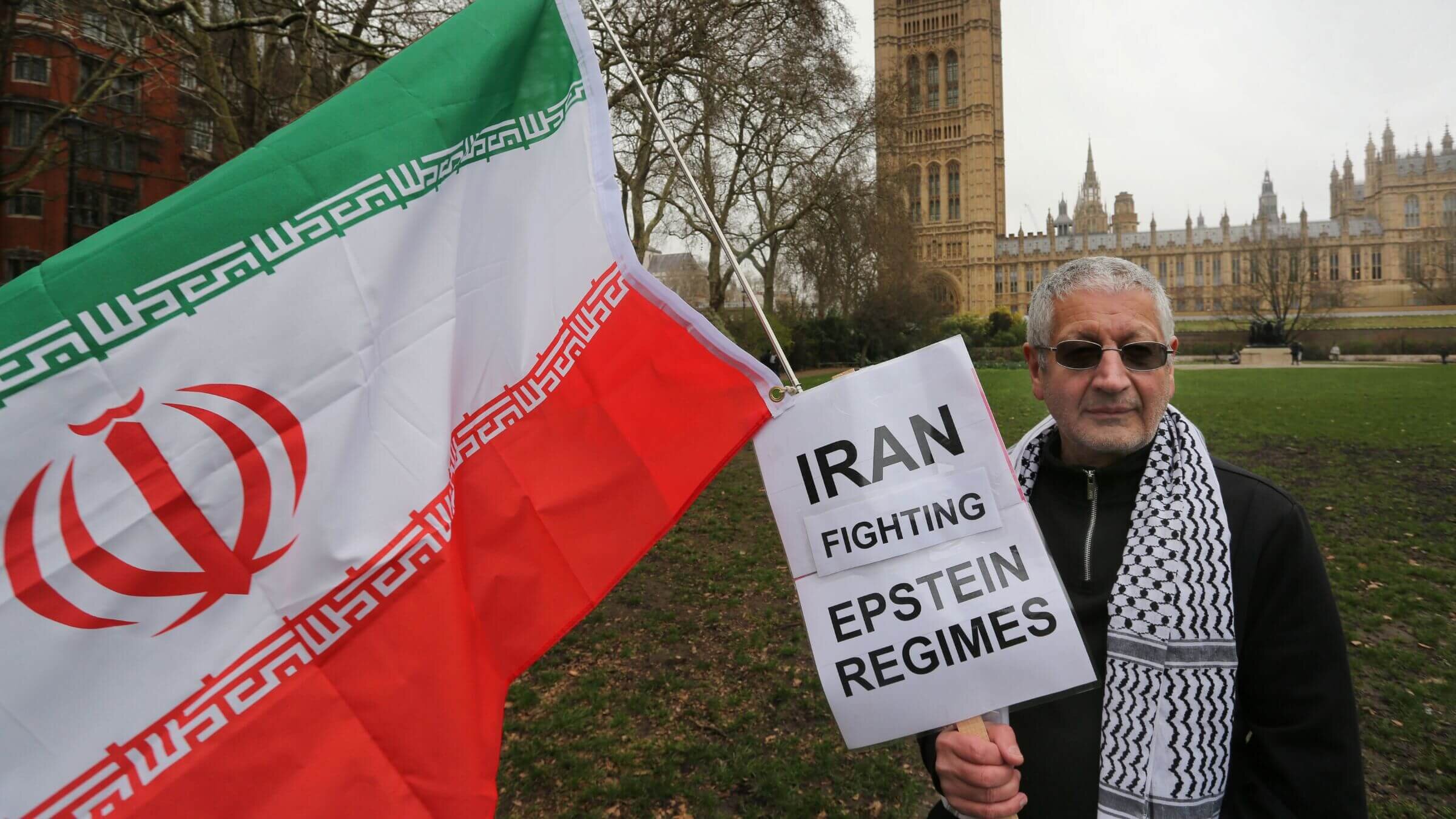
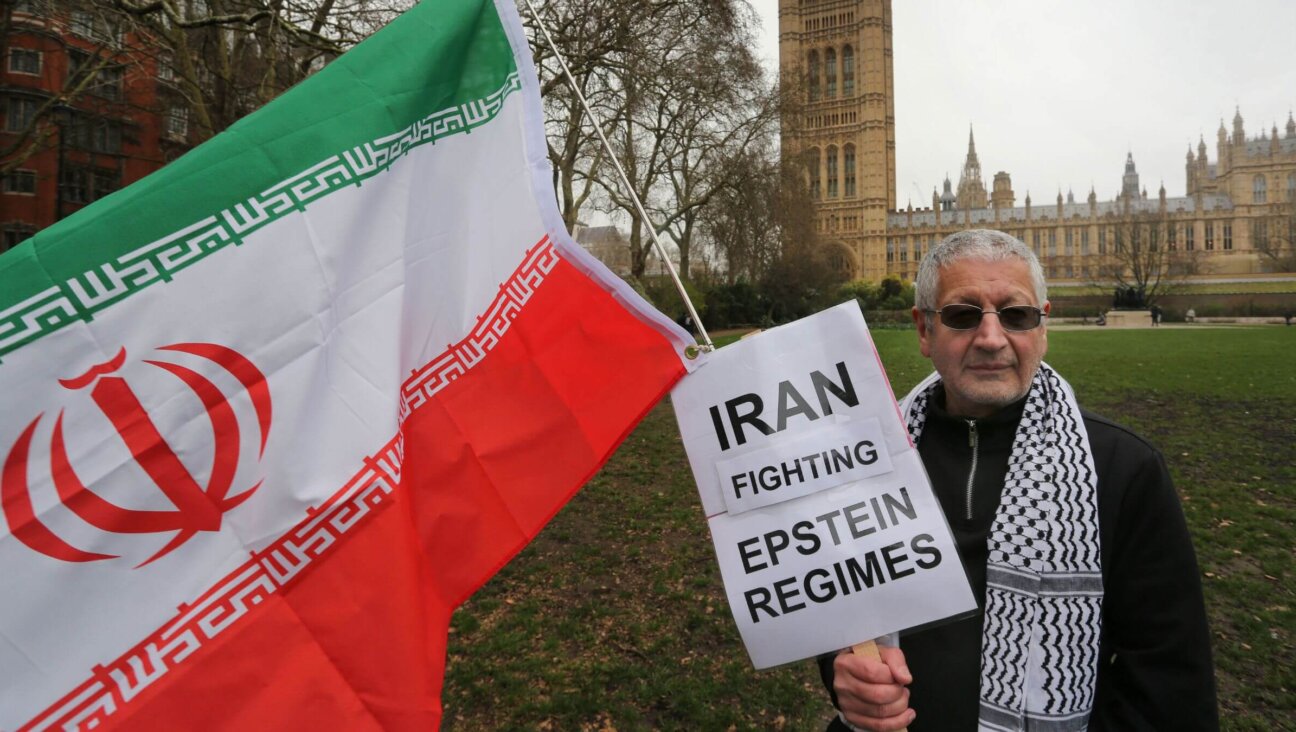
LONDON, ENGLAND – MARCH 7: A protester holding a sign saying ‘Iran Fighting Epstein Regimes’ during the ‘Stop The War’ rally against the strikes on Iran on March 7, 2026 in London, England. Photo by Martin Pope/Getty Images
By Simone Saidmehr April 12, 2026
In the hours leading up to the recent ceasefire between the U.S. and Iran, pro-regime AI-generated videos flooded social media. In one widely circulated clip, a Lego version of Donald Trump is shown desperately pleading with Iran for a ceasefire. The response comes in the form of a ballistic missile with the words “in memory of the victims of Epstein’s Island” written on it, hurling toward U.S. allies in the region.
Another video shows a terrified Trump in bed with young girls, having a nightmare of an Iranian missile barrage before waking and agreeing to ceasefire terms while eating a taco — a reference to the acronym “TACO” (“Trump Always Chickens Out”).
These videos are just some of the dozens released by media organizations affiliated with the Iranian regime that invoke pedophile sex abuser Jeffrey Epstein in its anti-Western propaganda.
“The IRGC is very happy to use him in every venue they have—in media, newspapers, speeches,” said Saeid Golkar, an Iranian-born expert on the Iran regime’s propaganda, using the acronym for the Islamic Revolutionary Guard Corps. “Everything they are talking about, especially right now, goes back to the corruption of the West and Epstein.”
Golkar, who grew up exposed to regime messaging, said the fixation on Epstein reflects a broader ideological goal: convincing Iranians that the West is a place of moral decay.
“From the beginning, one of the pillars of the Islamic Republic’s ideology was anti-Westernism and portraying the West as a corrupt place,” he said. “There is no respect for families or values … no limitation for sexual interaction. I remember the phrase ‘living like pigs’ — that they are living together like animals. That was a big concept.”
Golkar says the Epstein files released by the U.S. Department of Justice earlier this year have been a “gift” to the regime, offering a concrete example of the Western immorality it hopes to present to its people. When Iranians express a desire for a “normal life” without Sharia law or morality police, the regime invokes Epstein.
“They say, ‘You don’t want a normal life — you want a corrupted life…. These people don’t care about your freedom. They are a group of pedophiles.’” This, despite the fact that girls can be legally married in Iran at the age of 13, and even younger with the approval of a male guardian and judge.
The Baal game
One of the most prominent features of pro-regime rallies in Iran is the burning of Baal statues. The figure of Baal — meaning “lord” in ancient Semitic languages — is referenced in the Old Testament as a rival to the God of the Israelites. Historically, Baal was a fertility deity associated with rain and agricultural prosperity. Later interpretations and conspiracy theorists came to portray the worship of Baal as tied to sexual deviance and child sacrifice.
A popular online conspiracy theory ties Jeffrey Epstein and his co-conspirators to Baal, pointing to a viral document from the Epstein files that appears to show bank transfer details with the name “Baal.name” listed where a financial institution would typically appear. They interpret this as evidence that Epstein maintained an account connected to the deity, suggesting he may have worshiped Baal or been involved in ritual abuse. Popular right-wing influencer Candace Owens weighed in with a video titled, “BAAL SO HARD: The Epstein Files,” where she referred to Jews as “pagan gypsies.” It has almost 3 million views.
Fact-checkers have disputed the interpretation of the bank document, noting that “Baal.name” is likely a misreading or formatting artifact of “Bank Name,” and that the actual account name — Clearlake Centre, LLC — is clearly identified elsewhere in the record.
On numerous occasions, the Iranian regime has staged the burning of Baal statues in major cities during pro-regime rallies, sometimes even coordinating multiple burnings across the country. Mehr News Agency, a state-owned Iranian news network, reported on one such rally in early February, writing: “Participants set fire to the symbolic Baal idol, describing the act as a representation of condemnation over crimes linked to Jeffrey Epstein’s island, where children were abused.”
These events are often accompanied by chants of “Death to America,” “Death to Israel,” or “God is Great.” In some cases, the statues have been marked with a painted Star of David.
The Baal figure has also appeared in many of the AI-generated videos circulating online amidst the war. In one, created by pro-regime media organization Explosive Media, Lego versions of a drunken Pete Hegseth and Trump are paired with a rap track: “We hitting the Baal-worshipping Epstein Island crew, the ones who hurt the kids. Revenge for every American soul you and Trump’s dirty crew oppressed and did. We taking payback for the girls you broke.”
Though Explosive Media claims it is not directly affiliated with the Iranian government, Golkar said he has seen evidence suggesting it operates as part of the IRGC’s media apparatus. The regime has also acknowledged granting tiered internet access to select individuals tasked with amplifying official messaging. In early March, government spokesperson Fatemeh Mohajerani said full internet access had been given to those “who can carry the voice of the government further.” Explosive Media, which says it has 2.5 million followers across Iranian messaging platforms, has cited its status as a media organization to explain its continued access. This has prompted experts like Moustafa Ayad, a researcher with the Institute of Strategic Dialogue, to raise questions about how closely it is connected with the state.
Another video, played on Iranian state TV, depicts figures the regime frames as victims of the West — a Native American man, a Gazan child, an Epstein victim, and former Iranian general Qassem Soleimani, who was killed in a US strike in 2019 — gazing skyward as an Iranian missile strikes the Statue of Liberty. In this version, the statue is reimagined as Baal holding a Talmud. Upon impact, both sink into the Hudson River.
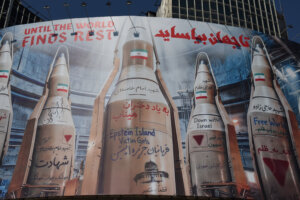
The Epstein fixation extends beyond rallies and social media. Golkar said Epstein is frequently referenced in official Basij (a plainclothes paramilitary volunteer militia in Iran) and IRGC materials, as well as in speeches by Iranian officials. Just two days before his assassination, Ali Larijani, Iran’s top security official, posted on X, “It has been reported that what remains of Epstein’s network is working to prepare a conspiracy aimed at fabricating an incident similar to the September 11 attacks, in preparation for accusing Iran of being behind it.”
In another post in response to U.S. Defense Secretary Pete Hegseth, Laranjani posted on X, “Mr. Hegseth! Our leaders have been, and still are, among the people. But your leaders? On Epstein’s island!”
The Epstein War?
These propaganda videos are largely made in English. With Iran still in a media blackout, the Iranian people may not be their intended audience.
Shaping global perception through media is a key part of the Iranian war strategy. In a meeting with a group of Iranian poets in 2024, Ayatollah Khamenei, who was assassinated on the first day of the war, stated, “All war is a media war. Whichever actor has greater media influence will achieve their goals.”
The IRGC has spent years building a media apparatus designed to do just that. IRGC-affiliated production studios, media-focused university programs, and cultural centers are dedicated to training and refining propaganda content. Iran also outsources some of its media production to countries more attuned to Western cultural cues, particularly Pakistan.
A key element of the regime’s narrative is the claim that the Trump administration initiated the war to distract from the Epstein files. This theory has also circulated on both the left and the right in the United States.
In Washington D.C., posters cover the streets referring to the War in Iran, formally titled Operation Epic Fury, as Operation Epstein Fury.
U.S. Republican Rep. Thomas Massie of Kentucky posted on X shortly after the war began, garnering over 250 thousand likes, “Bombing a country on the other side of the globe won’t make the Epstein files go away, any more than the Dow going above 50,000 will.”
The popular podcaster Joe Rogan espoused the theory on a recent episode, stating, “Look, the Epstein files comes out — we go to war with Iran. It’s a good way to get people to stop talking about certain things.”
This is a moment of great uncertainty. Here’s what you can do about it.
We hope you appreciated this article. Before you go, we’d like to ask you to please support the Forward’s independent Jewish news. All donations are still being matched by the Forward Board - up to $100,000 until April 24.
This is a moment of great uncertainty for the news media, for the Jewish people, and for our sacred democracy. It is a time of confusion and declining trust in public institutions. An era in which we need humans to report facts, conduct investigations that hold power to account, tell stories that matter and share honest discourse on all that divides us.
With no paywall or subscriptions, the Forward is entirely supported by readers like you. Every dollar you give is invested in the future of the Forward — and telling the American Jewish story fully and fairly.
The Forward doesn’t rely on funding from institutions like governments or your local Jewish federation. There are thousands of readers like you who give us $18 or $36 or $100 each month or year.

Support our mission to tell the Jewish story fully and fairly.