After Minneapolis, a YouTuber comes for Jewish ‘welfare queens’
At a time when federal policy can be shaped by the online outrage machine, Tyler Oliveira has turned his sights on two Jewish communities
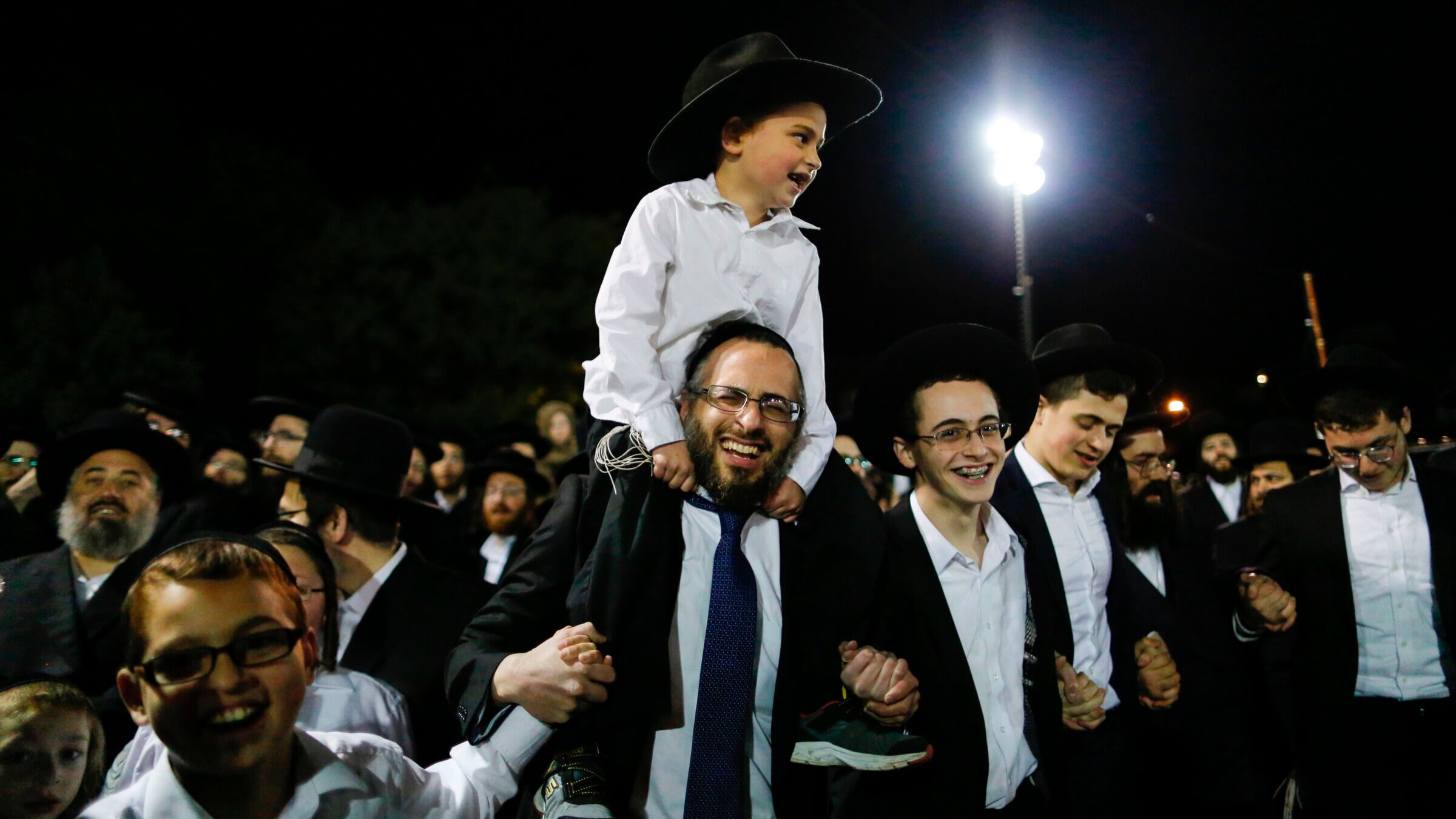
Orthodox Jews in the village of Kiryas Joel, New York, May 14, 2017, during celebrations for the Jewish holiday of Lag BaOmer, marking the anniversary of the death of Talmudic sage Rabbi Shimon Bar Yochai approximately 1,900 years ago. Photo by EDUARDO MUNOZ ALVAREZ/AFP via Getty Images
By Arno Rosenfeld February 25, 2026
Antisemitism Decoded is the Forward’s biweekly newsletter that helps you separate the signal from the noise and understand current debates over Jewish safety. Sign up to get it in your inbox.
Overt antisemitism among online influencers — the folks who often make a very comfortable living from podcasting, live streaming and clip farming — has started to break into the real world.
A notable recent example comes via Tyler Oliveira, a YouTuber who rose to fame with stunts like trying to absorb a swimming pool’s worth of water with paper towels before pivoting to “documentaries” that often purport to expose conservative bugaboos — and who has filmed two recent videos focused on Jews.
Or, as Oliveira put it to his nearly 9 million YouTube subscribers, “the New York town invaded by welfare-addicted Jews” and “New Jersey’s Jewish invasion.”
The two videos — about Kiryas Joel, a Hasidic enclave in New York, and Lakewood, a heavily Orthodox town in New Jersey — fit a mold gaining increasing traction in the second Trump era.
Harmeet Dhillon, civil rights director for the Department of Justice, has said she finds cases to prosecute by scrolling social media. The massive Immigration and Customs Enforcement operation in Minneapolis was prompted in part by a 23-year-old vlogger who made a video claiming to expose social services funding fraud by Somali residents of the city, and an immigrant arrest operation in Manhattan followed an influencer’s demand for a crackdown.
Oliveira tried to get in on the Minnesota action, posting “Inside Minneapolis’ Somali invasion” in December. But he has struck more novel territory with his recent content about the Orthodox Jewish enclaves in the greater New York City region.
The videos themselves total around two hours of footage and are a strange mix of man-on-the-street interviews with Jews and others who he insists on calling “goyim” in the towns he visits, along with more formal interviews with local activists and Oliveira’s own narration.
Oliveira repeatedly seeks to connect what are fundamentally local disputes over land use and the changing face of these suburban towns into something far more sinister, editing in ominous music over a story about a concrete yard turned into a kosher grocery and similar tales.
“How do you combat a group of people chosen by God, practicing rampant ethno-nationalism,” he asked Mike Caldarise, an independent journalist from a town near Lakewood. Caldarise primarily seemed concerned with the more obscure goal of reforming the Religious Land Use and Institutionalized Persons Act to prevent synagogues without parking from being built in residential neighborhoods.
“You think moving capital and charging interest is something more valuable than what I do or what?” Oliveira asks a random Jewish man in Lakewood who had questioned his profession as a YouTuber.
Oliveira couldn’t seem to decide if the point of his videos was to make a point about welfare — he vacillates between claiming Orthodox Jews are engaged in fraud and acknowledging they legitimately qualify for programs like Medicaid and food stamps that he doesn’t think taxes should pay for, at least when it comes to large Jewish families — or to hold up the Jewish communities in Kiryas Joel and Lakewood as models for white Americans.
“When you live the same, you look the same, you pray the same, you can do cool shit like that,” he says after visiting volunteer emergency service teams in Kiryas Joel. “We got to do this for ourselves.”
At several points he complains of a double standard that allows Jews to live together but supposedly prevents white people from doing the same, posting screenshots of the Forward’s coverage of a white supremacist settlement in Arkansas that forbids Jews. “Why is it OK for Jewish people to live together in a homogenous Jew-only community but it’s illegal when white people try to build their own?” Oliveira asked.
But coherence doesn’t really matter here. Oliveira isn’t doing investigative journalism. And, although his politics clearly match the manosphere’s ethos of white grievance, he’s not much of a pundit. His videos on various minority “invasions” are interspersed with ones about Scientology and scammers targeting European tourists. (The title of one promises a “fart spray gun 🔫 + 2 bodyguards.”)
What matters is that these videos help Oliveira confirm whatever stereotypes his viewers already have about Jews. When a man in Lakewood leaned on his horn, Oliveira commented “that honk was promised to him 3,000 years ago,” referencing a popular antisemitic meme that suggests Jewish attachment to Israel is the result of a broader sense of entitlement.
The notion that Jews are a people apart — and should be treated as such — has exploded since the Oct. 7 Hamas attack in Israel and resulting political turmoil in the U.S. Some of it has a clear connection to the Israeli-Palestinian conflict, but much of it is nothing more than the regurgitation of longstanding antisemitic conspiracy theories about Jewish control.
“The Great Noticing continues,” reads one of the top comments on Oliveira’s Lakewood video, and similar “noticing” references are studded throughout the replies. It’s a coded antisemitic term, labeling the act of identifying the supposedly nefarious Jewish influence over society. The Blue Square Alliance found use of the meme increased more than 2,000% last year.
Orthodox towns like those Oliveira highlighted are an easy target for this kind of “noticing” because, if one doesn’t think too hard about it, they appear to confirm various antisemitic stereotypes: They can be insular communities whose leaders often leverage political influence to advance what they perceive to be Jewish interests.
That’s very close to the classic claim that Jews are pulling the strings in society.
But the connection between the reality of towns like Kiryas Joel and broader antisemitic conspiracy theories fall apart upon even cursory inspection. Oliveira seems to suggest that the Jews of Kiryas Joel are somehow gaming the welfare system to fund their lifestyles, while simultaneously acknowledging the high poverty rates in the town that qualify residents for programs like Medicaid. Repeatedly, he implies that Jews should not have children if they need help affording them, as though the birth rates themselves are part of a fraudulent scheme.
And the disputes he covers in Lakewood revolve around where Jews should be allowed to build synagogues and the allocation of school district resources. Those are serious issues for local residents and have received lots of normal media coverage. But convincing the local municipality to install a new traffic light outside an informal synagogue, which Oliveira points to as an example of outsize Jewish influence, would be a pretty bush-league priority for any kind of all-powerful cabal.
A flimsy premise also undergirded a much shorter video released this week by Essa Ejelat and Erik Warsaw, two online influencers who use concern for Palestinian rights as a thin veneer for antisemitism. The six-minute short shows the pair walking and driving through an affluent part of Riverdale in the Bronx while Essa talks about how feminine “Zionists” are and Warsaw does a dance meant to represent a scheming Jew. The point of the video is that somehow Rep. Ritchie Torres, a strong supporter of Israel, is responsible for the wealth disparity between Riverdale and poorer parts of the borough.
The claim is so thoroughly absurd — and frankly rather unclear — that it’s hard to fact check, though it’s worth noting that despite Ejelat repeatedly calling it a “Zionist neighborhood” Riverdale is only 20% Jewish.
These kinds of details rarely matter to antisemites, who alternate between accusing Jews of orchestrating capitalism and communism and of simultaneously belonging in Israel (“Why don’t you move back to Israel?” Oliveira asks a man in Lakewood) and needing to vacate the region.
The danger, though, is real.
Racist online content is making its way into the real world. Federal agencies are sharing white supremacist memes on social media at the same time that immigration agents have been documented arresting American citizens based on foreign accents.
Oliveira seems to be pushing to extend the same kind of racist dragnet that spurred the federal crackdown in Minneapolis to capture Jewish communities, even if he recognizes this approach may not catch on for the time being.
“If Americans are upset about Somalis in Minneapolis not assimilating and living according to ‘Sharia law’ while sucking the teat of welfare programs,” he wrote on X while promoting the Kiryas Joel video, “then what’s the excuse for this religious ethno-state feeding their massive families with your secular tax-dollars?”
This is a moment of great uncertainty. Here’s what you can do about it.
We hope you appreciated this article. Before you go, we’d like to ask you to please support the Forward’s independent Jewish news this Passover. All donations are being matched by the Forward Board - up to $100,000.
This is a moment of great uncertainty for the news media, for the Jewish people, and for our sacred democracy. It is a time of confusion and declining trust in public institutions. An era in which we need humans to report facts, conduct investigations that hold power to account, tell stories that matter and share honest discourse on all that divides us.
With no paywall or subscriptions, the Forward is entirely supported by readers like you. Every dollar you give this Passover is invested in the future of the Forward — and telling the American Jewish story fully and fairly.
The Forward doesn’t rely on funding from institutions like governments or your local Jewish federation. There are thousands of readers like you who give us $18 or $36 or $100 each month or year.
Support our mission to tell the Jewish story fully and fairly.