Israel is at a turning point with the UN. There’s one major way things could go wrong
The far-right wants to respond to new recognitions of a Palestinian state by annexing parts of the West Bank
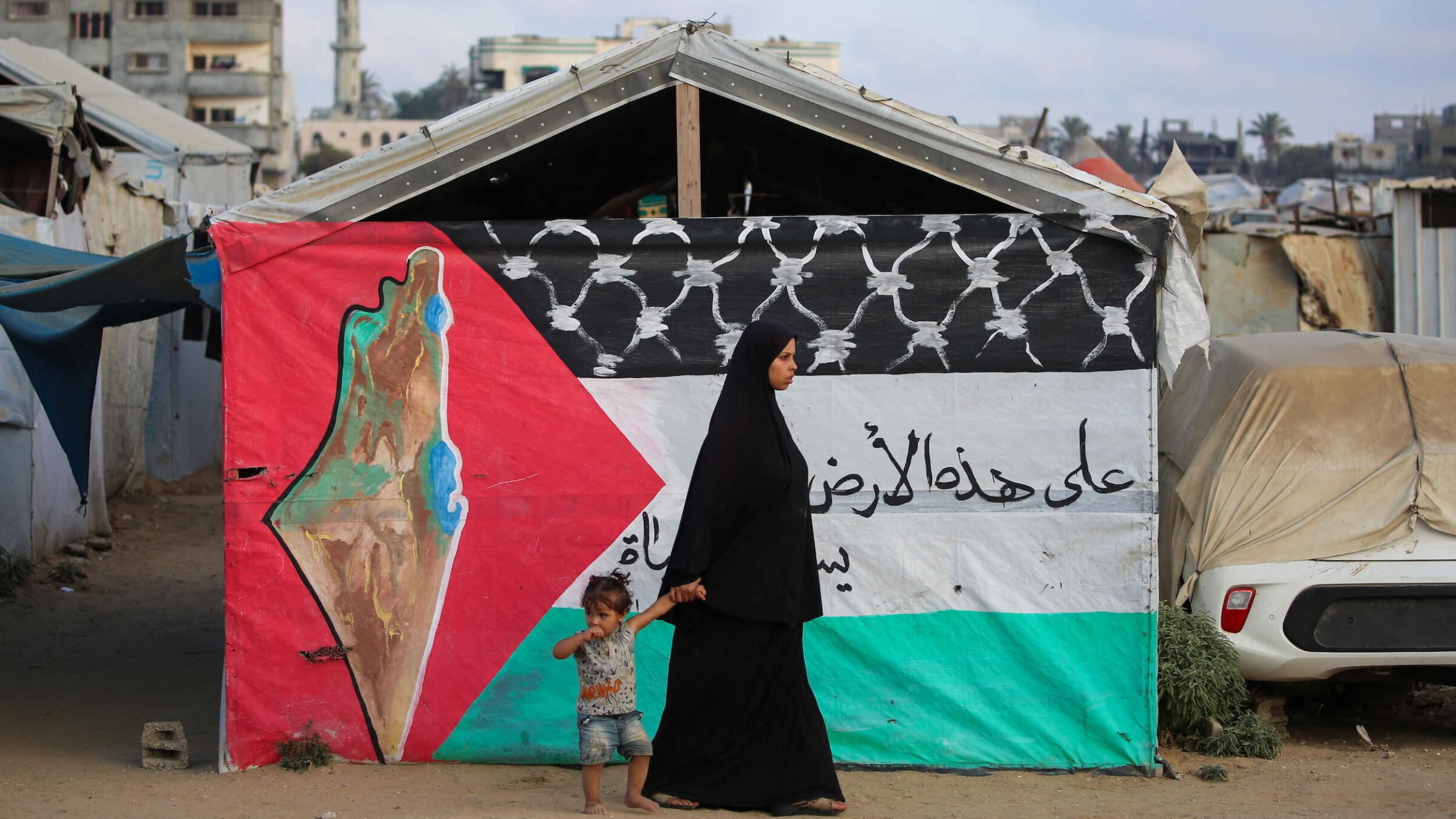
A Palestinian woman walks with a child past a Palestinian flag at the Bureij camp for refugees in the central Gaza Strip on Sept. 22. Photo by Eyad Baba / AFP / Getty Images

Columnist Dan Perry September 22, 2025
By recognizing a Palestinian state, the United Kingdom, Canada, Australia and Portugal have backed Israeli Prime Minister Benjamin Netanyahu into a corner. Now, his government is considering making a retaliatory attempt to assert strength amid evaporating international support — by formally annexing parts of the West Bank.
That’s what Netanyahu’s right-wing allies want, at least. The move would be a disaster, pitting Israel against almost the entire world community; threatening the Abraham Accords with Arab nations; and provoking a cascade of economic and diplomatic reprisals.
Whatever happens next will be hugely polarizing in Israel. Many people have concluded that Netanyahu’s decisions are driven not by strategic necessity, nor even rightist ideology, but rather by his pathological obsession with retaining power. Worse, Netanyahu seems to be in the throes of a profound attack of hubris. Israel’s military successes against Iran and Hezbollah have inflated his confidence, encouraging him to pursue ever-riskier moves — including prolonging the war in Gaza against the wishes of the military and most of the country, and the idea of annexation.
Netanyahu’s right-wing allies argue that if the world is going to hand the Palestinians a state regardless of Israel’s consent, then Israel has no reason to keep waiting or compromising. Annexation, in their logic, is the only way to reassert control, punish the Palestinians for “unilateralism,” and show domestic supporters that Israel can still dictate realities on the ground.
In this sense, international recognition of a Palestinian state doesn’t push Israel toward peace. Instead, it provokes a defensive, retaliatory impulse to annex land, both as symbolism and as a bid to shift the balance back in Israel’s favor.
The result of this rash choice, if Netanyahu makes it, won’t just devastate West Bank Palestinians. It will mean serious trouble for ordinary Israelis.
Saudi Arabia has warned that any annexation of land could bring devastating consequences. Among them: cutting off behind-the-scenes security coordination, and ending Israeli airlines’ ability to pass through Saudi airspace.
There is a real possibility that the United Arab Emirates would join a regional backlash, possibly by trashing diplomatic and economic channels Netanyahu has spent years cultivating.
Egypt and Jordan, Israel’s only neighbors with formal peace treaties — anchoring what remains of regional stability — would likely take action as well.
Egypt controls the Rafah crossing into Gaza, and works with Israel to contain Hamas and jihadist groups in Sinai. If Cairo suspends or downgrades this cooperation, Israel could face more security threats and a far less manageable Gaza border.
Jordan, for its part, sits astride the West Bank, and has custodianship of Islamic holy sites in Jerusalem. A rupture there would inflame tensions in the Palestinian territories. And if either Egypt or Jordan were to freeze cooperation or recall ambassadors, it would unravel decades of hard-won security coordination, and deepen Israel’s isolation in the very neighborhood where it most needs allies.
Outside the Middle East, the European Union is preparing concrete measures against Israel, which will surely become worse if Netanyahu does move toward annexation. The suspension of trade concessions, ending of preferential customs treatment, and placement of new limitations on research funding and scientific collaboration would have profound, painful implications for the Israeli economy.
Israelis would feel the effects in rising prices, slower growth, and reduced international opportunities. A third of Israel’s GDP relies on exports, and the country’s main market is in Europe.
The members of the Israeli right pushing for annexation fall into two categories: those who refuse to acknowledge the manifold problems it would bring, and the more honest but less moral group who intend to one day expel millions of Palestinians. This latter group, represented by Netanyahu’s fanatical right-wing ministers Itamar Ben-Gvir and Bezalel Smotrich, understand such a move would make Israel an impoverished pariah nation. Smotrich, the finance minister, has suggested he would take that trade.
The most significant barrier to his success is the United States.
On the sidelines of the United Nations General Assembly, President Donald Trump’s administration is gathering Arab and Muslim leaders — from Saudi Arabia, the UAE, Qatar, Egypt, Jordan and Turkey — to discuss ending the Gaza war. Those leaders are expected to press Trump to rein in Netanyahu and block annexation, warning that unilateral moves could unravel the Abraham Accords.
Trump will also meet Gulf leaders to address anger over Israel’s unprecedented recent strike on Hamas figures in Qatar, underscoring the mounting diplomatic pressure on Israel.
There remains a route forward in which Israel is persuaded against annexation, and a lasting peace is established. But guiding Israel to follow it will require courage and restraint. It is up to the U.S., and Trump, to navigate that challenge, and time is running short. A storm is brewing, and if Israel responds to this new wave of recognitions with annexation, it could become a hurricane.
This is a moment of great uncertainty. Here’s what you can do about it.
We hope you appreciated this article. Before you go, we’d like to ask you to please support the Forward’s independent Jewish news this Passover. All donations are being matched by the Forward Board - up to $100,000.
This is a moment of great uncertainty for the news media, for the Jewish people, and for our sacred democracy. It is a time of confusion and declining trust in public institutions. An era in which we need humans to report facts, conduct investigations that hold power to account, tell stories that matter and share honest discourse on all that divides us.
With no paywall or subscriptions, the Forward is entirely supported by readers like you. Every dollar you give this Passover is invested in the future of the Forward — and telling the American Jewish story fully and fairly.
The Forward doesn’t rely on funding from institutions like governments or your local Jewish federation. There are thousands of readers like you who give us $18 or $36 or $100 each month or year.
Support our mission to tell the Jewish story fully and fairly.