In defense of the Sarah Hurwitz we know — and the nuance we all need in this moment
Three former White House liaisons to the American Jewish community decry online attacks over remarks their friend and former colleague made about the Holocaust and antisemitism
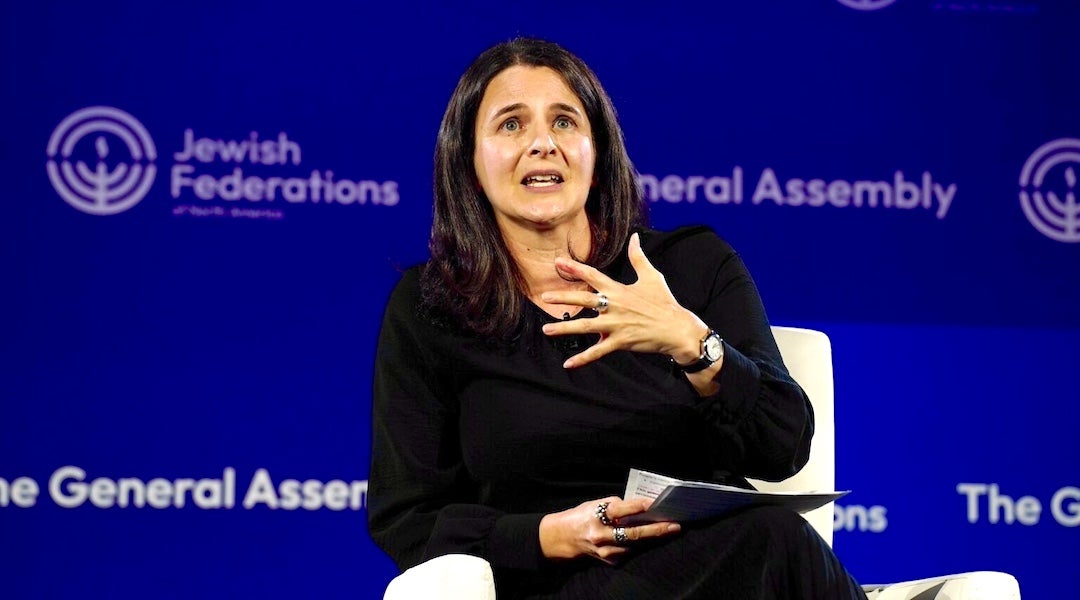
Author Sarah Hurwitz speaks at the opening plenary of the General Assembly of the Jewish Federations of North America, Washington, D.C., Nov. 16, 2025. Courtesy of JFNA
(JTA) — Over the course of the Obama and Biden administrations, each of us served as the White House liaison to the American Jewish community. In that role, we were responsible for reaching out to Jewish Americans from across the political and denominational spectrum, listening to their concerns, understanding their needs, and representing their voices in the White House.
Over the past couple of weeks, we were stunned to watch as our friend and former colleague, Sarah Hurwitz, became the subject of a mob attack on social media.
It is hard to watch anyone you care about be savaged online, but it was particularly painful to see this happen to Sarah. In the White House, where she served as a speechwriter first for President Barack Obama and then for First Lady Michelle Obama, Sarah was known for her kind heart, integrity and fierce loyalty to her colleagues and the leaders she served. We often marveled at the compassion she wove into the speeches she wrote for our bosses. Her empathy for the plight of Americans of every background and her commitment to social justice and equality were evident in her devotion to serving our country.
We watched with pride as she went on to write widely acclaimed books about Jewish ritual, tradition, and spirituality and about the effects of antisemitism on Jewish identity. Meticulously researched, her books are an exercise in nuance, empathy, and complexity as she articulates and wrestles with competing viewpoints. In her most recent book, for example, she both passionately defends Zionism, the national independence movement of the Jewish people, and also fiercely criticizes the current Israeli government.
So you can imagine our dismay when several far left and far right X accounts posted and retweeted a video clip of remarks she made at a recent Jewish conference that was selectively edited to cut off the actual point she was making. What followed was a torrent of outrage from people who claimed Sarah was arguing that we shouldn’t teach Holocaust education because doing so makes young people think the Israel-Hamas war in Gaza is a genocide. Others claimed she was saying that genocide only matters when it’s perpetrated against Jews.
Such sentiments would obviously be obscene, and we were shocked that people would attribute them to Sarah, someone who just published a book in which she expressed profound anguish about the unbearable deaths of civilians in Gaza. And we were appalled when people began circulating more out of context videos of Sarah with the intent of portraying her as callous and cruel.
Those who took the time to track down and watch the entire original video, including the part that was cut off, would have seen the actual points Sarah was making about antisemitism education, which were as follows: Some forms of prejudice are about a majority dominating a minority whom they see as inferior — a kind of “punching down.” But as many scholars have noted, antisemitism is about “punching up.” The Holocaust happened in part because the Nazis insisted that the Jews, who were 1% of the German population, were actually the powerful ones and were using their power to harm ordinary Germans. They accused Jews of undermining Germany’s World War I efforts and destroying the German economy. The Nazis claimed that killing Jews was therefore a form of self-defense, that they were protecting themselves against a powerful, depraved enemy.
Sarah was also conveying that, contrary to the impression young people get on social media, what happened in Gaza is not analogous to the Holocaust. It was a devastating war that does not fit neatly into a simplistic frame of oppressor versus oppressed. That black and white paradigm disregards the complex challenges that continue to stymie a resolution to this heartbreaking conflict.
But just try having this kind of complex discussion on social media where algorithms are designed to prize outrage and gin up hatred and too often amplify dissension sown by foreign actors.
Sarah certainly could have been more sensitive in the language she used, but the points she was actually making are worth considering.
The views and opinions expressed in this article are those of the author and do not necessarily reflect the views of JTA or its parent company, 70 Faces Media.
This is a moment of great uncertainty. Here’s what you can do about it.
We hope you appreciated this article. Before you go, we’d like to ask you to please support the Forward’s independent Jewish news. All donations are still being matched by the Forward Board - up to $100,000 until April 24.
This is a moment of great uncertainty for the news media, for the Jewish people, and for our sacred democracy. It is a time of confusion and declining trust in public institutions. An era in which we need humans to report facts, conduct investigations that hold power to account, tell stories that matter and share honest discourse on all that divides us.
With no paywall or subscriptions, the Forward is entirely supported by readers like you. Every dollar you give is invested in the future of the Forward — and telling the American Jewish story fully and fairly.
The Forward doesn’t rely on funding from institutions like governments or your local Jewish federation. There are thousands of readers like you who give us $18 or $36 or $100 each month or year.

Support our mission to tell the Jewish story fully and fairly.