Americans are waking up to right-wing antisemitism. We’re still ignoring the root problem
When we focus on isolated figures, we overlook the significance of the networks that elevate them
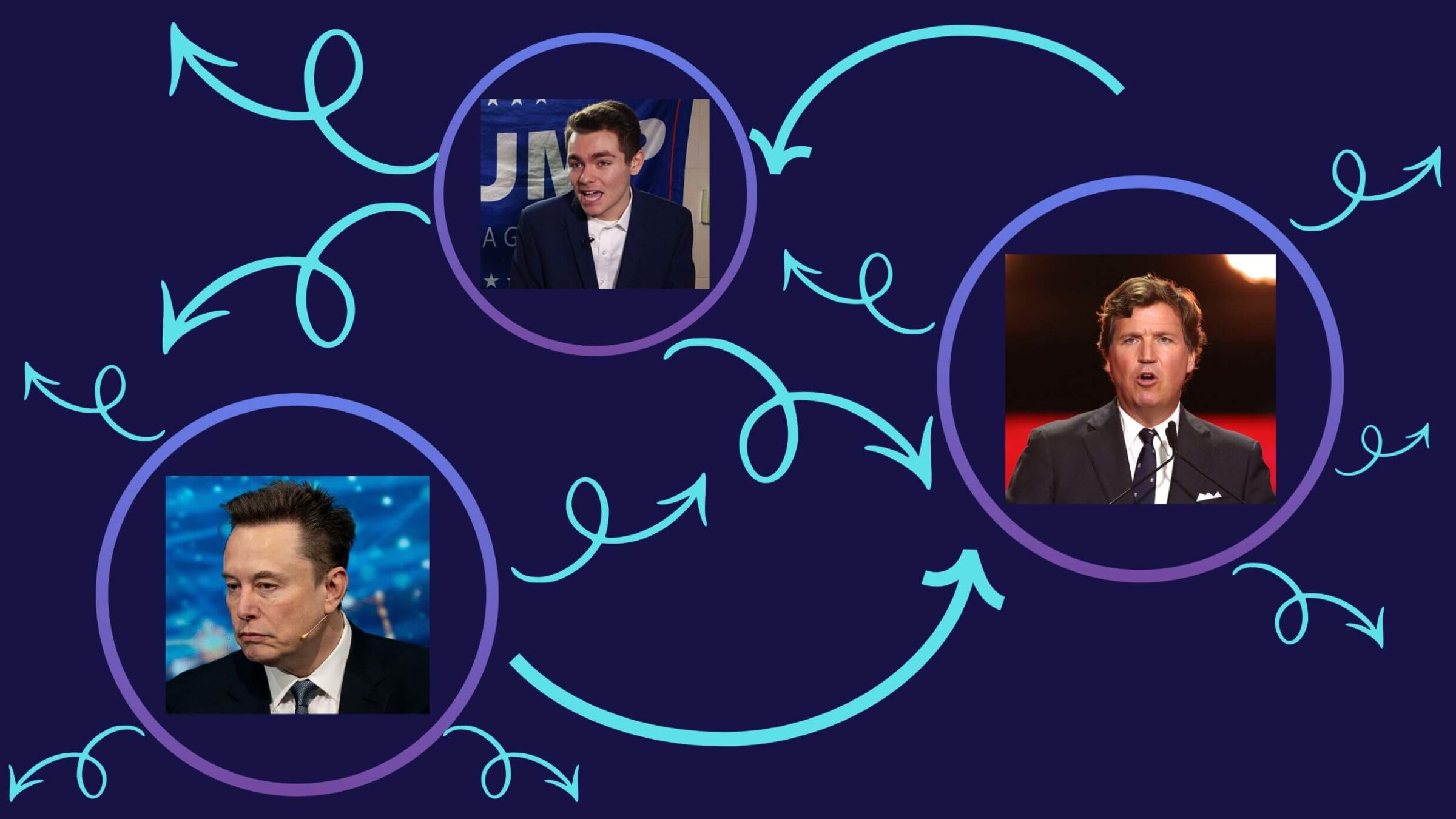
Concerns about antisemitism on the right are focused on individuals — which misses the point. Photo by Stefani Reynolds/Bloomberg/William Edwards/AFP/Patrick T. Fallon/Getty Images via Canva

Elad Nehorai December 5, 2025
Nick Fuentes is ascendant. The millennial neo-Nazi with a growing base of followers, called Groypers, is finally entering the mainstream after years of working in the darkest corners of the internet. His recent appearance on Tucker Carlson’s podcast set off a civil war on the right — one that shows no signs of abating, as new reports suggest Republican Jewish donors are struggling to decide how to respond to the crisis.
I, like many others, believe that Fuentes and his movement have brought the Republican Party, and much of the American right, closer to a culture that embraces open antisemitism than at any point in modern history. But attributing that change to Fuentes doesn’t tell the full story of how we got here. Not just in the United States, but around the world.
Because the real engine behind the rise of antisemitism today is the far-right’s digital ecosystem, which is primed to elevate fringe extremists like Fuentes, integrate them into other movements, and deliver their message to millions. Individuals matter, but that ecosystem matters far more. And that is the part we still are not talking about enough.
Change does not happen through individuals. It happens through networks. The danger posed by someone like Fuentes is obvious, but it is still the danger of a single propagandist. The danger posed by the major distribution networks enabling him and his ilk is different. It is structural. Platforms can decide who gets amplified, who gets reinstated, and which narratives move from the fringe into the mainstream. And amid President Donald Trump’s second term, as social media networks have broadly done away with content moderation in response to criticism suggesting it silences conservative ideas, that power is more dangerous that ever.
Trump may be the MAGA movement’s leader. But it is networks of influencers, podcasters, and others that allowed him to politically survive past the disastrous end of his first term and win the popular vote in 2024. And those people were able to succeed because the owners of social media platforms allowed them to spread the bigotry, false facts, and conspiracy theories required to keep him afloat.
The most obvious case of this truth is that of Elon Musk, whom I argued in the Forward more than two years ago is the most dangerous antisemite in this country. That argument still holds true. Fuentes was not on Twitter before Musk bought it. He had been suspended by virtually every social media platform and streaming service, includingYouTube, Reddit, TikTok and Spotify, for his hateful, bigoted rhetoric, and his participation in the Jan. 6, 2021 insurrection at the Capitol.
In 2024, Musk reinstated him, allowing him to tap into a network to which he previously did not have access. Musk also reinstated countless other antisemites and bigots, including Andrew Anglin, founder of the neo-Nazi Daily Stormer, and David Icke, popularizer of the antisemitic conspiracy theory that claims the world is run by shapeshifting alien lizard people.
One of the early signs that Musk would make his platform friendly to those who spread antisemitism came when he offered Tucker Carlson a chance to host a show on X after the pundit was fired in disgrace from Fox News. There, Carlson had obsessively shared conspiracy theories about George Soros, mainstreamed the Great Replacement conspiracy theory, and platformed Kanye West’s antisemitism. Once Carlson accepted his offer, Musk, known for gaming the algorithm to his advantage, used both his own massive following and X itself to elevate Carlson.
Carlson has used that launchpad to build a powerful independent audience. The result: His interview with Nick Fuentes alone was seen by 18 million people on Twitter and 6.5 million on YouTube. Millions more accessed it via audio podcast channels, where Carlson consistently sits on the top of the charts. As of this writing, his is the 5th most popular podcast on Spotify. This does not include viewership of the countless clips shared by other accounts, which get spread to tens of millions.
To put this in perspective, at its most popular, Carlson’s show on Fox News was viewed by 5.3 million people.
X helped return Carlson to the mainstream. It platformed Fuentes. And then Carlson made Fuentes mainstream, bringing him new visibility and legitimizing his views among those who would otherwise be put off by them.
In other words, he gave Fuentes access to a whole new network — one that has allowed antisemitism and far-right bigotry to thrive in this new era.
X is at the center of the ecosystem. A recent report from the Center for Countering Digital Hate and the Jewish Council for Public Affairs found that posts containing antisemitic language got 193 million views between February 2024 and January 2025. Particularly striking was that 9 out of 10 of the biggest antisemitic influencers on X had more followers on that platform than any other.
But the reality is bigger than X. It is bigger than Musk. It is a phenomenon that has spread across the internet — especially as platforms like Facebook and YouTube have ceded responsibility for fact-checking and content moderation.
Media Matters recently diagnosed this issue, showing that “Nine of the 10 online shows… with the largest total following across platforms were right-leaning, accounting for at least 197 million total followers and subscribers.”
Even if X disappeared, Musk’s efforts with it have helped create an ecosystem for antisemitism to thrive in. Even if Carlson, Musk, and Fuentes disappeared, the issue would remain.
That’s because we’ve come to a point at which the power of far-right networks outstrips that of the platforms on which they exist. Many of the antisemitic influencers taking off on X existed well before it became their platform of choice. They have learned from experience that they must exist in multiple places if they wish to maintain their influence; even if they are banned from certain platforms in the future, they’ve succeeded in building audiences that will likely travel with them.
Unfortunately, many of those fighting antisemitism have not learned the same lesson.
If digital networks like this are the engine of political change today, then the test for any movement fighting antisemitism is whether it can build such a network of its own. The far-right has done this with remarkable focus. Our institutions have not.
Instead, they’ve increasingly turned inward, creating an echo chamber focused on combatting criticism of Israel, while failing to sufficiently engage with these serious and growing domestic threats.
While the far-right links its influencers, platforms, funders, and micro-cultures into a self-reinforcing ecosystem, Jewish institutions have built closed loops that rarely reach beyond their traditional base.
This is not the way to make change: It is the way to lose influence.
This is a moment of great uncertainty. Here’s what you can do about it.
We hope you appreciated this article. Before you go, we’d like to ask you to please support the Forward’s independent Jewish news this Passover. All donations are being matched by the Forward Board - up to $100,000.
This is a moment of great uncertainty for the news media, for the Jewish people, and for our sacred democracy. It is a time of confusion and declining trust in public institutions. An era in which we need humans to report facts, conduct investigations that hold power to account, tell stories that matter and share honest discourse on all that divides us.
With no paywall or subscriptions, the Forward is entirely supported by readers like you. Every dollar you give this Passover is invested in the future of the Forward — and telling the American Jewish story fully and fairly.
The Forward doesn’t rely on funding from institutions like governments or your local Jewish federation. There are thousands of readers like you who give us $18 or $36 or $100 each month or year.
Support our mission to tell the Jewish story fully and fairly.