Trump’s National Security Strategy reveals a painful truth: Israel is newly vulnerable
‘The affairs of other countries are our concern only if their activities directly threaten our interests,’ the document says
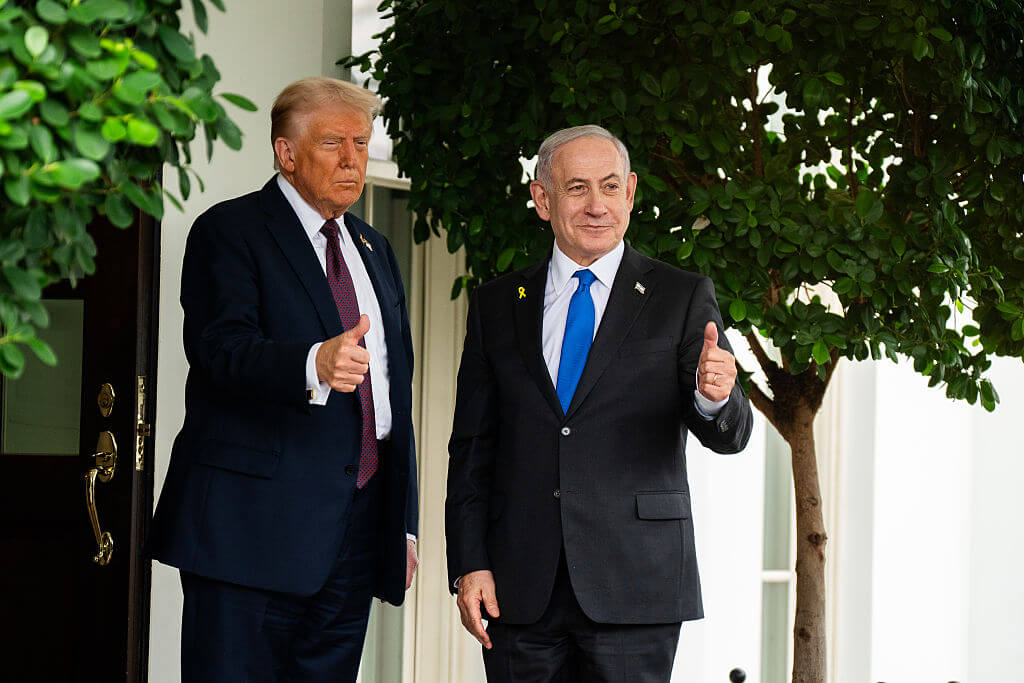
President Donald Trump greets Israeli Prime Minister Benjamin Netanyahu on Sept. 29. Photo by Demetrius Freeman/The Washington Post via Getty Images

Columnist Dan Perry December 12, 2025
The central message of the United States’ new National Security Strategy should shake the foundations in Jerusalem: Under the Trump administration, the complex web of values-based diplomacy and global American leadership has been replaced by a Hobbesian vision of constant competition for resources based on self-interest alone.
In such a bleak landscape, the relationship with Israel, once deeply rooted in shared values and a foundational American commitment, is now based on interests also. The Middle East section of the strategy describes the security of Israel as an interest alongside the countries of the Gulf and other Arab nations.
“The key to successful relations with the Middle East is accepting the region, its leaders, and its nations as they are, while working together on areas of common interest,” the document says.
Past American administrations, including Republican ones like the two Bush presidencies, believed in spreading democracy – and in this context prized Israel as a fellow democracy, and indeed the only real one in the Middle East. Moreover, democracy and shared values, along with Israel’s special relationship with the U.S., were critical to Israel receiving the economically invaluable associate member status in the European Union in the 1990s.
The current document chides predecessors for trying to spread democracy to countries where it doesn’t fit and seems to value values not at all. So it is no surprise that there is no mention of the 2008 commitment – codified in law – to maintain Israel’s qualitative military edge (which even has been dignified with an oft-used acronym, the QME).
The main concern, however, is the basic posture of the document, which places the supreme emphasis on interests and not values.
“The affairs of other countries are our concern only if their activities directly threaten our interests. Our elites badly miscalculated America’s willingness to shoulder forever global burdens to which the American people saw no connection to the national interest,” the document argues. “They allowed allies and partners to offload the cost of their defense onto the American people, and sometimes to suck us into conflicts and controversies central to their interests but peripheral or irrelevant to our own.”
The departure from every administration in the post-War era is clear and overt. Yet the implications for Israel have gone almost unnoticed for two reasons.
First, more sweeping changes have sent shockwaves throughout the world. Russia and China, which were not truly singled out as direct threats, can be relieved. But Europe absorbed a series of broadsides, from fantastical and quasi-racist notions that it will become majority non-white (described as “non-European”), to encouragement of its far-right parties that aim to break up the union and attacks on its efforts to regulate tech (which is annoying Elon Musk, who absorbed a $140 million fine a few weeks ago for X’s digital skullduggeries).
Second, in Israel, which should be worried and aware of the change, there is infantile adoration for President Trump based on the patently false notion that he is a huge friend.
Trump is not a friend of Israel; he is a friend of Netanyahu. Why? Because both men embody the same populist-nationalist worldview: They believe in elected autocracy where the government is all-powerful, they share a disdain for liberalism, and they use external threats — fabricated, exaggerated, or distorted — to confuse and manipulate the public. It is no accident that Trump is drawn more to Russian dictator Vladimir Putin than to Ukrainian President Voldymyr Zelensky: Putin has succeeded in turning an entire country into an absolute dictatorship. This is a model that many right-wing populists around the world quietly admire. Netanyahu is no different.
Trump tried to help Netanyahu at key electoral junctures with U.S. recognition of Israeli sovereignty over the Golan Heights and by moving the embassy to Jerusalem. But Trump’s true foreign policy — as now revealed in the administration’s most official document — points to something entirely different: The moment Israel does not serve an immediate self-interested need, it becomes simply one ally among many.
It is true that the document is non-binding, and Israel still has other agreements and arrangements in place. But the new NSS faithfully tracks with Trump’s dog-eat-dog worldview. His willingness, for example, to ignore the QME was on vivid display last month when he agreed to sell Saudi Arabia the same level of F35s as Israel, joking with Crown Prince Mohammed Bin Salman in televised comments from the White House that Israel won’t be happy with that.
In the past, U.S. support for Israel might have been connected also to electoral victory and especially fundraising from Jewish donors – but that too is changing as support for Israel plummets among the U.S. public, especially among the far-right isolationist wing, and among American youth, because of the country’s brutality in the Gaza war and the generally illiberal posture of the Netanyahu government.
When the American vision of foreign policy is stripped of its moral foundation — a foundation that shaped the post-World War II global order — Israel is in a particularly precarious position. For years, Washington’s unwavering support was built not only on shared interests but on an idea: a shared Western identity, a liberal democracy standing against oppressive forces. Contrary to what many in Israel believe, Democrats carried this banner no less, and perhaps more, than Republicans. They understood the value of the region’s only democracy, even when it faltered.
But Israel abandoned the Democrats with surprising ease. Netanyahu led a dangerous gamble: full alignment with the Republican Party, based on the belief that interests and sympathy among Trumpists were stronger. Yet a partnership based on anti-Muslim animus and global populism is not a values-based alliance, and therefore it is easily discarded. Israel may be left depending on the support in the U.S. of evangelical Christians, which comes with its own complications.
In an environment where America views the world as an endless struggle for material power, and has little interest in discouraging authoritarians or standing up for shared values, Israel’s position weakens dramatically.
The new U.S. strategy makes it clear more than ever: The cards Netanyahu placed on the table were dangerous from the outset. Instead of safeguarding the bipartisan alliance with Washington — the alliance that has been Israel’s ultimate pillar of support — he made it dependent on one side of the political map, and that side no longer believes in shared values or commitments to democracies. When everything is transactional, nothing is assured.