I grew up believing Australia was the best place to be Jewish. This Hanukkah shooting forces a reckoning I do not want.
The Bondi Beach shooting at a Chabad event in Sydney has killed at least 15 people, including a rabbi
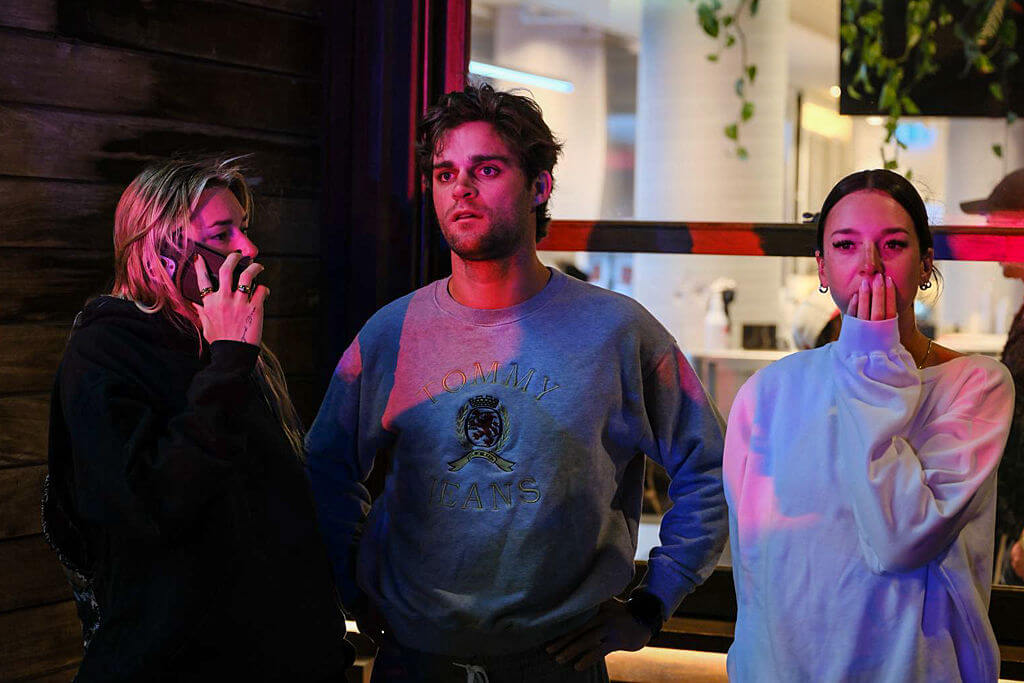
Members of the public look at the scene at Bondi Beach after a mass shooting on December 14, 2025 in Sydney, Australia. Photo by George Chan/Getty Images
Nomi Kaltmann December 14, 2025
Rabbanit Nomi Kaltmann lives in Melbourne. Her family first arrived in Australia in the 1860s, part of the Ballarat goldrush. They came for opportunity, and also for something quieter and more enduring, a country where being Jewish was expansive rather than limiting.
I grew up believing that Australia was one of the best places on earth to be Jewish. This country always felt like a gift: extraordinary beaches, glorious wildlife, and a cultural temperament that values fairness and ease over hierarchy. For most of my life, my Jewishness in Australia was unremarkable. My parents and grandparents chose this place because it promised normality, and for a long time, it delivered.
So when I heard that there had been a mass shooting at Bondi Beach, at a Hanukkah event, my body reacted before my mind could catch up.
Gun violence is almost unthinkable in Australia. The country limited gun ownership after the Port Arthur massacre in Tasmania in 1996, when we made collective choices about who we wanted to be as a nation. That a shooting could happen here, and that Jews were the target, feels like a rupture in something we believed was settled.
At the time I write this, at least 11 people are dead, including a rabbi. Dozens more are injured. I recognize some of the names being circulated in prayer groups.
Rising antisemitism in Australia
Historically, being Jewish in Australia was not something that required vigilance; it was something you simply were.
Since Oct. 7, that certainty has begun to fray. I have had the persistent feeling that something fundamental has shifted, and that the country I love is becoming less recognizable to me.
Many in Australia’s Jewish community mark Oct. 9, 2023, as the moment the ground moved beneath our feet. The protest outside the Sydney Opera House, where there were open chants of “Where’s the Jews” and “F— the Jews,” at one of our country’s most iconic sites, with no arrests and no charges, felt like a breaking point.
The months since have been relentless, with Jewish Australians assaulted, hateful graffiti, doxxing, Jewish businesses targeted, and a steady drip of hostility that causes us to question whether something is irreversibly changing for Jews in this country.
We have repeatedly reached out to our government, telling them that we do not feel safe. And yet, it has often felt as though these concerns are met with procedural gestures, like more security funding, that never quite reach the level of protection and reassurance we are seeking.
When Australia wants to take a zero-tolerance approach to anything, it does so with gusto — ask anyone who lived here during the COVID-19 pandemic. Australian Jews do not feel that the Australian government is taking its approach to antisemitism as seriously as it should.
And so, here we are.
Bondi Beach now symbolizes death and disaster
Images of bodies on Bondi Beach are now seared into my mind. Bondi, the shorthand for Australian ease and sunlight and openness, has become a shrine to death and disaster for Australian Jews.
For most of my life, being a Jewish Australian has felt like a profound blessing. Today I feel something colder. I find myself asking questions that feel both irrational and unavoidable.
Is it foolish to stay in a country where Jews can be killed in public for lighting Hanukkah candles? Am I clinging to a story about Australia that no longer matches reality? Is it naive to assume that Jewish life here will stabilize, rather than continue to narrow?
These thoughts are frightening, but what frightens me more is how practical they suddenly feel. I am a parent, and I take my children to community events. The idea that attending a Hanukkah celebration could be a life-threatening decision is not something I ever imagined I would have to consider in Australia.
This moment forces a reckoning I do not want. It asks whether Jewish belonging in Australia is conditional. Whether safety is fragile. Whether the country my ancestors chose, and that I still love deeply, is willing and able to protect Jewish life.
As I type these words I feel grief not just for the dead tonight, but for a version of Australia that felt solid and reliable, alongside a growing fear that something essential about the way Jews have always lived in this country has already been lost.
This is a moment of great uncertainty. Here’s what you can do about it.
We hope you appreciated this article. Before you go, we’d like to ask you to please support the Forward’s independent Jewish news this Passover. All donations are being matched by the Forward Board - up to $100,000.
This is a moment of great uncertainty for the news media, for the Jewish people, and for our sacred democracy. It is a time of confusion and declining trust in public institutions. An era in which we need humans to report facts, conduct investigations that hold power to account, tell stories that matter and share honest discourse on all that divides us.
With no paywall or subscriptions, the Forward is entirely supported by readers like you. Every dollar you give this Passover is invested in the future of the Forward — and telling the American Jewish story fully and fairly.
The Forward doesn’t rely on funding from institutions like governments or your local Jewish federation. There are thousands of readers like you who give us $18 or $36 or $100 each month or year.
Support our mission to tell the Jewish story fully and fairly.