The 3 responses to the Bondi Beach Hanukkah attack that could make Jews safer
At least 11 people were killed and dozens wounded at a Chabad event in Sydney
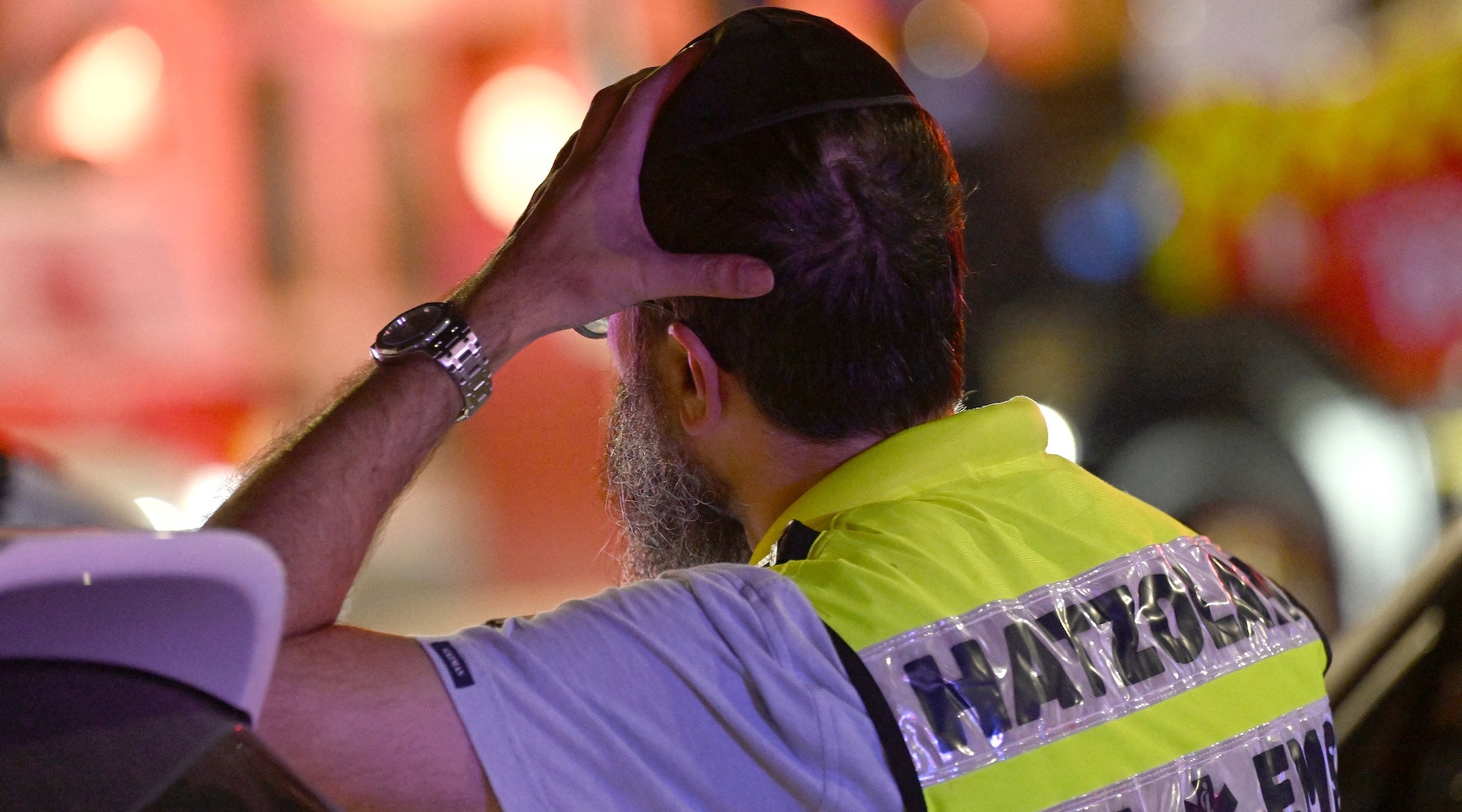
A Jewish first responder reacts as he stands at the site of the shooting incident at Bondi Beach in Sydney on Dec. 14. Photo by Saeed Khan/AFP

Columnist Dan Perry December 14, 2025
After two gunmen opened fire at a Hanukkah celebration on Sydney’s Bondi Beach, killing at least 11 people and wounding dozens more, the world is asking urgent questions: Could this be the first of many such attacks? Who might be behind it? And how can we prevent the next tragedy?
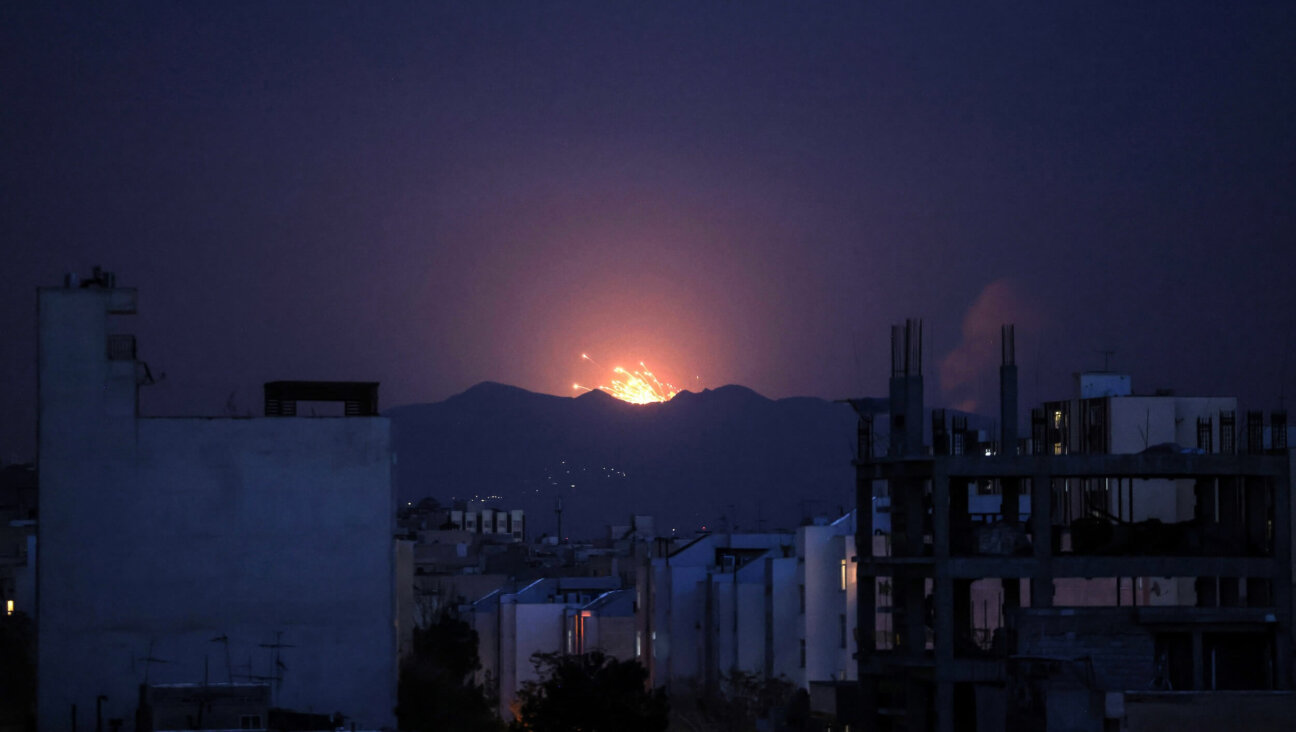
Was Iran involved?
Iran, with its long history of using proxies and terrorism, naturally comes to mind. Israeli intelligence has publicly warned that Tehran remains highly motivated to target Israeli and Jewish interests abroad.
Reports suggest that Israeli agencies have assessed not only that Iran has the intent, but that it also possesses the capability to use its networks — through Hezbollah, Hamas, and other proxy groups — to strike outside the Middle East. Western governments, including Australia, the U.S., and members of the EU, have acknowledged Iranian intelligence activity on their soil.
The motivation is clear: Israel’s military strike damaged Iranian infrastructure and positions in June, followed shortly by U.S. attacks that compounded the damage and were widely celebrated in Israel and by Jewish communities. To Iran’s benighted regime, they were provocations that demanded a response. Certainly some of the investigation into the Bondi Beach attack will look in that direction.
But focusing solely on Iran risks missing a more immediate and pervasive danger: Violence against Jews does not require orchestration by a foreign state. The conditions that make it possible — and increasingly thinkable — are already everywhere.
Terrorism against Jews has gone global
Terrorism is tragically easy to carry out. Only two months ago, two Jews were killed by a Muslim attacker on Yom Kippur who rammed a car into a crowd outside a synagogue in England and attacked people with knives.
And while the U.K. and Australia severely restrict access to weapons, nowhere in the developed world is mad violence easier to orchestrate than in the United States. Firearms are cheap, accessible, and legal for virtually anyone, and the sheer size of the country makes monitoring and security far more difficult than in smaller, more centralized nations. Lone actors can wreak destruction on a scale that would be unthinkable elsewhere. If one wanted to locate the most vulnerable place for ideologically motivated attacks, the United States sits uncomfortably near the top.
Motivation for such violence has been growing steadily. Antisemitic attacks have increased across the Western world, and the way the Gaza war unfolded has only accelerated the trend. The narrative of “genocide” has become increasingly entrenched, making it harder for Jews to occupy the once-unquestioned moral space: I still defend Israel and should not be attacked for it. That space is collapsing.
Polls now show that roughly half of Americans believe Israel is committing genocide in Gaza. Substantial minorities go further, rationalizing recent attacks against Jews as “understandable” or even “justified.” These numbers do not indicate majority support for violence, but they are significant enough to suggest that moral restraints are weakening.
This shift is particularly pronounced among younger generations, where hostility toward Israel has become a moral baseline. It does not automatically translate into action, but it lowers the social cost of excusing violence. The idea that Jews collectively bear responsibility for Israel’s actions is seeping into public consciousness in ways that make massacres like Bondi Beach more thinkable, if not inevitable.
The situation is compounded by Israel’s current government. Its policies and rhetoric have alienated large swathes of the global community, including non-Orthodox Jews in the United States. The government’s posture — contemptuous, dismissive, and occasionally openly sneering — makes the work of diplomats, community leaders, and advocates far more difficult. Israel’s failure to convey a nuanced understanding abroad of the delicacy of its own situation, nor give any inkling of introspection about its conduct in Gaza, feeds perceptions of illegitimacy and exacerbates antisemitism.
So, what can be done?
The 3 ways to make Jewish communities safer
First, Jewish communities must assume that maximal security at every event, and certainly on holidays and around landmarks, is essential, not optional. Every public event, school, and institution should be protected at the highest feasible level. Prudence demands it. Governments that claim to protect minorities must fund and sustain this protection, not treat it as an emergency add-on after tragedy strikes.
Second, political leadership matters. World leaders must speak clearly and forcefully against antisemitic violence. Silence or hedging is read as permission. Muslim leaders, in particular, should speak plainly: Condemning attacks on Jews is not an endorsement of Israel, nor a betrayal of Palestinian suffering — it is an assertion of basic moral boundaries. President Donald Trump, despite his many failings, has a unique capacity to apply pressure. If he insisted publicly that major figures in the Muslim world denounce antisemitic violence, he could secure statements and commitments that might otherwise be unattainable. That could save lives.
Finally, Israel itself must confront its role. The current government has become a strategic liability — not just for Israel’s security, but for Jews worldwide. Its policies, tone, and posture have helped create the conditions in which antisemitism flourishes abroad. This in no way justifies attacks on Jews, but we must live in the real world that can be cruel, indifferent, superficial and unfair.
A government that understands the global stakes, communicates openness to the world, respects the diversity of the Jewish diaspora, and approaches foreign and domestic policy with nuance and restraint would do enormous good. It would not eliminate the threat overnight, but it would drastically reduce the conditions that allow such hatred to grow. Replacing the current government with one capable of such diplomacy and moral awareness could, in a sense, be the most effective preventive measure of all.
The Bondi Beach massacre is a devastating warning. It is a tragedy that could have happened anywhere and serves as a grim reminder that antisemitic violence is an urgent threat to Jews everywhere.