What can really be done to prevent antisemitic attacks like Bondi Beach?
The first step in curing a sickness is diagnosing it
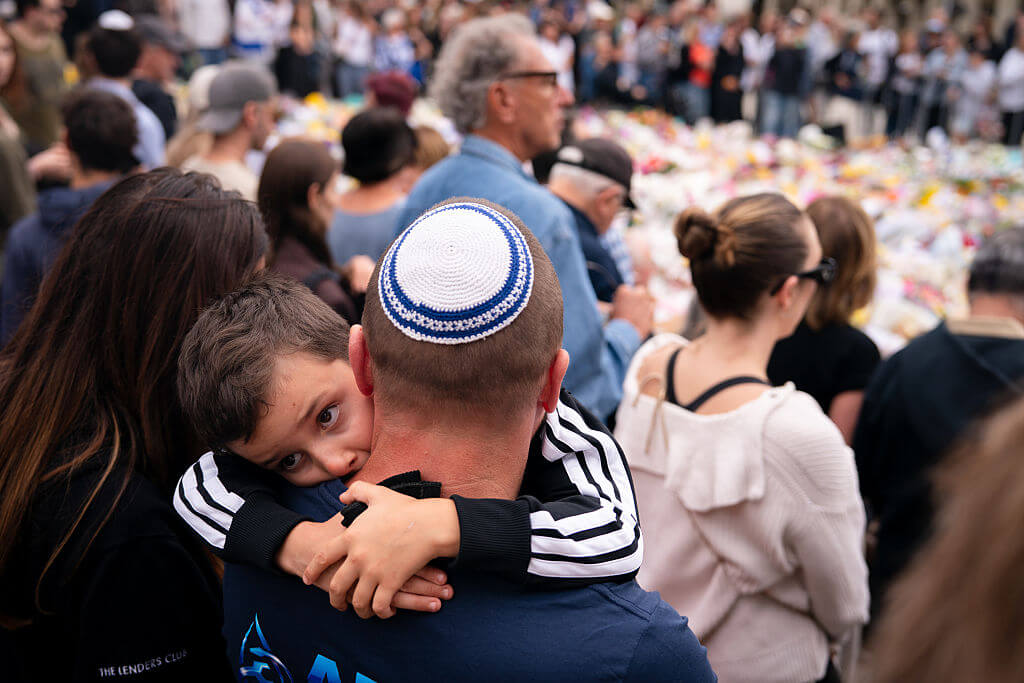
Jagger Blewitt, 5, hangs on to his father, Trent Blewitt, during a vigil at Sydney’s Bondi Beach on December 16. Photo by Audrey Richardson/Getty Images

Contributing Columnist Jay Michaelson December 17, 2025
In the wake of the horrific antisemitic attack in Sydney, Australia, many have called for a stronger response to antisemitism – in Australia and elsewhere – and for us to do more to combat it.
But what would that actually mean in practice? This is not an easy question to answer.
Arguably, the first step in treating an illness is to diagnose it as precisely as possible, with as much objectivity as possible. Yet the demands of reason and those of emotion are at odds with one another. There is a visceral appeal in refusing to go beyond the act of violence itself. Jews were targeted “just for being Jews,” we are told. Antisemitism is purely bigotry – a blind, timeless hatred that has existed since time immemorial.
Lately, this view has been called “Judeo-Pessimism,” since it holds out no hope for change. If antisemitism is an eternal, constant, baseless hatred of Jews across time and space, for any reason or none at all, it can never be eradicated and must only be met with force. That is pessimistic indeed.
Fortunately, as emotionally resonant as this account may be, it flies in the face of the available evidence.
The father-son murderers, Sajid and Naveed Akram, have known links to ISIS. And, according to Israeli intelligence sources, ISIS has released several statements explicitly calling for attacks against Christians and Jews in revenge for Gaza, which it describes as but the latest spasm of violence directed against Muslims by the West (Christians as well as Jews), like others in Syria, Iraq, Libya, Sinai, and Yemen.
So, the Sydney attack was both antisemitic and anti-Israel in nature; it punished innocent Jews for Israel’s perceived sins, as if attendees at a Chabad Hanukkah celebration are culpable for (or even supported) the war in Gaza. (The attacks outside a Manchester synagogue in October were similarly motivated.)
But once again, precision is needed. Some pundits and Jewish leaders – Bret Stephens, David Frum, Deborah Lipstadt – have rushed in to insist that this attack is what people mean by “Globalize the Intifada,” the infamous cri de coeur of some Palestinian protesters.
Not likely. In fact, ISIS and Hamas loathe one another – so much so that there was even a conspiracy theory among Gazans that ISIS was secretly being supported by Israel and the United States, in part because it prioritized the fight against Syria over the fight against Israel. ISIS also opposes Palestinian nationalism (and thus the Intifada) because they seek to unite the entire Muslim world in a single umma governed by Islamic Law (and by their own clerics). ISIS has no interest in the Intifada, globalized or otherwise. Nor, of course, does an ISIS-affiliating terrorist care what American campus activists or mayor-elect have to say.
The takeaway: Don’t believe anyone who says that a terrorist attack confirms their prior beliefs.
In light of how little we presently know about the motivations for this attack, what can be done?
The most obvious answer is increased law enforcement. In this case, Australia was already doing a lot: Jewish institutions already had beefed-up security in place, in part paid for by public funds; Australia has strict gun laws; and when antisemitic incidents took place over the last year, Australia’s prime minister and other officials have made strong, unequivocal statements condemning them.
But antisemitic violence has been escalating there in recent years – a synagogue was nearly burned down a year ago – and many have complained that Australia has not taken the threat seriously enough. If that is true (and presumably there will be an investigation), then obviously, the government must do better.
But Jews cannot Security ourselves into absolute safety. Law enforcement can’t protect everyone everywhere, or stop all hate speech everywhere. There are bigots everywhere and nowhere today, especially online, and the few global actors who could really prevent hate speech from spreading – the tech companies – have flatly stated that they will be doing so less in the future, not more. (If anyone deserves public pressure, it is surely them.)
But if law enforcement alone can’t solve this problem, what else can help?
I admit that my answer may seem a little idealistic. But given that an Australian Muslim, Ahmed al Ahmed, has emerged as a hero of this story, perhaps it’s worth remembering that while there may be hundreds of thousands of ISIS or Hamas supporters, there are two billion Muslims in the world and they hold a wide range of beliefs. Imagine if a thousand imams and other religious leaders denounced the attack in Sydney, or if pro-Palestinian activists voiced support for the Palestinian struggle for liberation and opposition to the targeting of any civilians anywhere.
Contrary to what the Sam Harrises of the world say, these voices do exist. I know some of them myself, and there are many with large followings. Here’s Mo Husseini, for example, responding to Sydney:
View on Threads
But does the Trump administration, or the American Jewish establishment, do anything to help them? Quite the contrary. Pro-Palestinian activists (and even some liberal Zionists) are condemned, cancelled, doxxed, ridiculed, trolled, labeled as bigots, and even threatened with deportation. Moderate Palestinians are endlessly undermined by right-wing Israeli governments, who make them look foolish by expanding settlements, allowing settlers to run amok in the West Bank with impunity, and placing roadblocks in the way of Palestinian commercial and residential development.
Meanwhile, here at home, President Donald Trump, Vice President JD Vance, and other figures in the Republican party regularly (including this week) traffic in broad, bigoted generalizations about Muslims, as do, sadly, many in the Jewish community. Consider this repellant diatribe posted by Rep. Randy Fine of Florida after the Sydney attack:
A few weeks ago, two National Guardsmen were shot in DC by a Muslim terrorist.
Today, Muslim terrorists killed twelve innocent lives in Australia on the first day of Hanukkah.
How many more times is this going to happen until we wake up?
Islam is not compatible with the…
— Congressman Randy Fine (@RepFine) December 14, 2025
Islam is not compatible with the West? Could we imagine someone condemning all of Christianity for the bigotry of Nick Fuentes? Or all Jews for the racism of Itamar Ben Gvir or the crimes of Jeffrey Epstein?
Of course, that’s just what antisemites do, isn’t it?
If we want relatively moderate Muslims, Palestinians, and pro-Palestinian activists to reduce the appeal of ISIS, Hamas, and other terrorist organizations, we have to strengthen their hand against the fundamentalists. But the Israeli and American governments, and much of the Jewish community, have been rushing in the opposite direction for decades now.
When (relatively) moderate Palestinians want to build a new city in the West Bank, Israel should help them, not stand in their way. When extremist Israeli nationalists destroy olive groves and conduct pogroms, we should speak loudly in opposition to them, not pretend it isn’t happening and will hopefully go away. And when Jews have the chance to work together with Muslim leaders with whom we may disagree, we should approach them with open minds, not Mamdani Monitors and incendiary rhetoric about enemies of the Jews.
I am under no illusions. No amount of goodwill is going to erase the reality of the videos and images from Gaza that people watched for two years. Whether or not the carnage in Gaza motivated the Sydney terrorists, the sheer brutality of the war, and the likely war crimes that accompanied it, are a nearly insurmountable obstacle.
It is also true that, as I have written many times before, there is far too much stochastic terrorism on the Left: using the harshest language possible to describe the “enemy,” equating all Jews with Zionists and all Zionists with genociders. And any time Jews are targeted – not just with violence but also with taunts, graffiti or angry protests – the line has been crossed.
But there must at least be some vision for the future. People like Rep. Fine have no hope to offer Jews or Israelis. For one thing, there are four million Muslims in America. Is his proposal to gradually make life so miserable for them that they all emigrate, or somehow decide to befriend their oppressors and make nice? Does that make any sense at all?
I’m under no delusion that moderate voices can prevail over every extremist. But when I see Israelis and Palestinians, Jews and Muslims, working together in groups like Standing Together, Rabbis for Human Rights, the Sulha Peace project, IfNotNow, Seeds of Peace, and many others, I at least have hope that the feedback loops of Israeli and Palestinian extremism can be interrupted, and that maybe someday the balance might tip. I can at least imagine a world in which the people working for coexistence are supported, rather than stigmatized, prosecuted, and banned from community life.
And even if only for our own sakes, let alone the lives of others, I can imagine a world in which the conditions that cause people to become murderers are less prevalent than they are now. Today, that is the most I can hope for.
This is a moment of great uncertainty. Here’s what you can do about it.
We hope you appreciated this article. Before you go, we’d like to ask you to please support the Forward’s independent Jewish news this Passover. All donations are being matched by the Forward Board - up to $100,000.
This is a moment of great uncertainty for the news media, for the Jewish people, and for our sacred democracy. It is a time of confusion and declining trust in public institutions. An era in which we need humans to report facts, conduct investigations that hold power to account, tell stories that matter and share honest discourse on all that divides us.
With no paywall or subscriptions, the Forward is entirely supported by readers like you. Every dollar you give this Passover is invested in the future of the Forward — and telling the American Jewish story fully and fairly.
The Forward doesn’t rely on funding from institutions like governments or your local Jewish federation. There are thousands of readers like you who give us $18 or $36 or $100 each month or year.
Support our mission to tell the Jewish story fully and fairly.