A year after the LA fires, the lesson is clear: Our greatest disasters are often self-inflicted
It’s a lesson that the city’s German Jewish exiles learned many decades ago
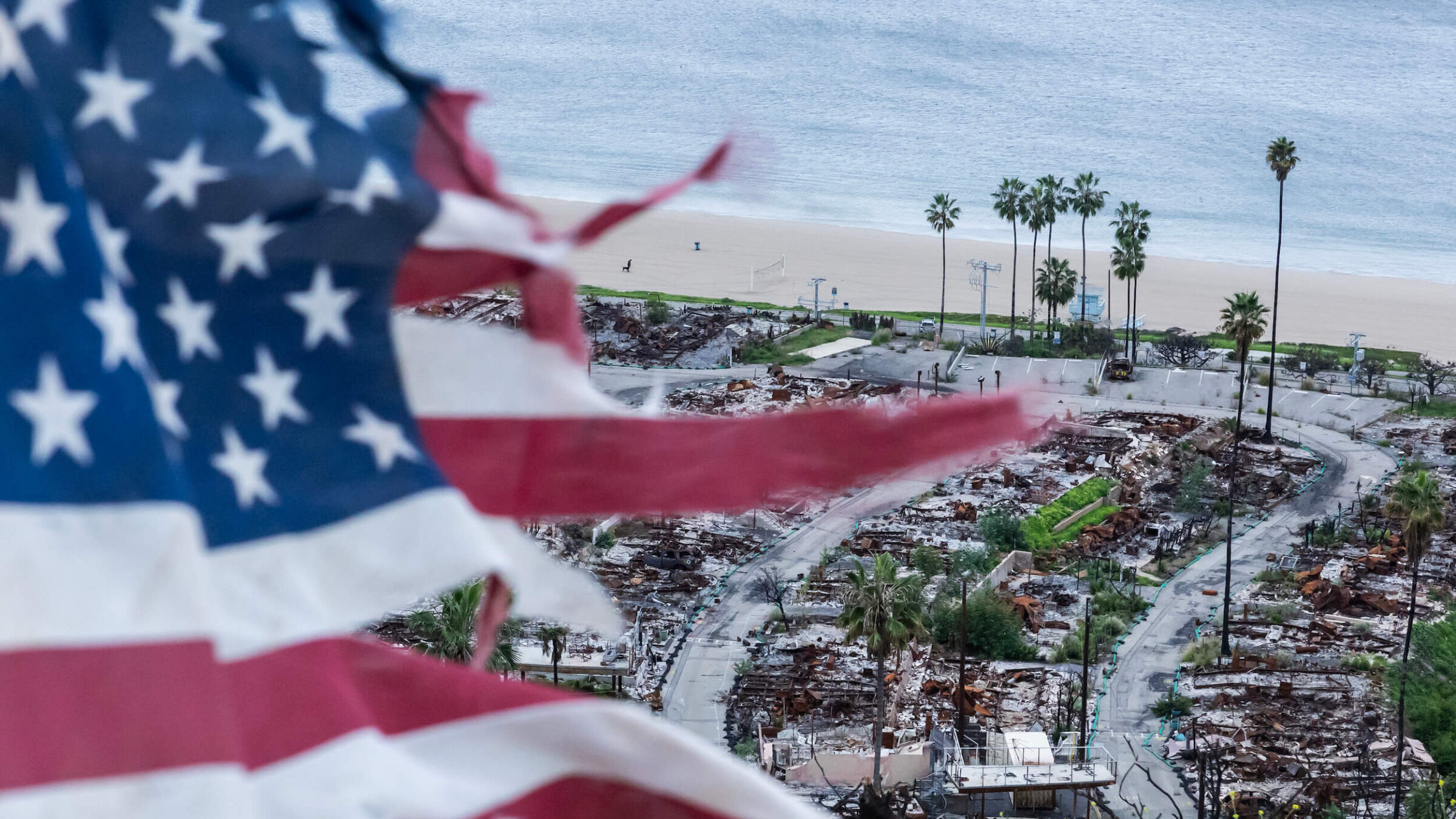
A tattered U.S. flag at Asilomar View Park above the Pacific Palisades Bowl Mobile Estates in Pacific Palisades, CA on Dec. 31, 2025. Photo by Myung J. Chun / Los Angeles Times via Getty Images

Senior Columnist Rob Eshman January 6, 2026
LOS ANGELES — “The Palisades was this idyllic community,” Jeremy Padawer said. “People actually knew each other. They talked to one another. You knew your neighbors. It was exactly what I needed to provide for my children.”
Padawer, an entrepreneur, lost his home in the fire that tore through the Pacific Palisades, an affluent Los Angeles neighborhood, a year ago. That fire was not a natural disaster; instead, an arsonist lit the original fire in a brushy area beyond Palisades Drive. Then, after firefighters extinguished it, we know from a tireless Los Angeles Times investigation, their senior officials failed to order further monitoring of the burn area, which reignited.
Nature provided 80-mph winds on Jan. 8, 2025. But human incompetence and hubris fed the flames.
The result? 12 people died. More than 6,500 local homes were destroyed, 25,000 people were displaced, and 37 square miles were burned or covered in toxic ash. The economic loss is estimated at $250 billion.
A year after the fire, I visited one of the most iconic buildings affected by the fire: Villa Aurora, once owned by the German Jewish novelist Lion Feuchtwanger, who fled Nazi Germany after the Nazis declared him “enemy of the state number one.”
There, the lessons of this unnatural disaster became clear.
‘Everything you see now was burned’
It’s not an especially brilliant insight to point out that most of the tragedies that beset us, with the exception of the body’s natural decay and demise, are of our own making.
But that insight rang true to me as I stood on the balcony of Villa Aurora two weeks ago and looked out over the Palisades.
The sprawling, Spanish Revival hillside mansion was built in 1928 as a model home by a consortium of investors that included the Los Angeles Times, and came into Feuchtwanger’s hands after he fled southern France — where he had been in exile — in disguise as an old woman. Eventually, he reached Los Angeles as a refugee.
In his novel The Oppermans, published in 1933. Feuchtwanger detailed the persecution of a highly assimilated German Jewish family like his own. “The Oppermanns were clever people, they understood the world,” he wrote. “The world at large was indifferent.”
But in Villa Aurora, he and his wife Marta founded a refuge from indifference: a center of intellectual and cultural life for his fellow refugees, including the German Nobel laureate Thomas Mann, who found refuge in his own home, six miles east.
The 2025 fire came within a few feet of the villa, and while the flames didn’t claim the structure, they did infiltrate and pollute the precious books and furnishings with smoke and ash.
The fire torched the landscaping right up to the house. “Everything you see now was burned,” said Claudia Gordon, the director of Villa Aurora, which was bought by the German government in 1989 and eventually converted, along with the Thomas Mann House, into a retreat center for German artists.
Gordon let a group of us into the home last month. Industrial air purifiers were still churning, the last signs of an extensive year-long smoke remediation process.
The fire came so fast that Gordon was able to flee with only a few rare books and a Renaissance-era Purim scroll.
“It stopped there,” she pointed to a spot just a few feet from the balcony. “We were very lucky. This was all burned.” Houses on either side of the villa went up in smoke.
I stood on the balcony and looked down at the yard that a year earlier had been blackened. Now, I watched butterflies and hummingbirds flit over clusters of bright yellow and orange flowers, amid the deep green bushes that covered the hillside.
“The place is a monument to endurance in the face of exile and disaster,” wrote Los Angeles Times columnist Gustavo Arellano after his recent visit.
True, but it is also a reminder of the stubborn permanence of human folly.
Feuchtwanger’s refuge at Villa Aurora was marred by more inhumanity after the end of World War II. Because he had flirted with communism, he became a target of a new wave of American intolerance: that of McCarthyism. After the war, he couldn’t go abroad to take advantage of his best seller status, for fear of not being allowed to return.
Mann’s refuge was even more impermanent. Targeted by the House Un-American Activities Committee for his left-leaning associations, he left Los Angeles and moved to Switzerland, where he died.
“Spiritual intolerance, political inquisitions, and declining legal security, and all this in the name of an alleged ‘state of emergency.’ That is how it started in Germany,” Mann said in 1947.
None of these tragedies had to be, I reflected. Whether fleeing fascism, weathering McCarthyism, or watching a preventable fire consume a neighborhood, the human capacity for self-inflicted tragedy is as enduring as Villa Aurora itself.
The missing deputy mayor
Several hundred homeowners have filed a lawsuit against the state and city for negligence leading up to the fire. In a phone interview, Padawer, the entrepreneur who lost his home, outlined some of their claims.
A Palisades water reservoir was empty, he said; fire hydrants lacked pressure; state environmental regulations prevented adequate fire abatement measures in the initial burn area; and the city failed to field enough fire engines despite the imminent threat.
It didn’t help that a key city post was unfilled after a bizarre fake antisemitic bomb threat. On Oct. 3, 2024, Brian K. Williams, then Los Angeles deputy mayor of public safety, reported receiving a bomb threat against City Hall. It was the first day of Rosh Hashanah, and the caller said he was tired of the city’s support for Israel, according to Williams.
“In light of the Jewish holidays,” Williams’ memo to Mayor Karen Bass at the time read, “we are taking this a little more seriously. I will keep you posted.”
An investigation found that Williams himself made the threat. He was arrested by the FBI and removed from his position in December 2024. Williams, who said he acted out of “anxiety,” pleaded guilty to making a bomb threat and was sentenced to one year probation and a $5,000 fine. Bass left his position empty.
The Deputy Mayor for Public Safety specifically oversees crisis and disaster response, including wildfires, according to the city. Which meant that when the fires came in January, Los Angeles had no official overseeing the LAPD, LAFD, emergency management or disaster response. Bass didn’t appoint a replacement for Williams until April 2025, months after the city burned.
“These deputy mayors have real jobs,” said Padawer. “The mayor didn’t replace him.”
‘They Let Us Burn’
One year later, I drove down Radcliffe Ave., in the heart of the Palisades, where two dear friends once lived. I couldn’t figure where their houses had stood. It was all just empty land..
On many of the burned out buildings, someone had affixed posters with the words, “THEY LET US BURN,” in stark red and black.
The posters were part of a neighborhood movement, launched by Padawer, to hold officials accountable for the fire and the rebuilding.
“The damage is done. The city is gone,” reads an entry on the movement’s website. “Let’s keep politicians, builders, banks, insurance companies and all key stakeholders honest as we rebuild together. So that this NEVER happens in Los Angeles again.”
The motto for Padawer’s website? “News for Our Unnatural Disaster.”
“The first day after the fire, you have the mayor and the governor, saying, natural disaster, climate change,” said Padawer. “And why would they do that? They don’t want the liability associated with all of the failure. But everything about it was unnatural.”
Driving out of the Palisades, I thought back to Villa Aurora and the streets where my friends’ homes once stood. The exiles understood that while nature can be cruel, humans pose the greater threat. The empty lots prove them right.