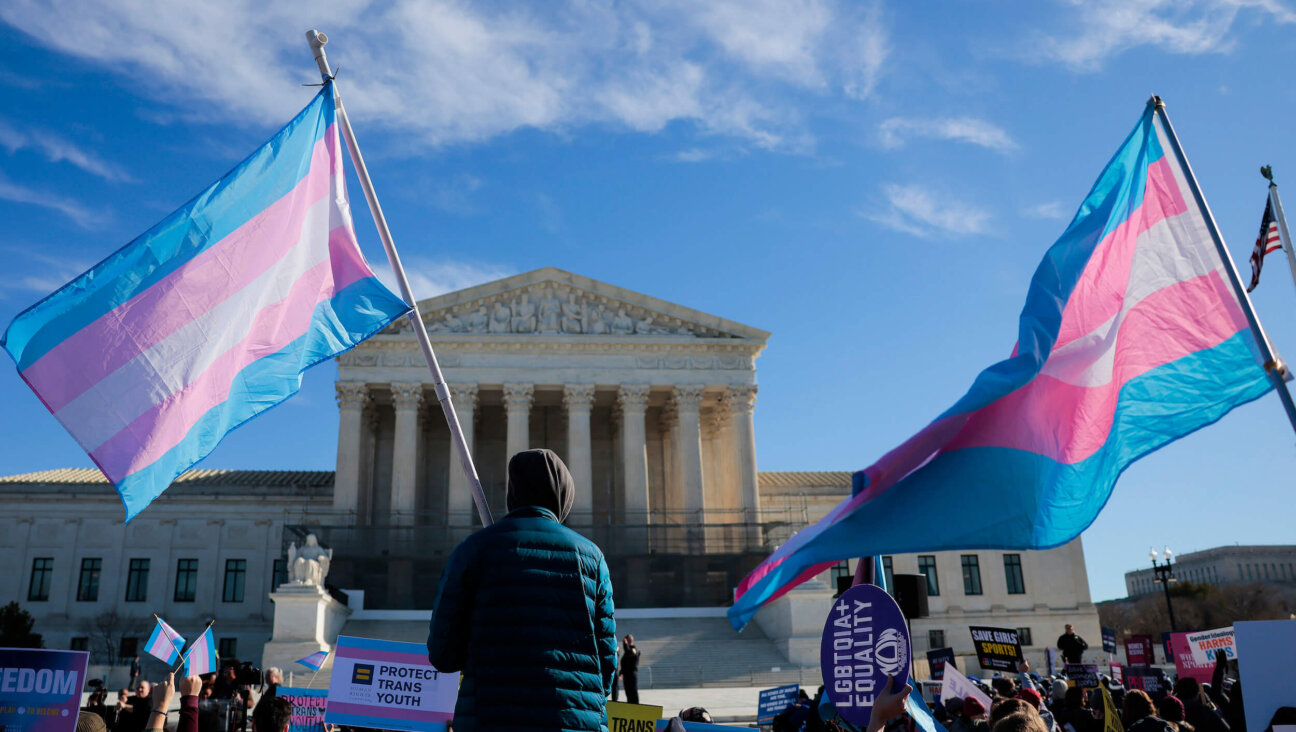
What does Marjorie Taylor Greene’s break with Trump mean for Jews? Nothing good
The rift is deeply connected to the Republican party’s internal battles over antisemitism, in ways that might not be immediately obvious
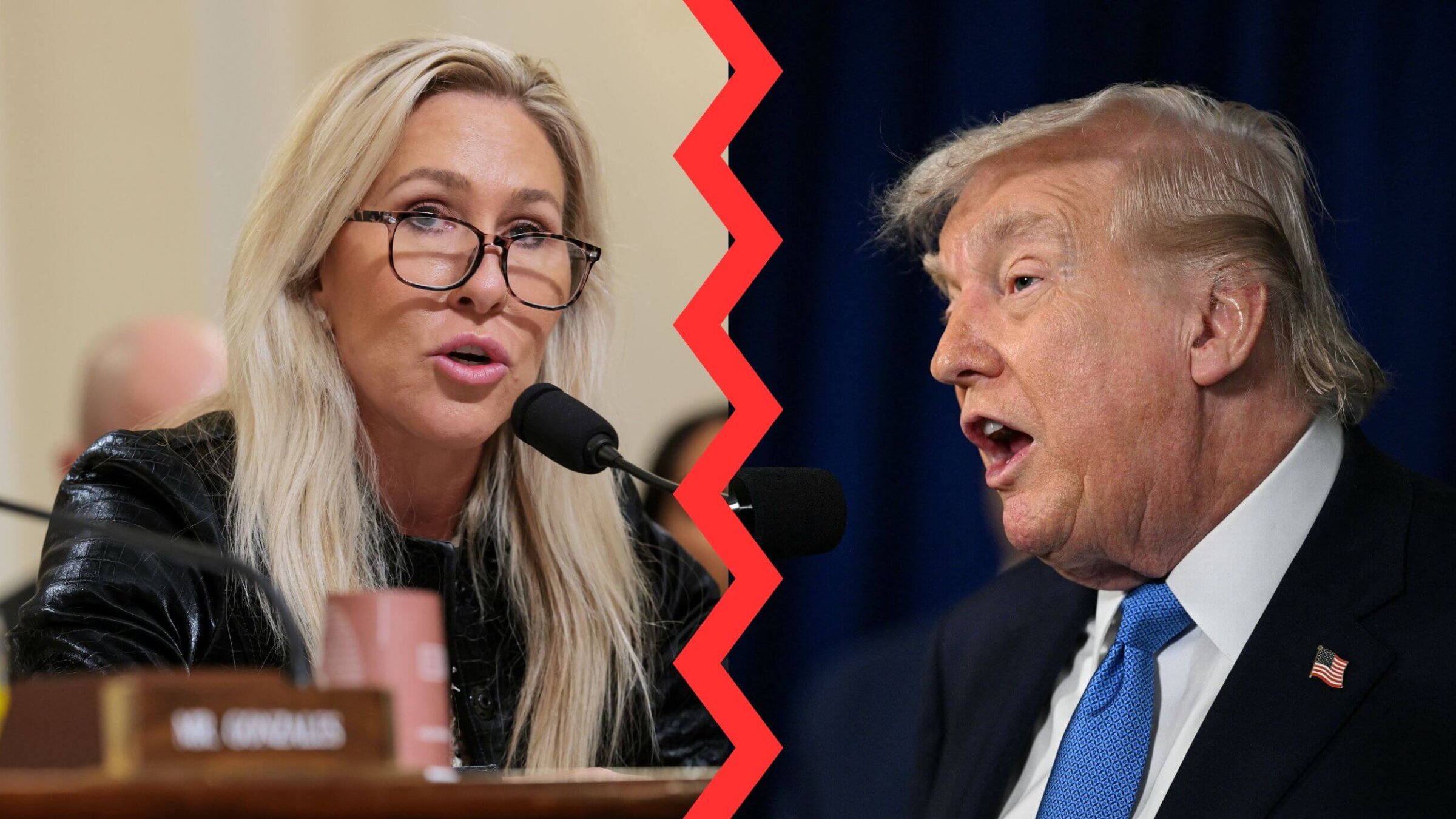
Marjorie Taylor Greene and Donald Trump’s rift isn’t really about Jews and Israel … or is it? Photo by Anna Moneymaker/Jim Watson/AFP/Getty Images

Joel Swanson January 8, 2026
Since her widely publicized break with President Donald Trump, former Rep. Marjorie Taylor Greene has been on a public redemption tour, including with an extended profile in The New York Times — the kind of media source that the far-right firebrand might have shunned for being biased against the right just a few short months ago.
Amid this reputation management tour, a familiar media reflex has kicked in: Pundits have rushed to frame the split between Greene and Trump as a sign of ideological moderation on Greene’s part. Perhaps Greene was “softening,” “repositioning,” or inching toward a more liberal posture. The editor of the center-left anti-Trump publication The Bulwark even declared that Greene’s break with Trump “gives me hope.”
In this telling, any deviation from Trump is assumed to be a move toward the center, or at least away from the hard right. But this framing badly misunderstands both Greene and the political tradition she increasingly represents, with potentially serious consequences for Jews.
Greene is not, in fact, becoming more centrist or less right-wing. Instead, her departure is the most dramatic symptom to date of deepening fractures on the far-right — largely over issues related to Israel, antisemitism and the meaning of nationalism itself.
To understand this, we need to stop thinking of the American right as a single ideological line running from “moderate” to “extreme.”
A political aberration on the right
The contemporary right is a coalition of sometimes-incompatible traditions. Trump fused them temporarily, building a coalition of business-friendly Wall Street Republicans; conservative evangelical Christians; conspiracy-minded populists; and a younger, online, nationalist right. But now, after a year of Trump’s final term, the MAGA movement is under greater strain than ever before.
Perhaps the central factor in that strain is Israel.
Trump has loudly embraced Israel, cultivated high-profile Jewish allies, and positioned opposition to a certain kind of left-wing antisemitism associated with pro-Palestinian college student protestors as an essential part of his brand. During his first administration, he moved the United States embassy to Jerusalem, normalized relations between Israel and certain Gulf Arab states, and made support for Israel a litmus test for Republican loyalty.
But the striking philosemitism that characterized Trump’s first term has always coexisted uneasily with his fondness for dog whistles about “globalists” and conspiracy theories about George Soros, and with his early cultivation of a far-right fan base. Still, for a nationalist movement defined by border walls, civilizational rhetoric, and suspicion of cosmopolitan elites, the fact that Jews were rarely at the center of Trump’s list of enemies was rather unusual — in part because the kind of nationalist, closed-border politics Trump embodies has almost always placed Jews at the symbolic center of its animus.
In late 19th- and early 20th-century Europe, nationalist antisemitism was not simply a matter of old Christian religious prejudice, or of personal hatred. Rather, it was a cohesive worldview in which Jews were imagined as the antithesis of the nation-state: rootless, transnational, disloyal and corrosive to organic national unity.
In this ideological framework, Jews symbolized border crossing itself. They were cast as the people who moved too freely, who belonged everywhere and nowhere, who undermined the stable boundaries that nationalism sought to impose.
This is why antisemitism became so tightly enmeshed in nationalist politics. Jews were not hated merely as Jews, but as embodiments of everything against which nationalism defined itself: cosmopolitanism, international finance, liberal universalism, and the erosion of traditional hierarchies. The figure of the Jew in nationalist antisemitic thought was a cipher for the destabilizing forces associated with modernity itself.
From this perspective, Trumpism’s early philosemitism was not the norm. It was the exception.
Marjorie Taylor Greene, and a different kind of nationalism
Greene has always been different from Trump when it comes to Israel — and to Jews.
Since her election to Congress in 2020, she’s engaged in critiques of U.S. support for Israel and flirtations with antisemitic conspiracy theories. In doing so, she has signaled alignment with a more traditional nationalist logic — one that views Jews, whether in Israel or in the diaspora, as challenges to a purified vision of the nation-state.
She’s not alone. For younger activists on the American right, especially those shaped by online subcultures and post-Iraq War cynicism about an assertive U.S. role in global affairs, Israel has increasingly become seen as a problem, rather than a partner.
In the past three years, the percentage of young Republicans who have a negative image of the state of Israel increased from 35% to 50%, a shockingly rapid change in such a short time. As one young staffer at the Heritage Foundation explained, “Gen Z has an increased unfavorable view of Israel, and it’s not because millions of Americans are antisemitic. It’s because we are Catholic and Orthodox and believe that Christian Zionism is a modern heresy.” During a recent focus group, one young, extremely online conservative said that Jews are “a force for evil.” These younger far-right voters frame Israel not as a civilizational ally but as a foreign state entangling America in unwanted wars.
And in so doing, they treat American Jewish influence as suspect, recycling old tropes about dual loyalty, financial manipulation and media control.
In November, at a Turning Point USA event, a young conservative activist asked Vice President JD Vance why the U.S. was expending resources on “ethnic cleansing in Gaza” and declared that Judaism “as a religion, openly supports the prosecution of ours.”
Vance did not challenge him. Vance likewise dismissed leaked chats from young Republican leaders praising Adolf Hitler and joking about gas chambers, commenting: “They tell edgy, offensive jokes, like, that’s what kids do”— even though some of these “young Republicans” were in their 30s.
To interpret Greene’s break with Trump as a move toward moderation is to assume that Trump defines the far-right baseline. In reality, Trump has actually moderated certain aspects of far-right politics, even as he has radicalized others. His movement was nationalist, but selectively so. It was anti-globalist, but not uniformly antisemitic. It was populist, but protective of certain elites.
Greene represents a faction that wants to resolve these internal contradictions within the MAGA movement. In her worldview, nationalism should be consistent. All foreign aid, including to Israel, is suspect. All international alliances are burdensome. And groups perceived as transnational — whether immigrants, NGOs or Jews — are inherently destabilizing.
A perilous future
Greene and Trump didn’t fall out over Israel. Instead, the final breaking point appears to have been related to Greene’s demand that Trump’s Justice Department release all of the files related to the late sex offender Jeffrey Epstein.
But their rupture over the Epstein files exposed the deeper gap between how Trump understands right-wing nationalism and how Greene does.
Greene framed Epstein as proof of a corrupt, transnational, globalist elite that must be confronted openly, even if doing so means attacking powerful figures within her own movement. Trump, by contrast, prioritized loyalty, message control and coalition management, treating the issue as a political risk rather than a moral crusade.
In that sense, their fight reflected a clash between grievance-driven, anti-elite populism, and a leader-centered nationalism organized around personal loyalty and strategic discipline.
The reasons behind their rift thus helps to explain why Israel has become a flashpoint.
Support for Israel, and for Jews who advocate for it, increasingly feels incoherent to many on the far right who share Greene’s populist vision. If nationalism is about defending one’s own people, why privilege another nation’s security over domestic concerns? And if elites are corrupting the nation — so the antisemitic thinking goes — why exempt those associated, whether fairly or not, with global networks?
It is telling that younger right-wing activists increasingly view Trump’s Israel policy as a betrayal rather than a triumph. For them, Trump’s philosemitism looks like an accommodation to donors, evangelicals or geopolitical inertia.
Instead, they hold postures like Greene’s: suspicious of foreign entanglements, hostile to perceived cosmopolitan influence, and willing to revive taboos that Trump temporarily suppressed.
None of this means Greene is destined to lead the Republican Party. But it does suggest she may be closer to the future of Trumpism than Trump himself.
That trajectory should concern anyone committed to pluralism and democratic stability. But it should also sharpen our analytical clarity. Calling Greene more moderate because she breaks with Trump obscures what is actually happening.
The conflict is not between right and center. It is between two versions of the right. One is at least marginally pragmatic, transactional and selectively inclusive. The other is ideological, purist and draws deeply from historical antisemitic tropes.
This is what those Jews who cast their lot in with the Trump administration in the name of policing campus protests failed to understand. It was never going to be possible, in the long term, to build a right-wing nationalist movement that was fine with Jews.
Marjorie Taylor Greene is not an aberration. She is a correction. And if the past is any guide, it is her version of nationalism, not Trump’s historically exceptional philosemitism, that more closely resembles where far-right movements end up.
This is a moment of great uncertainty. Here’s what you can do about it.
We hope you appreciated this article. Before you go, we’d like to ask you to please support the Forward’s independent Jewish news this Passover. All donations are being matched by the Forward Board - up to $100,000.
This is a moment of great uncertainty for the news media, for the Jewish people, and for our sacred democracy. It is a time of confusion and declining trust in public institutions. An era in which we need humans to report facts, conduct investigations that hold power to account, tell stories that matter and share honest discourse on all that divides us.
With no paywall or subscriptions, the Forward is entirely supported by readers like you. Every dollar you give this Passover is invested in the future of the Forward — and telling the American Jewish story fully and fairly.
The Forward doesn’t rely on funding from institutions like governments or your local Jewish federation. There are thousands of readers like you who give us $18 or $36 or $100 each month or year.
Support our mission to tell the Jewish story fully and fairly.