The Israeli government wants you to stop calling Oct. 7 a ‘massacre.’ Yes, really.
It’s part of a broader effort to rewrite memory, evade responsibility and diminish the meaning of the attack
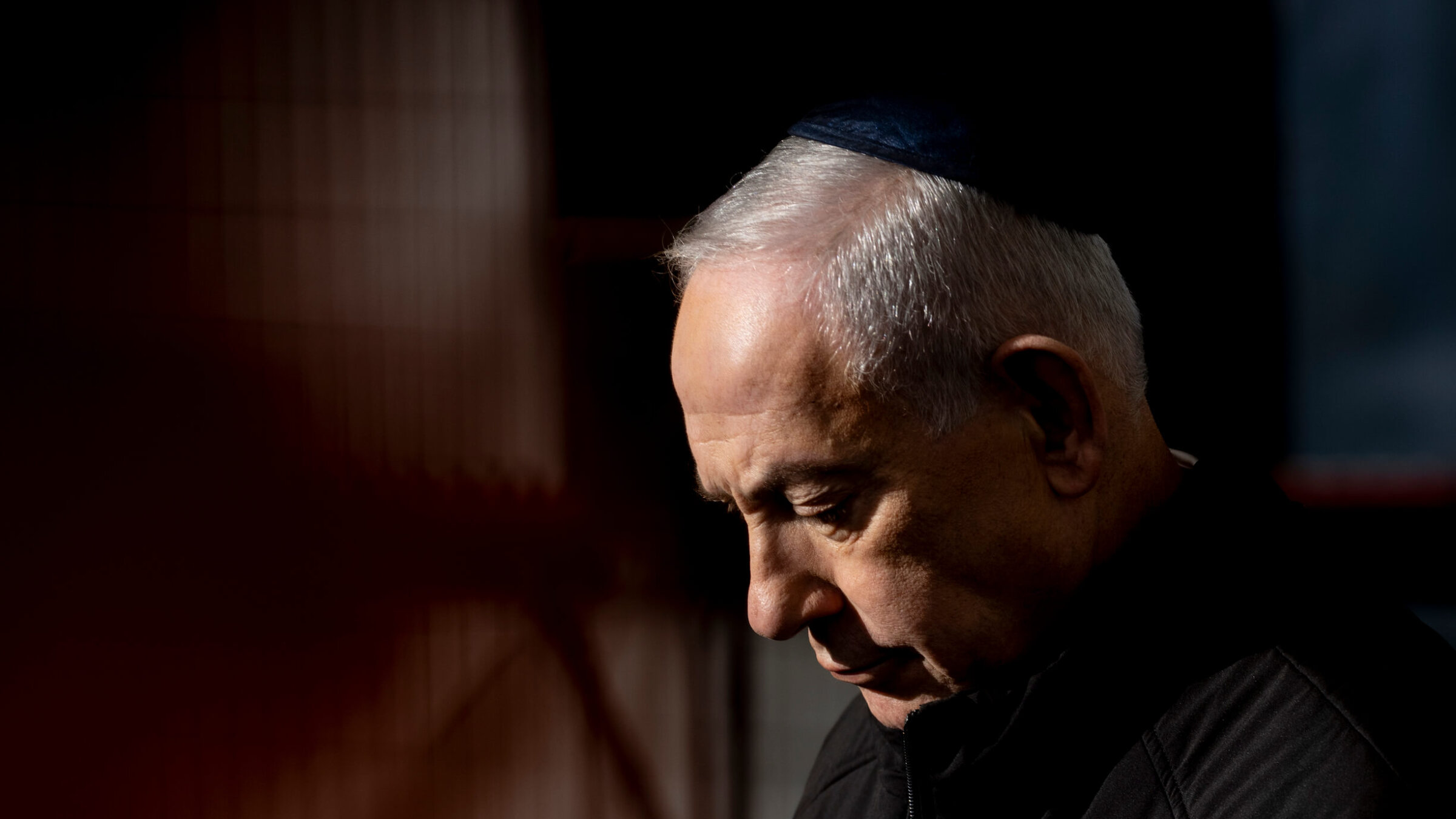
A linguistic change speaks to the depth of Prime Minister Benjamin Netanyahu’s efforts to rewrite the story of the Oct. 7 attack. Photo by Amir Levy/Getty Images

Columnist Dan Perry February 13, 2026
The Oct. 7 attack was a massacre. But Israeli authorities would prefer you not call it that.
The Prime Minister’s Office demanded that a bill establishing a national memorial for the incursion remove the term “massacre” from its title, with Minister Mickey Zohar explaining that since Israel is “strong,” no one can “massacre the people of Israel.”
In other words: To accurately describe what happened when Hamas struck Israel on Oct. 7, 2023 — killing almost 1,200 and kidnapping 251 hostages — is unpatriotic, signals weakness, and is, somehow, leftist.
This is not really a matter of semantics. It’s an attempt to control language in order to distort reality. And it’s tied to the Netanyahu government’s vast project of evading accountability for the many military and political failures that contributed to the horrors of Oct. 7.
Their method is time-tested. Early versions of it appear in classical sources, in which rulers often rename actions to soften their meaning.
King Saul masks disobedience as a religious act. King David cloaks the fact that he planned the death of his romantic rival Uriah in the language of war.
Ancient Greeks observed that political conflicts alter not only reality but also the meaning of words. Thucydides described how during civil strife, recklessness was called courage, moderation was branded as weakness, and caution was treated as betrayal, illuminating how language could be inverted to serve passion and polarization.
In ancient Rome, the phenomenon assumed a more formal character. The emperor Aurelian gave himself the title restitutor orbis, meaning “restorer of the world”; he framed a series of brutal conflicts he embarked on to reunite the Roman empire as an act of correction, rather than conquest. It was a formulation that wrapped violence in a mantle of legitimacy and proper governance.
As political systems evolved, so did linguistic sophistication. During the French Revolution, the Reign of Terror was overseen by a body called the Committee of Public Safety. The Nazi regime called its deportations of Jews to concentration camps “resettlement” and described some executions as “special treatment.” Stalin did not cause famine; there were “grain procurement difficulties.” Mao Zedong did not preside over catastrophe; he launched a “Great Leap Forward.”
George Orwell identified this mechanism with unmatched clarity in his novel 1984. His fictional government’s “Ministry of Truth” serves the function of degrading language until truth becomes inexpressible, with the slogan “War is peace. Freedom is slavery. Ignorance is strength.”
The contradictions are deliberate. Their purpose is to train citizens to accept inversion and surrender their independent grasp of reality.
Orwell’s deeper insight was that the corruption of language precedes the corruption of politics. When words lose precision, accountability dissolves. Reality becomes malleable, and loyal followers will believe whatever they are told. If aggression is always “defense,” repression always “order,” and censorship always “responsibility,” there is little limit to what rulers can do.
The American novelist Kurt Vonnegut put it even more sharply — beautifully, even — in 1973’s Breakfast of Champions: “In nonsense is strength.”
This phenomenon is not confined to totalitarian regimes. Democracies, too, are tempted to soften language when confronting failure. Even — and perhaps especially — in Israel.
Thus, the killing of civilians becomes “harm to uninvolved civilians,” phrasing that distances attention from human reality. Torture becomes “moderate physical pressure.” Extrajudicial killings become “targeted prevention.”
Set aside the question of whether these measures are ever justified: It’s essential to note that the language itself undergoes distortion for political ends.
The Netanyahu government has a specific goal behind this approach. Avoiding the word “massacre” in describing Oct. 7 fits into its broader strategy of evading responsibility for the disaster itself.
Netanyahu has refused to accept any blame since the first hours after the attack, including by arguing that no investigation into his actions could take place during wartime, while prolonging the war as much as possible. At the same time, his allies attacked the Supreme Court to justify avoiding a state commission of inquiry with real authority.
To refuse to call Oct. 7 a massacre is to suggest it was somehow less brutal or devastating than it was. So let us dispel the nonsense.
A massacre involves the deliberate killing of a large number of defenseless people. It does not imply permanent strategic defeat. It does not preclude a military response afterward. It does not suggest inherent weakness. It describes a specific act: the intentional slaughter of civilians under circumstances in which they cannot defend themselves.
On Oct. 7, 2023, armed Hamas militants invaded Israel and committed a massacre, almost unopposed by Israeli security forces, in a crushing national collapse. Families were shot in their homes. People were hunted down, executed or burned. Hostages were taken. Most of the victims were civilians. It was hours before the public heard anything from the shell-shocked Netanyahu.
Call it what it was. Truth combined with moral clarity, over time, are a nation’s deepest source of strength. Resistance to accurate language serves to dull the recognition that something profoundly shocking occurred — something that demands deep reckoning and change, not a continuation of the morally bereft and misleading status quo.
This is a moment of great uncertainty. Here’s what you can do about it.
We hope you appreciated this article. Before you go, we’d like to ask you to please support the Forward’s independent Jewish news this Passover. All donations are being matched by the Forward Board - up to $100,000.
This is a moment of great uncertainty for the news media, for the Jewish people, and for our sacred democracy. It is a time of confusion and declining trust in public institutions. An era in which we need humans to report facts, conduct investigations that hold power to account, tell stories that matter and share honest discourse on all that divides us.
With no paywall or subscriptions, the Forward is entirely supported by readers like you. Every dollar you give this Passover is invested in the future of the Forward — and telling the American Jewish story fully and fairly.
The Forward doesn’t rely on funding from institutions like governments or your local Jewish federation. There are thousands of readers like you who give us $18 or $36 or $100 each month or year.
Support our mission to tell the Jewish story fully and fairly.